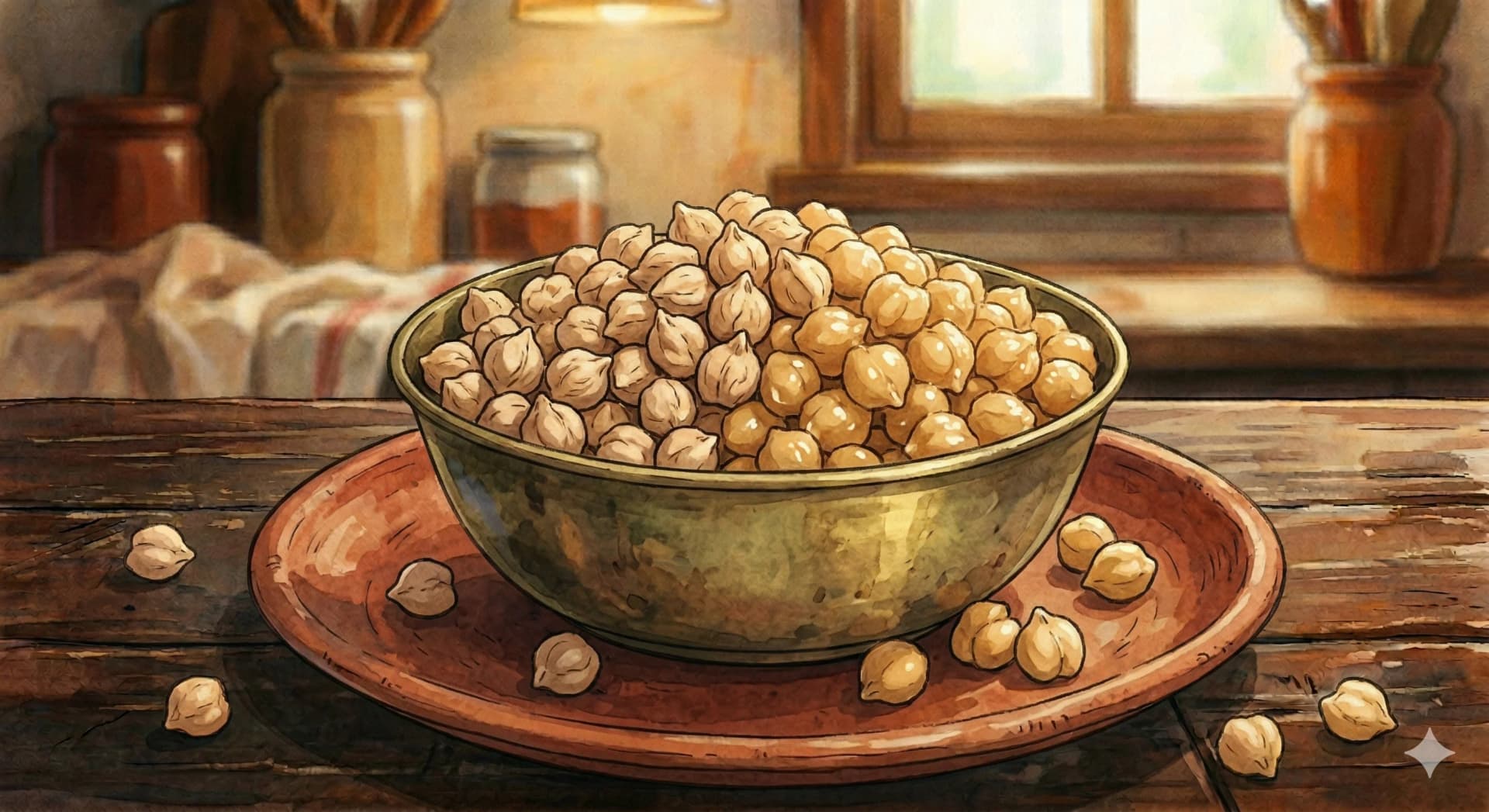
Chickpeas
Also known as: Kabuli Chana, Garbanzo Beans, White Chickpeas, Cicer arietinum
Chickpeas are among the most widely consumed legumes on the planet, and for good reason. Round, cream-colored, and satisfying in a way few other plant foods manage, they offer an unusual combination of high protein, high fiber, complex carbohydrates, and a flavor that deepens rather than disappears when cooked with aromatics. The variety most commonly found in Western grocery stores and across the Middle East is the kabuli chickpea: large, smooth-skinned, pale cream to ivory in color.
In South Asia, particularly in India, Pakistan, and Bangladesh, the desi chickpea is equally important. It is smaller, darker (ranging from tan to black), and has a rougher, thicker skin. Desi chickpeas have a more intense, earthier flavor and a higher fiber content, and they are the raw material from which chana dal and besan (chickpea flour) are made.
Both varieties share the same species name and the same culinary virtues: remarkable protein density (around 15 grams per cooked cup), significant iron and folate content, and the ability to absorb surrounding flavors while contributing their own. The kabuli variety, with its more delicate skin and creamier texture, is the chickpea of hummus, falafel, and chole bhature. The desi variety, with its firmer bite and more complex flavor, holds its ground in the spiced, acidic preparations of North Indian cooking.
Chickpeas require significant preparation. Dried chickpeas need at least 8 hours of soaking in cold water before cooking. Overnight is standard.
After soaking, they still require 45 minutes to 1.5 hours of cooking, depending on age and method. Pressure cooking is standard in most South Asian households: 3 to 4 whistles on a stovetop pressure cooker produces perfectly cooked chickpeas in a fraction of the time.
The soaking water should be discarded, as it contains some of the oligosaccharides responsible for digestive discomfort.
Key facts at a glance:
- The desi — Variety, with its firmer bite and more complex flavor, holds its ground in the spiced, acidic preparations of North Indian cooking.
- Dried chickpeas — Need at least 8 hours of soaking in cold water before cooking.
- Chickpeas are — Among the most widely consumed legumes on the planet, and for good reason.
- In South Asia — Particularly in India, Pakistan, and Bangladesh, the desi chickpea is equally important.
- It is — Smaller, darker (ranging from tan to black), and has a rougher, thicker skin.
- The kabuli — Variety, with its more delicate skin and creamier texture, is the chickpea of hummus, falafel, and chole bhature.
Flavor Profile
Origin
Middle East, Indian subcontinent, Mediterranean
Traditional Medicine Perspectives
Ayurveda:
Chickpeas in Ayurvedic thought are primarily Vata-aggravating due to their dryness and gas-producing properties, and they are not recommended in excess for those with Vata imbalances or sensitive digestion. However, they are considered balancing for Pitta and Kapha. Proper preparation, including thorough soaking, discarding the soaking water, and cooking with Vata-calming spices such as asafoetida (hing), cumin, and ginger, significantly mitigates these effects. Chickpea flour (besan) is used in some preparations to treat skin conditions, applied as a paste with turmeric and water.
Traditional Chinese Medicine:
Chickpeas are considered tonifying to the Spleen and Stomach, supporting digestion and Qi production. Their sweet flavor and neutral temperature make them suitable for most constitutions in moderate amounts.
Modern Scientific Research
Chickpeas have been extensively studied for their role in metabolic health. Their combination of protein and soluble fiber produces a pronounced satiety effect, and multiple studies have linked regular legume consumption to improved glycemic control and reduced LDL cholesterol. A 2012 randomized controlled trial published in the Archives of Internal Medicine found that replacing refined carbohydrates with legumes, including chickpeas, significantly improved HbA1c and blood pressure in participants with type 2 diabetes.
Their resistant starch content feeds beneficial gut microbiota, and their prebiotic fiber has been associated with improved bowel transit time.
The protein in chickpeas is of moderately high quality by plant standards, providing significant amounts of lysine, an amino acid limited in most grains. This is why the combination of chickpeas or other legumes with grains, dal-rice, hummus with bread, falafel in pita, is nutritionally effective across cultures. Combined, they approximate the amino acid profile of animal protein.
Cultural History
Chickpeas are one of humanity's oldest cultivated crops. Archaeological evidence places their cultivation in the Fertile Crescent, in what is now southeastern Turkey and northern Syria, at least 10,000 years ago. From there, they spread east into the Indian subcontinent and west through the Mediterranean, carried by trade routes, migrating peoples, and armies.
The Romans ate them, ground into porridge or roasted as street food. The word "Cicero," the famous Roman orator's name, is thought to derive from "cicer," the Latin word for chickpea, and there is a legend that a Cicero ancestor had a distinctive chickpea-shaped wart on his nose.
In the Indian subcontinent, chickpeas in their desi form became a foundational ingredient of the agricultural and culinary system. Chana cultivation requires little water and enriches the soil through nitrogen fixation, making it valuable as a rotation crop. By the medieval period, chickpeas in various forms, whole, split, ground into flour, had woven themselves into the cooking of nearly every region of the subcontinent.
The Mughal period formalized many of the spiced preparations still in use today. Pindi chana, the deeply spiced, dark, dry preparation associated with Rawalpindi, is thought to be among the oldest surviving forms of spiced whole chickpea cooking in the Punjabi tradition.
In the Middle East and Mediterranean, the chickpea found its most famous forms. Hummus, the paste of cooked chickpeas blended with tahini, lemon, and garlic, appears in cookbooks dating to 13th-century Cairo, though the dish is certainly older. Falafel, ground chickpeas or fava beans shaped and fried, is the street food of Egypt, Israel, Palestine, Lebanon, and beyond.
In each of these contexts, the chickpea is not an exotic ingredient but a daily necessity.
Culinary Uses
The culinary range of chickpeas is extraordinary. In North India, the preparation known as chole or chana masala involves slow-cooking soaked and boiled chickpeas in a masala of onion, tomato, ginger, garlic, and an array of spices including coriander, cumin, garam masala, dry mango powder (amchur), and often a small piece of dried pomegranate peel (anardana) or tamarind. The key to the distinctive dark, complex flavor of chole, particularly the Punjabi style served with bhature, is time.
The chickpeas and masala need 20 to 30 minutes of slow cooking together for the masala to penetrate the chickpeas, for the tomatoes to break down and reduce, and for the oil to begin to separate from the gravy. This separation, known as bhunoing to doneness, indicates the raw flavors have cooked out.
In the Middle East, the approach is different: chickpeas are cooked very soft (often with a pinch of baking soda to soften the skins), then blended while hot for the creamiest hummus. For falafel, dried chickpeas are soaked but not cooked, then ground raw with herbs and aromatics and fried immediately. The raw grind gives falafel its dense, falafel-specific texture that cooked canned chickpeas cannot replicate.
Preparation Methods
Soaking: Cover dried chickpeas with at least twice their volume of cold water. Soak for 8 to 12 hours (overnight). Drain and discard the soaking water. Rinse well.
Stovetop cooking: Soaked chickpeas in fresh water, brought to a boil, skimming any foam, then simmered for 45 to 90 minutes until tender but not falling apart. Add salt only in the last 15 minutes to avoid toughening the skins.
Pressure cooker: Soaked chickpeas with water (2:1 ratio), cooked on high pressure. On a stovetop cooker, 3 to 4 whistles for firm-cooked, 5 to 6 for very soft. On an Instant Pot, 20 minutes on high pressure with natural release.
For chole: After pressure cooking, add the boiled chickpeas to a prepared masala (bhunoed onion-tomato base) and simmer on low for 20 to 30 minutes. The chickpeas should absorb color from the masala. Mash a few against the side of the pot to thicken the gravy naturally.
Canned chickpeas: A valid shortcut for hummus, salads, and quick curries. Drain and rinse well. For chole or dishes requiring deep flavor absorption, fresh-cooked dried chickpeas are noticeably superior.
Traditional Dishes
- Chole bhature
- Chana masala
- Pindi chana
- Hummus
- Falafel
- Chaat (various)
- Punjabi chole
- Chana sundal
- Moroccan chickpea tagine
- Egyptian ful medames (with chickpeas added)
- Chickpea and spinach curry (Palak chana)
- Sarvari
Comments
Share your thoughts on this ingredient.
Sign in to comment0 Comments