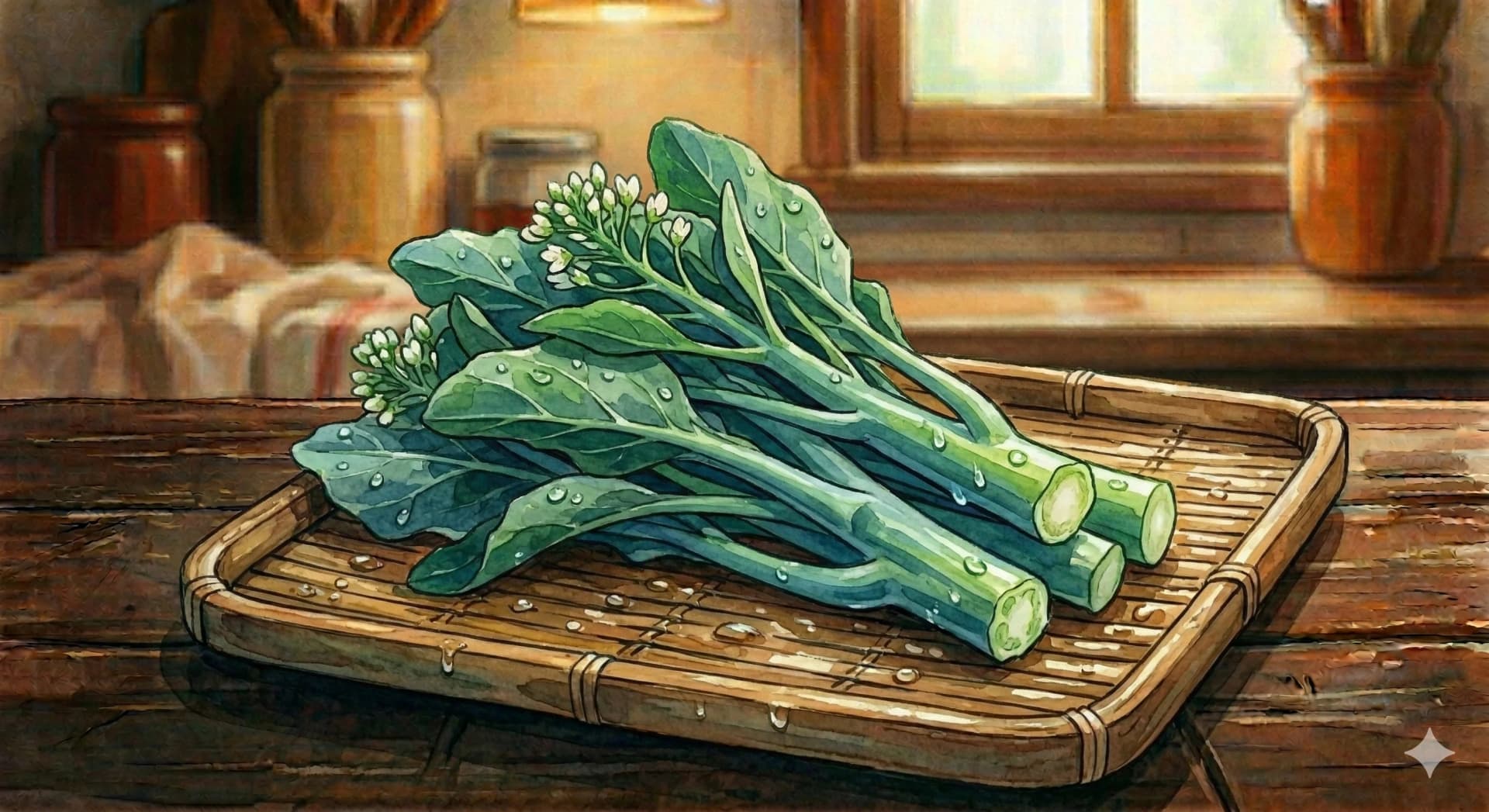
Chinese Broccoli
Also known as: Kai Lan, Gai Lan, Chinese Kale, Brassica oleracea var. alboglabra
Chinese broccoli (kai lan) is a leafy brassica with thick, firm stems, dark green waxy leaves, and small florets. Its flavor is more robust and slightly more bitter than regular broccoli, with a satisfying crunch in the stems that holds up to high-heat cooking. It is one of the most beloved vegetables in Cantonese cooking, typically prepared very simply — blanched and dressed with oyster sauce, or stir-fried with garlic — where its quality speaks for itself.
Key facts at a glance:
- Its flavor — More robust and slightly more bitter than regular broccoli, with a satisfying crunch in the stems that holds up to high-heat cooking.
- Chinese broccoli (kai lan) — A leafy brassica with thick, firm stems, dark green waxy leaves, and small florets.
Flavor Profile
Origin
Southern China, Cantonese cuisine, Southeast Asia
Traditional Medicine Perspectives
Traditional Chinese Medicine
Chinese broccoli (Kai Lan) is classified as cool and sweet-bitter in TCM, associated with the Lung, Stomach, and Large Intestine meridians. It is used to clear heat, detoxify, relieve cough, and support the Lung. The slightly bitter quality is associated with Heart-clearing and heat-resolving properties. It is considered particularly beneficial for dry cough and heat patterns in the upper burner.
Modern Scientific Research
Chinese broccoli is exceptionally rich in glucosinolates, vitamins A, C, and K, and calcium. Research on glucosinolate metabolites (isothiocyanates and indoles) from brassicas shows consistent cancer-preventive effects in epidemiological studies and plausible mechanisms in laboratory research. Chinese broccoli contains sulforaphane precursors, studied for anti-cancer, antioxidant, and anti-inflammatory properties.
Cultural History
Kai lan is deeply associated with Cantonese cuisine and is one of the signature vegetables of southern Chinese cooking. In Cantonese restaurants, stir-fried kai lan with oyster sauce is a standard item on virtually every menu — a measure of a kitchen's ability to handle vegetables at high heat. In Hong Kong, beef with kai lan in oyster sauce is a classic Cantonese combination. The vegetable is also beloved in Malaysian and Singaporean Chinese cooking, where it appears in char kway teow and other hawker preparations.
Culinary Uses
Blanch and dress with oyster sauce for the classic Cantonese preparation. Stir-fry with garlic and a splash of Shaoxing wine.
Add to beef stir-fries and noodle dishes. Use in hot pots. The thick stems benefit from being cut smaller or blanched slightly before stir-frying so they cook at the same rate as the leaves.
Preparation Methods
Trim the bottom inch from stems. If stems are thick, split lengthwise or score the base for even cooking. Blanch 2–3 minutes in boiling salted water for tender-crisp results. For stir-frying, add a splash of water to the wok and cover briefly to steam the stems through.
Traditional Dishes
- Kai lan with oyster sauce
- Beef with kai lan
- Char kway teow (Malaysian)
- Cantonese stir-fried greens
- Dim sum side vegetable
Comments
Share your thoughts on this ingredient.
Sign in to comment0 Comments