Chinese Sausage
Also known as: Lap Cheong, Lop Chong, 腊肠, La Chang
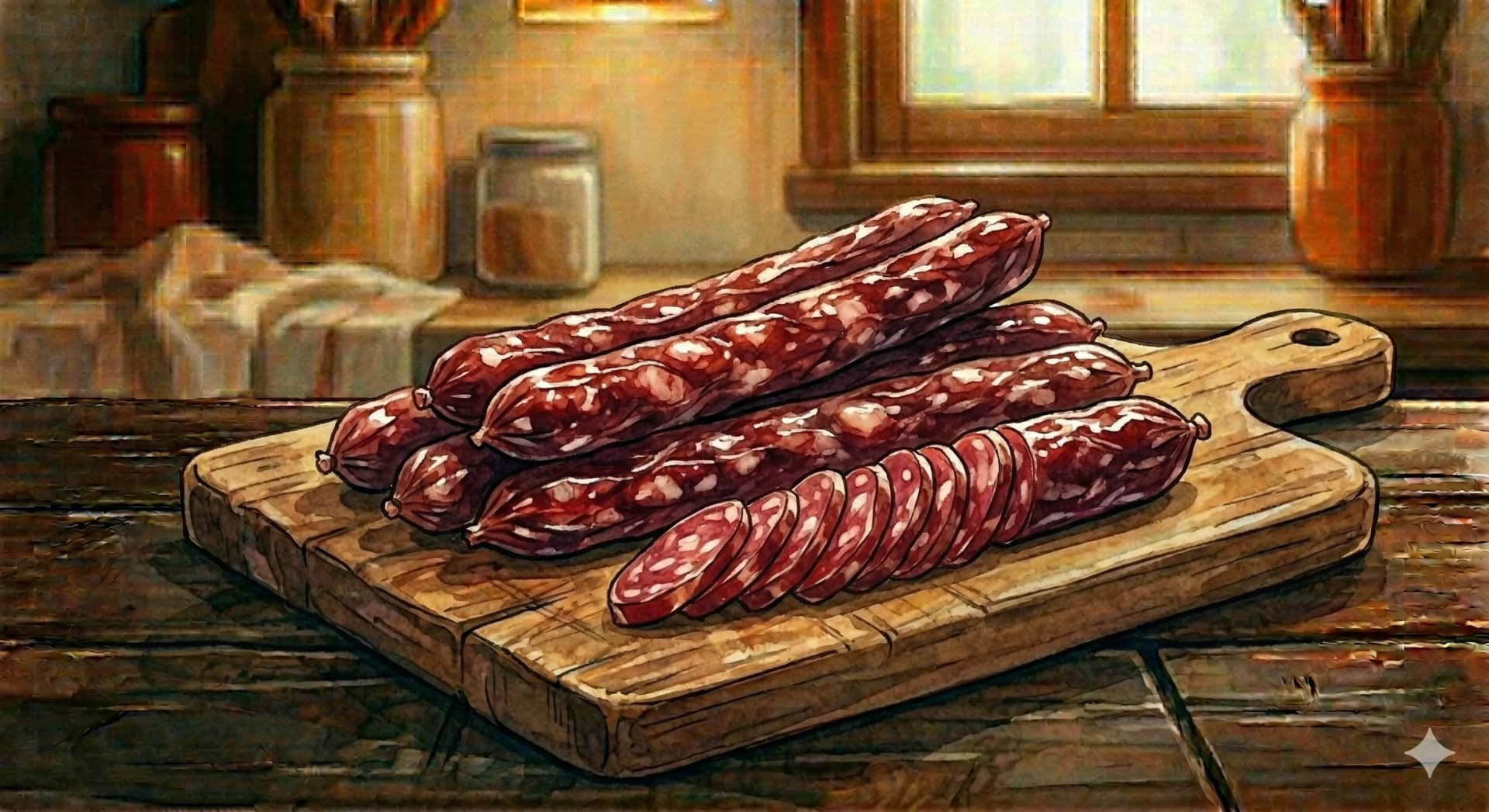
Chinese sausage refers to a family of air-dried, cured pork sausages produced across southern China, with Guangdong province and Hong Kong as the most influential centers of production. They are immediately distinguishable from European-style sausages by their distinctive sweetness: Chinese rose wine (mei gui lu jiu), soy sauce, and sugar are fundamental to the cure, producing a flavor profile that is simultaneously savory, umami-rich, and genuinely sweet in a way that surprises first-time tasters. The fat is rendered to a translucent, slightly waxy texture during cooking, and the whole sausage shrinks and concentrates during the drying period to an intense, dense cylinder.
There are two primary types available in Chinese grocery stores. The standard version is made from pork, typically a mixture of lean meat and pork fat, cured and stuffed into natural casings before air-drying or smoking. The second, often labeled as duck liver sausage or liver lap cheong, incorporates duck liver alongside pork, producing a darker, richer sausage with a deeper savory depth and slightly more pronounced minerality. Both types are sold dry and shelf-stable, hanging in clusters in market windows or packaged in vacuum-sealed trays.
Raw Chinese sausage is not eaten directly. It must be cooked, and the most traditional and elegant method is to steam the sausages directly atop rice as the rice cooks. The sausage renders its fat and juices down into the rice, flavoring it throughout, while the sausage itself becomes tender and glossy. It is a method of extraordinary efficiency and flavor transfer.
Key facts at a glance:
- The sausage renders its — Fat and juices down into the rice, flavoring it throughout, while the sausage itself becomes tender and glossy.
- There are two primary — Types available in Chinese grocery stores.
- Chinese sausage refers to a family of air-dried — Cured pork sausages produced across southern China, with Guangdong province and Hong Kong as the most influential centers of production.
- The fat is rendered to a translucent — Slightly waxy texture during cooking, and the whole sausage shrinks and concentrates during the drying period to an intense, dense cylinder.
Flavor Profile
Origin
China, Guangdong, Hong Kong
Traditional Medicine Perspectives
Traditional Chinese Medicine:
Preserved and cured meats occupy a specific niche in TCM dietary thought. Pork itself is considered sweet in flavor and neutral to slightly cooling in temperature, associated with the Kidney, Liver, and Spleen. It nourishes Yin and Blood, and pork is one of the meats most often recommended for thin, depleted, or Blood-deficient individuals in classical dietary medicine. However, curing, drying, and the addition of alcohol and salt fundamentally alter the meat's energetic character. Cured meats are generally considered warming and tonifying in TCM dietary practice, appropriate in cold conditions or for those needing warming nourishment. They are also considered rich and heavy, and TCM dietary guidance consistently recommends moderate consumption, noting that excess preserved foods can create dampness and contribute to excessive internal heat over time. The rose wine used in curing adds warming, circulating properties associated with promoting Qi and Blood flow.
Modern Scientific Research
Chinese sausage, like other cured and processed meats, has a high sodium content and contains nitrites used in preservation. Research consistently links high consumption of processed meats to elevated cardiovascular risk and, at significant intake levels, increased colorectal cancer risk. These findings are not unique to Chinese sausage and reflect the broader category of cured meats. The relevant guidance is moderation: lap cheong used as a flavoring ingredient in rice or fried rice, providing 1-2 thin slices per serving, delivers meaningful flavor impact with a relatively modest portion of cured meat compared to eating sausages as a primary protein source.
The fat content is high, approximately 40-50% of calories from fat in typical preparations, but much of this fat renders out during cooking. When cooked atop rice, a significant portion of the fat drips down and disperses through the dish rather than concentrating in the sausage itself. Compared to other globally popular cured sausages, the nutritional profile of lap cheong is broadly similar: it is a flavorful, shelf-stable preserved meat that performs best as a condiment and flavoring component rather than a dietary staple.
Cultural History
The tradition of curing and preserving meats in China extends back thousands of years. The character 腊 (la), which appears in lap cheong, refers specifically to winter-preserved meats: traditionally, the cold months of the lunar calendar were the time for slaughter, curing, and drying, when cool temperatures aided preservation and the drying winds of winter helped cure the meats evenly. The twelfth lunar month is still called La Yue, the month of preserved meats, reflecting how deeply this tradition is embedded in Chinese cultural time.
Guangdong and Hong Kong became particular centers of lap cheong production due to the region's export trade, the prevalence of pork in Cantonese cuisine, and the development of sophisticated curing and drying techniques suited to the local climate. Cantonese emigrants carried lap cheong throughout Southeast Asia and to Chinese communities in the United States, Australia, and Europe, where it became a staple pantry item for maintaining connection to home cooking. Vietnamese Chinese communities developed their own variants (lap xuong), as did communities in the Philippines, Thailand, and Malaysia, each adapting the curing blend to local ingredients and palates.
In Hong Kong, the claypot rice (bo zai fan) served at seasonal restaurants from autumn onward represents one of the most celebrated uses of lap cheong. The dish is made to order in individual claypots over charcoal, and the sausage is laid over the rice partway through cooking to steam and render. The resulting crust of rice at the bottom of the pot, caramelized by direct heat, is considered the finest part. Bo zai fan restaurants often have lines stretching around the block in cooler months.
Culinary Uses
The most important technique to master with lap cheong is steaming over rice. Slice the sausage thinly on the diagonal and arrange over the rice 5-8 minutes before the rice finishes cooking.
The steam cooks the sausage through while the rendered fat flavors the rice. This technique works in a rice cooker, in a claypot over the stove, or in any covered pot. The resulting rice is subtly sweet, savory, and aromatic throughout.
In lo mai gai (sticky rice in lotus leaf), lap cheong is a core filling ingredient alongside chicken, dried shiitake mushrooms, and dried shrimp. The sausage provides sweetness and fat that balances the other savory, earthy elements. In fried rice, lap cheong cut into small dice adds irregular pockets of intense sweet-savory flavor. It can also be steamed on its own or sliced and pan-fried briefly until the edges caramelize, then served with congee or plain rice.
Preparation Methods
Always cook before eating. For steaming over rice: slice diagonally into 1/4-inch pieces and lay over rice for the final 8-10 minutes of cooking in a covered pot.
For pan-frying: slice thinly and cook in a dry non-stick pan over medium heat for 2-3 minutes per side until the fat renders and edges turn golden. No added oil is necessary. For use in fried rice or stir-fries: cut into small dice and add to the wok first, rendering the fat, then use that fat as the cooking medium for subsequent ingredients.
Storage: unopened packages keep at room temperature in a cool, dry place for several months. Once opened, refrigerate and use within 2-3 weeks, or freeze for up to 3 months. Well-dried lap cheong will feel firm and slightly waxy to the touch; any signs of surface mold or off odor indicate spoilage.
Traditional Dishes
- Claypot Rice (Bo Zai Fan)
- Sticky Rice in Lotus Leaf (Lo Mai Gai)
- Cantonese Steamed Egg with Lap Cheong
- Lap Cheong Fried Rice
- Turnip Cake (Lo Bak Go)
- Taro Rice
- Taiwanese Oyster Vermicelli
Comments
Share your thoughts on this ingredient.
Sign in to comment0 Comments