Drumsticks
Also known as: Moringa Pods, Sahjan, Murungakkai, Moringa oleifera pods, Drumstick Vegetable
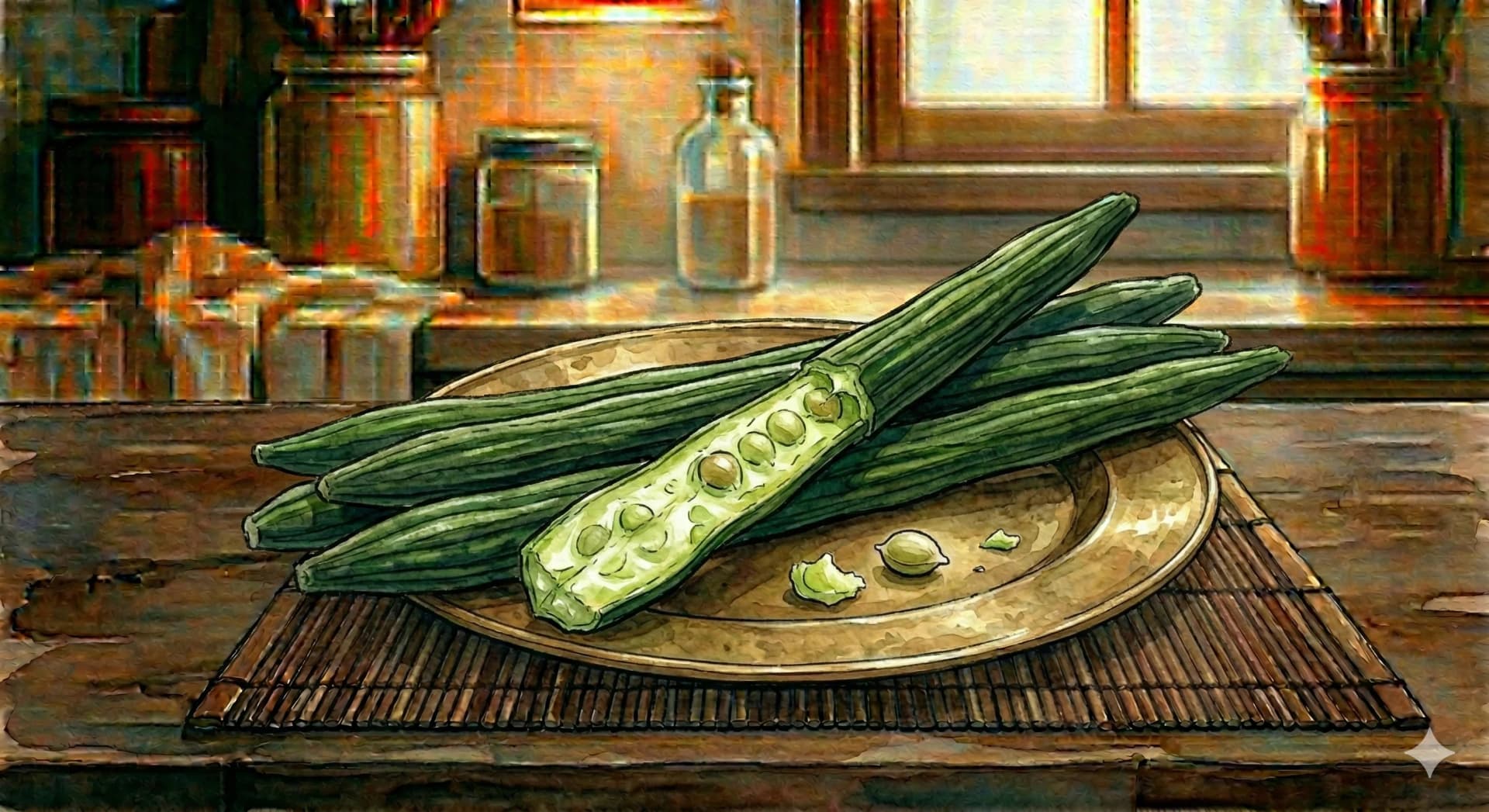
Drumsticks are the long, slender seed pods of the moringa tree, harvested before they fully mature and used as a vegetable across South Asia, particularly in Tamil Nadu, Karnataka, Kerala, Andhra Pradesh, and Sri Lanka. The pods can range from 20 to 50 cm in length, with a tough, fibrous outer skin and a pale, soft interior containing tender seeds embedded in pulpy flesh. The eating technique is entirely its own: the cooked pod is held between the fingers, one segment at a time, and the soft inner flesh and seeds are scraped out with the front teeth, leaving the spent fiber behind. Visitors unfamiliar with drumsticks sometimes attempt to eat the whole pod, which is a mistake the texture quickly corrects.
The moringa tree itself is extraordinary. Every part of the plant is edible or useful: the leaves are among the most nutrient-dense plant foods documented, the seeds can purify water and yield cooking oil, the roots have traditional medicinal applications, and the pods are the primary culinary product across South Indian cooking. In global wellness markets, moringa leaf powder has become a prominent superfood supplement. In Tamil Nadu, the pod-bearing tree has been a household fixture for generations, planted in courtyards and home gardens and harvested continuously through the fruiting season.
The flavor of drumstick pods is gently bitter and vegetal, sometimes compared to asparagus in Western descriptions, though that comparison only partially captures it. There is a faint earthiness and a particular quality that comes through most clearly in sambar, where the pods absorb the tamarind-spiced broth and release their flavor into the surrounding liquid. Drumsticks do not stand on their own as a starring ingredient in the way that a potato or an eggplant might. They are ensemble players, most fully themselves in company with dal, tamarind, and coconut.
Key facts at a glance:
- The flavor of drumstick pods — Gently bitter and vegetal, sometimes compared to asparagus in Western descriptions, though that comparison only partially captures it.
- The pods can range from 20 to 50 cm in length — With a tough, fibrous outer skin and a pale, soft interior containing tender seeds embedded in pulpy flesh.
- Visitors unfamiliar with drumsticks — Sometimes attempt to eat the whole pod, which is a mistake the texture quickly corrects.
- The moringa tree itself — Extraordinary.
Flavor Profile
Origin
South Asia, India, Tropical Asia, Tropical Africa
Traditional Medicine Perspectives
Ayurveda:
The moringa tree is one of the most frequently referenced plants in Ayurvedic texts, known as "shigru" or "sigru" in Sanskrit. The pods, leaves, roots, and seeds all have distinct therapeutic applications. The pods are considered light to digest and are recommended as a digestive stimulant. They are classified as having a pungent-bitter taste profile and a heating potency, making them beneficial for reducing kapha and vata imbalances. Traditionally, drumsticks were used to treat joint pain, respiratory congestion, and worm infestations. Drumstick soup made by boiling the pods is a traditional remedy for cold and congestion across South Indian households, considered warming, decongestant, and nourishing during illness.
Traditional Chinese Medicine:
Moringa is not native to China and does not appear extensively in classical Chinese medical texts, though it has been adopted in tropical Chinese regions and contemporary integrative practices acknowledge its nutritional density. Modern TCM-informed wellness frameworks classify it as a warming, qi-tonifying food.
Modern Scientific Research
The moringa plant has generated substantial scientific interest, primarily focused on the leaves, which contain exceptional concentrations of protein, iron, calcium, vitamin C, vitamin A precursors, and a range of antioxidant compounds including isothiocyanates and flavonoids. The pods contain lower nutrient concentrations than the leaves but contribute meaningful dietary fiber, vitamin C, and minerals. The pods also contain a compound called isothiocyanate moringin, which has demonstrated anti-inflammatory and antimicrobial properties in laboratory studies.
Research on moringa's anti-inflammatory, anti-diabetic, and hepatoprotective effects has increased significantly over the past two decades. Several clinical studies have examined moringa leaf supplementation for blood sugar regulation and cholesterol management with promising results. The pods themselves are less studied than the leaves, but given that the pod flesh shares phytochemical characteristics with the rest of the plant, traditional uses as a digestive and anti-inflammatory food are consistent with what research has found elsewhere in the plant.
Cultural History
Moringa oleifera is native to the foothills of the sub-Himalayan region, from northwestern India through Pakistan and Nepal, and has been cultivated in South Asia for thousands of years. Ancient Sanskrit texts reference the moringa tree and its medicinal properties. The Arthashastra, the Maurya-era treatise on statecraft and economics, mentions moringa among plants of significant agricultural value. In South India, the tree became so culturally embedded that specific villages and families developed reputations for the quality of their drumsticks, and certain cultivated varieties are associated with particular regions.
In Tamil Nadu, the drumstick tree occupies a position in home culture comparable to the curry leaf plant or the banana tree: something that families grow, share, and cook with as a matter of course rather than as an occasion. Drumstick season marked a particular time in the kitchen calendar, with freshly harvested pods finding their way into sambar, kootu, and curries. The tradition of gifting fresh drumsticks to neighbors and extended family from a household tree is documented across both rural and urban Tamil communities. Elders often recall the specific tree in a childhood home with the same warmth attached to the food produced from it.
The spread of moringa cultivation followed Indian migration across the globe. In South Africa, Trinidad, Mauritius, Fiji, and wherever significant Tamil or South Indian communities settled, moringa trees were planted and drumstick cooking continued. Today, drumsticks are available in South Asian grocery stores worldwide, and the global moringa leaf industry has introduced the plant to entirely new audiences who may encounter the leaves as a powder long before they discover the pods as food.
Culinary Uses
Drumstick pods must be cooked thoroughly. The fibrous outer casing is inedible and remains so even after long cooking, but the interior softens fully and the flesh loosens from the casing. In sambar, drumsticks are typically cut into 5 to 8 cm lengths and added to the pot after the lentils have cooked, simmering for 10 to 15 minutes in the tamarind-spiced broth until tender. The pods absorb the surrounding flavors with particular efficiency, and a piece of drumstick from a well-made sambar is simultaneously the pod's own mild bitterness and the full complexity of the sambar broth.
In dry preparations (drumstick sabzi in North India, called sahjan ki sabzi), the pods are cooked with a standard tempering of mustard seeds, cumin, onion, and tomato until tender and slightly reduced. South Indian preparations often incorporate grated coconut or coconut milk, and Kerala-style drumstick curry is a substantial dish with coconut milk as its base. When drumsticks appear in Kerala fish curry, they contribute their own flavor and absorb the rich, spiced coconut gravy. In all preparations, the eating is hands-on and considered perfectly proper: there is no fork-and-knife approach that works for drumsticks.
Preparation Methods
Selecting and storing: Choose pods that are uniformly green, firm, and without brown patches. Fresh pods should be pliable but not limp. Store refrigerated and use within 3 to 5 days. Pods darken and become more fibrous quickly once cut. Frozen drumstick pieces are widely available in South Asian grocery stores and perform well in sambar and curries.
Cutting: Trim the stem end. Cut into segments of 5 to 8 cm. If the pods are very thick and mature, scoring them along the length helps with even cooking but is not necessary for younger pods. Some cooks split the pod along its length for certain preparations.
Cooking: Drumstick pieces need 10 to 15 minutes of simmering in a liquid-based dish to become fully tender. In dry preparations, cover and cook over medium heat with a small amount of water to steam the pieces before finishing them in the pan. The pods are done when the flesh inside is soft and pulls away from the casing easily when scraped with the teeth.
Traditional Dishes
- Sambar (essential drumstick variety)
- Drumstick coconut curry (Kerala)
- Drumstick with lentils (kootu)
- Sahjan ki sabzi (North Indian)
- Drumstick soup (medicinal preparation)
- Moringa pod stir-fry with mustard seeds
- Drumstick in Kerala fish curry
- Andhra drumstick fry
- Drumstick rasam
Comments
Share your thoughts on this ingredient.
Sign in to comment0 Comments