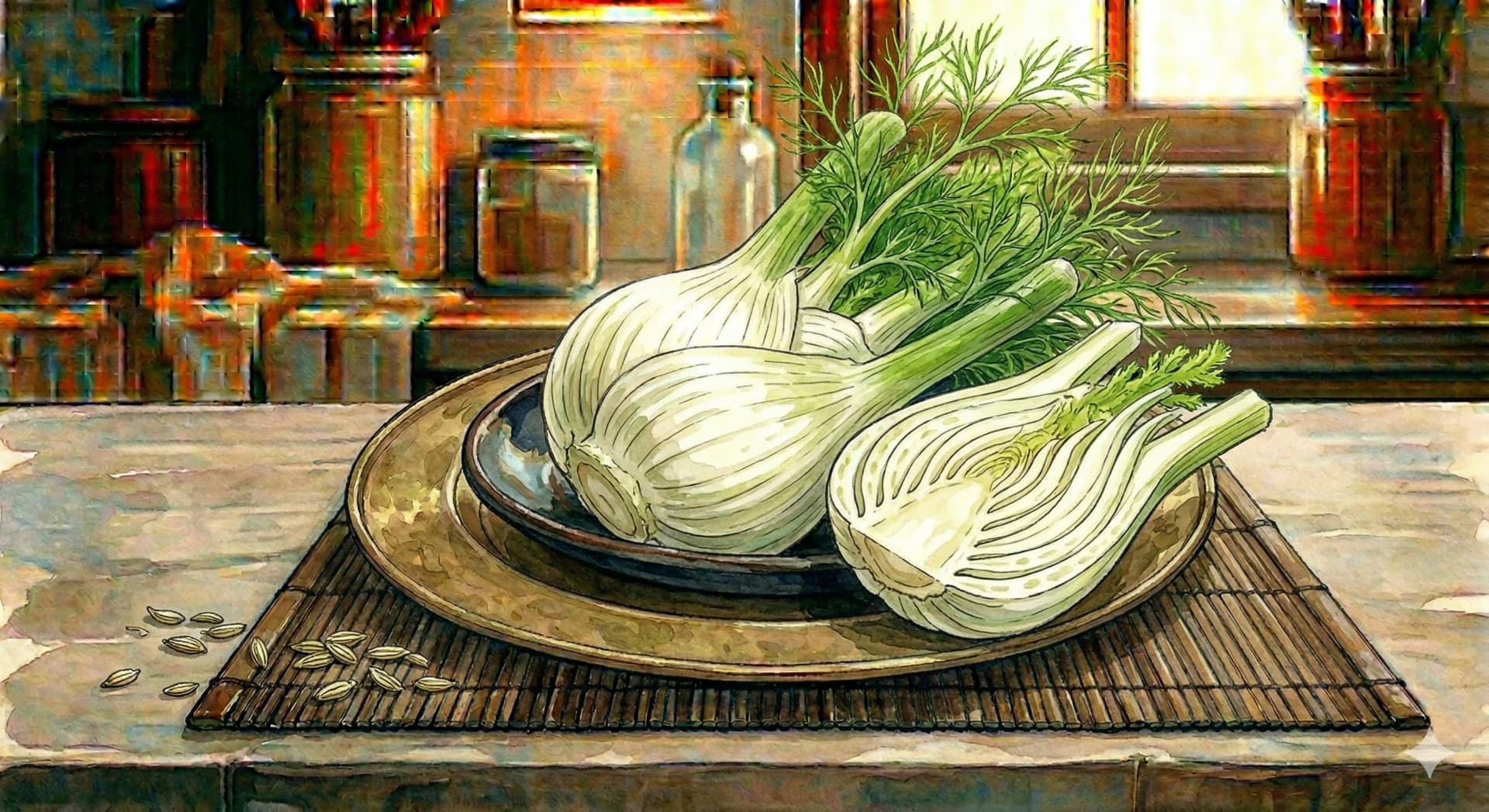
Fennel
Also known as: Saunf, Xiao Hui Xiang, Chinese Fennel, Sweet Fennel, Florence Fennel, Small Fennel, Foeniculum vulgare
Fennel (Foeniculum vulgare) is a single Mediterranean plant that two of the world's great food traditions adopted and then used in almost opposite ways. In India the roasted seed, saunf, is a digestive handed out after meals and a fixture of the spice box. In China the same seed, xiao hui xiang or "small fennel", is a warm braising spice and one of the five in five-spice powder. Italian and French cooking, meanwhile, lean on the bulb and fronds that neither of the others uses much.
Every part of the plant is edible: seeds, fronds, bulb, pollen and stalks. The seed is the part that travelled, and it carries a mild anise sweetness that makes it one of the most widely used digestive spices in any tradition.
Key facts at a glance:
- One species, two spice traditions. Indian saunf and Chinese xiao hui xiang are the same seed, prepared and used differently.
- Sweet and anise-like, but milder than star anise. It rounds out a spice blend rather than dominating it.
- Classified as cooling in Ayurveda and warm in Chinese medicine. The two systems disagree, and both descriptions are internally consistent.
- The digestive use is near-universal. After-meal saunf in India, braise aromatics in China and fennel tea in Europe all trace to the same carminative effect.
Flavor Profile
Origin
Mediterranean, Middle East, South Asia, China
Traditional Medicine Perspectives
Ayurveda
Fennel (Shatapushpa) is classified as sweet, cooling and slightly oily, properties that make it one of the few digestive herbs considered safe for Pitta constitutions prone to heat and inflammation. It is used to reduce bloating and gas, to support healthy lactation and to soothe colic in infants. Roasted fennel seeds (saunf) served after a meal work as a breath freshener and a digestive aid at the same time, and fennel is one of the three seeds in the standard after-meal digestive tea alongside cumin and coriander.
Note on the disagreement
Ayurveda calls fennel cooling and Chinese medicine calls it warm. The two systems are not describing temperature in the same sense: the Ayurvedic reading concerns its effect on Pitta and inflammatory heat, while the Chinese reading concerns its action on cold-pattern pain and Kidney Yang. Both frameworks arrive at the same practical use, which is to settle a struggling digestion.
Traditional Chinese Medicine
Fennel seed (Xiao Hui Xiang) is classified as warm and acrid, associated with the Liver, Kidney, Spleen and Stomach meridians. It is one of the primary herbs used to warm the Kidney, regulate Qi and relieve pain, and it is commonly prescribed for cold-type hernial pain, abdominal pain, dysmenorrhea, and digestive complaints including bloating, gas and nausea arising from cold patterns. It is often combined with ginger and cinnamon for menstrual pain. Chinese medicine uses the seed far more than the bulb.
Modern Scientific Research
Fennel seeds contain trans-anethole, the compound behind the anise aroma and behind most of the traditional medicinal claims. Research on fennel has looked at its antispasmodic effect on intestinal smooth muscle, which is the mechanism usually offered for its long use against bloating and cramping, and trials have examined fennel preparations in irritable bowel syndrome and in infantile colic.
Anethole also shows antimicrobial, antifungal and anti-inflammatory activity in laboratory work, and has been studied for estrogenic activity at high doses, which is relevant to the traditional use of fennel in lactation and menstrual discomfort. The seeds are a reasonable source of dietary fibre, manganese and antioxidants.
These are areas of active study rather than settled conclusions, and the doses used in research are generally larger than the amount in a spoonful of after-meal seeds.
Cultural History
Fennel runs through Mediterranean history from the beginning. It appears in Greek mythology, where Prometheus carries fire to humanity in a fennel stalk, and the Greeks called the plant marathon, which is how the town of Marathon got its name. Roman agricultural writers catalogued it, medieval European herbalism counted it among nine sacred herbs, and it travelled with colonists to the Americas, where it naturalised so successfully that it is now treated as invasive in California.
It reached China along the same trade routes more than a thousand years ago and was absorbed on different terms. Chinese cooking took the dried seed and essentially ignored the vegetable, the reverse of what happened in Italy and France. The seed settled into five-spice blends and into braising liquids for pork and lamb across northern and Sichuan cooking, and traditional Chinese medicine made it one of its most frequently prescribed digestive herbs.
In India the seed arrived early enough to appear in some of the oldest Ayurvedic texts. The habit of chewing roasted saunf after a meal is older than those texts, and it survives today as the bowl of seeds by the door of almost every Indian restaurant.
Culinary Uses
Indian cooking uses the whole seed in tempering and in pickles, the ground seed in Kashmiri and Bengali dishes, and the roasted seed on its own as after-meal saunf. It is one of the five seeds in panch phoron, the Bengali blend. Kashmiri cooking leans on fennel powder heavily, partly because the Pandit tradition avoids onion and garlic and needs the aromatics elsewhere.
Chinese cooking uses it almost entirely as a dried spice. It goes whole into braising liquids for pork, lamb and duck, into master stocks, and into five-spice powder alongside star anise, cassia, clove and Sichuan peppercorn. Northern Chinese cooking pairs it with lamb for dumplings and stir-fries.
European cooking takes the other half of the plant. The bulb is eaten raw in salads, braised or roasted, the fronds are used like dill as a finishing herb, and the seed goes into sausages, fish dishes and bread. Fennel pairs well with fish, pork, citrus and tomato.
Preparation Methods
Toast the seeds in a dry pan before use, thirty seconds or so, until they smell sweet and turn one shade darker. Go past that and they turn bitter.
Crack them lightly in a mortar to use whole, or grind them for spice blends and for Kashmiri dishes that call for fennel powder. Whole seeds hold their aroma far longer than ground, so buy whole and grind as needed.
For long-cooked Chinese braises, add the seeds whole and fish them out before serving. For after-meal saunf, dry-roast until lightly golden and toasty, cool completely, then store with rock sugar in a sealed jar.
Traditional Dishes
- Saunf (after-meal digestive)
- Indian pickle
- Panch phoron
- Five-spice preparations
- Braised pork hock
- Lamb dumplings (northern Chinese)
- Master stock
- Fennel sausage
- Bouillabaisse
- Fennel, Cumin & Coriander Digestive Tea
Comments
Share your thoughts on this ingredient.
Sign in to comment0 Comments