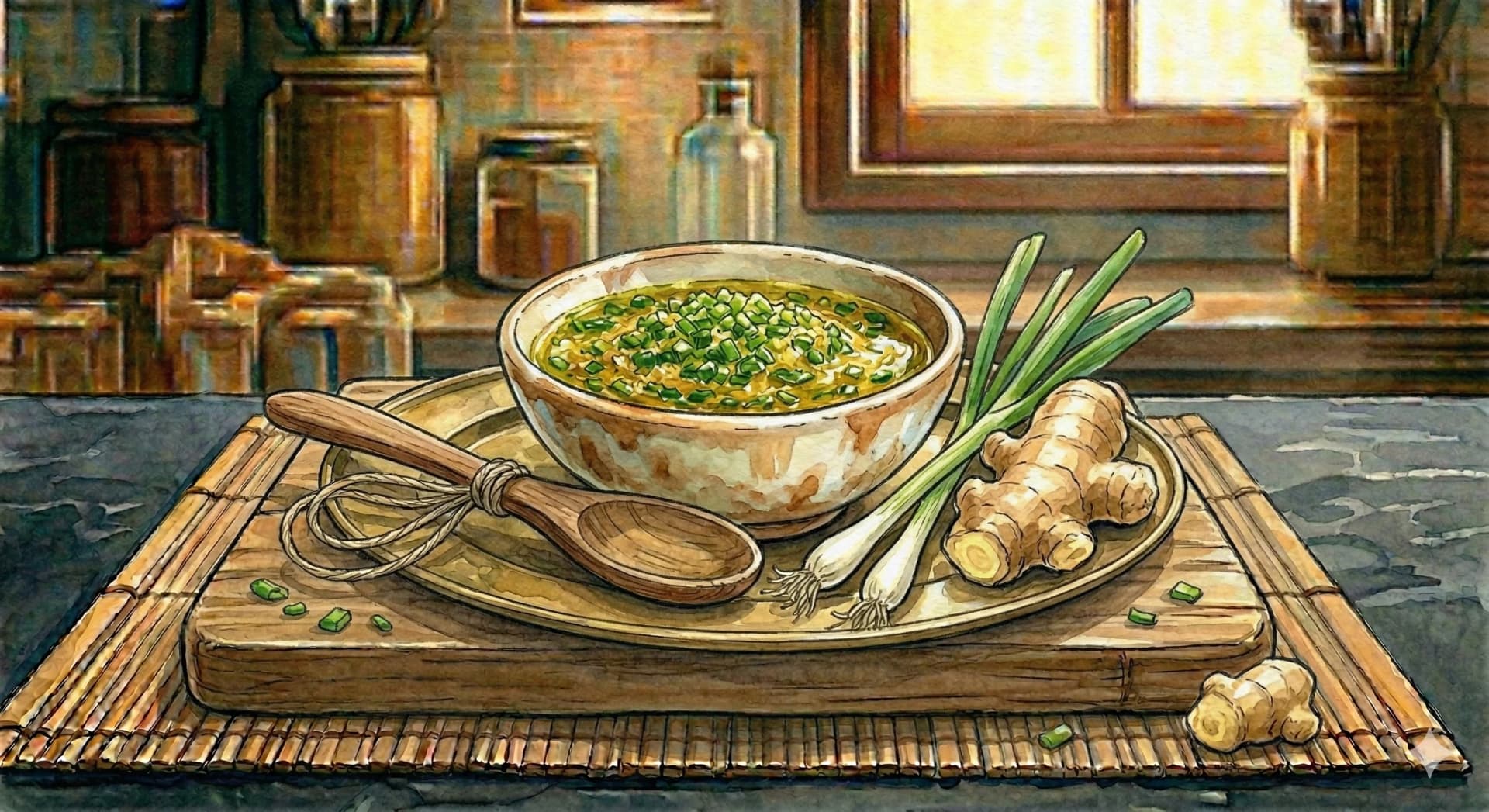
Ginger-Scallion Paste
Also known as: Ginger Scallion Sauce, Jiang Cong Jiang, 姜葱酱
Ginger-scallion paste is a prepared condiment, not a bottled product, and not something that requires cooking in the traditional sense. It is made from raw ginger and scallion, finely minced or pounded together with salt, and then transformed by the technique of pouring smoking-hot oil directly over the aromatics.
The heat blooms the volatile compounds instantly, releasing an explosion of fragrance while simultaneously softening the raw sharpness into something rounder and more complex. What results is a condiment of extraordinary aromatic intensity, bright with fresh ginger and scallion, enriched by the fat.
This is the canonical sauce for white cut chicken (bai qie ji), one of Cantonese cuisine's most refined and celebrated dishes. White cut chicken is deliberately understated: a whole chicken poached just to the point of doneness, served chilled or at room temperature, sliced simply. The entire flavor experience depends on the quality of the bird and the quality of the ginger-scallion sauce applied to it.
Beyond chicken, ginger-scallion paste functions as a universal brightener in Cantonese and Hong Kong cooking. It is spooned over steamed fish, served alongside poached seafood, stirred into noodles, and used as a condiment for congee. A jar in the refrigerator represents an immediate upgrade to almost any simply cooked protein or plain rice.
Key facts at a glance:
- Hot oil technique — smoking-hot oil poured over raw aromatics to bloom flavor
- White cut chicken — the canonical pairing, Cantonese cuisine's benchmark dish
- Universal condiment — works on steamed fish, noodles, congee, and any simply cooked protein
- Equal parts — roughly equal volumes of ginger and scallion, finely minced
- Best fresh — volatile aromatics diminish over time, keeps up to one week refrigerated
Flavor Profile
Origin
China, Guangdong, Hong Kong
Traditional Medicine Perspectives
Ayurveda:
Ginger (Sunthi when dried, Ardraka when fresh) is among the most revered herbs in Ayurveda, considered universally beneficial and referred to in classical texts as vishwabheshaj, the universal medicine. It is warming (ushna), pungent, and digestive-stimulating (deepana), capable of kindling agni (digestive fire) and relieving ama (undigested toxins). Scallion similarly supports Vata and Kapha reduction. Together as a paste, they constitute a strongly warming, digestive, and circulatory preparation most appropriate for Vata and Kapha types, and suitable for Pitta in modest quantities.
Traditional Chinese Medicine:
Ginger (Sheng Jiang, fresh ginger) is one of the most important medicinal herbs in TCM, classified as warm and pungent, associated with the Lung, Spleen, and Stomach meridians. Its actions include warming the middle, dispersing cold, stopping vomiting, and releasing the exterior in early-stage wind-cold conditions. Ginger is the foundation of numerous classical formulas and is considered safe and effective for nausea, digestive sluggishness, and cold-type pain patterns. Scallion (Cong Bai) adds its own exterior-releasing and Qi-moving properties, associated with the Lung and Stomach. Combined, these two herbs create a synergistic formula that warms, moves, and disperses: useful for cold constitutions, sluggish digestion, and those prone to chills. The hot oil that blooms the paste modifies the intensity of the raw herbs while preserving much of their therapeutic character in a more food-appropriate form.
Modern Scientific Research
Ginger's bioactive compounds, particularly gingerols in fresh ginger and shogaols formed during heat exposure, have been extensively studied. Gingerols demonstrate anti-inflammatory activity by inhibiting prostaglandin and leukotriene synthesis through pathways similar to NSAIDs but without the same gastrointestinal side effects.
Multiple clinical trials support ginger's efficacy for nausea related to pregnancy, chemotherapy, and surgery. The conversion of gingerols to shogaols upon application of heat concentrates certain bioactive effects, making the brief but intense application of hot oil over ginger a meaningful preparation method from a phytochemical standpoint.
Scallions contribute quercetin and other flavonoids with antioxidant and anti-inflammatory properties, along with organosulfur compounds related to those in garlic.
The combination of ginger and scallion creates a paste where volatile aromatic compounds from each ingredient are preserved and concentrated together. Research on synergistic interactions between ginger and Allium aromatics is early but suggests these compounds may work cooperatively to support immune modulation and gastrointestinal health.
Cultural History
Cantonese cuisine has long been defined by a philosophy of restraint: the best ingredients, treated with minimal intervention, allowed to express their innate quality. Ginger-scallion paste embodies this philosophy completely. It adds aromatics and richness to delicate poached meats without altering their fundamental character.
White cut chicken, the dish most associated with this condiment, has been a fixture of Cantonese banquets and family tables for centuries. It appears in the earliest records of Guangdong's restaurant culture and remains a benchmark dish by which Cantonese cooks are judged.
In Hong Kong, where Cantonese cuisine achieved some of its most refined modern expressions, ginger-scallion sauce became a defining condiment of the city's food culture.
Hainan chicken rice, which spread across Southeast Asia through Hainanese emigrant communities, brought ginger-scallion sauce into the culinary traditions of Singapore, Malaysia, Thailand, and Vietnam.
In each context it adapted slightly but retained its essential character: raw aromatics bloomed in hot oil, salt, and brightness. It is now recognized across the region as one of the essential three sauces accompanying the dish, alongside chili sauce and dark soy sauce.
Culinary Uses
The making of ginger-scallion paste is one of the simplest and most rewarding techniques in the Cantonese kitchen. The ratio is approximately equal parts ginger and scallion by volume, finely minced. The mixture is salted generously and placed in a heat-safe bowl.
Oil, typically neutral oil or a mixture of neutral and sesame oil, is heated until it just begins to smoke. It is then poured directly over the aromatics, producing a dramatic sizzle and releasing a cloud of fragrance. The mixture is stirred and cooled before serving.
For white cut chicken, the paste is served in a small dish on the side; diners spoon it over each piece of chicken as they eat.
For steamed fish, it may be placed on top of the fish and hot oil poured over at the table. For congee, it is stirred in as a seasoning and topping. The paste is best made fresh, as the bright volatile aromatics diminish over time, but it keeps refrigerated for up to a week.
Preparation Methods
Finely mince 3 ounces (85g) of fresh ginger (peeled) and 4-5 scallions, white and green parts, to roughly equal volume. Combine in a heat-safe bowl or jar. Add 1 teaspoon of salt, or to taste.
Heat 1/4 cup of neutral oil in a small saucepan over high heat until it just begins to smoke, approximately 400°F (200°C). Pour the hot oil over the ginger-scallion mixture in one motion. It will sizzle aggressively. Stir well, then allow to cool for 5 minutes.
Taste and adjust salt. Optional: add a few drops of sesame oil after cooling for additional aroma. Serve immediately or refrigerate, covered, for up to 5 days. Bring to room temperature before serving.
Comments
Share your thoughts on this ingredient.
Sign in to comment0 Comments