Lentils
Also known as: Dal, Masoor, Lens culinaris
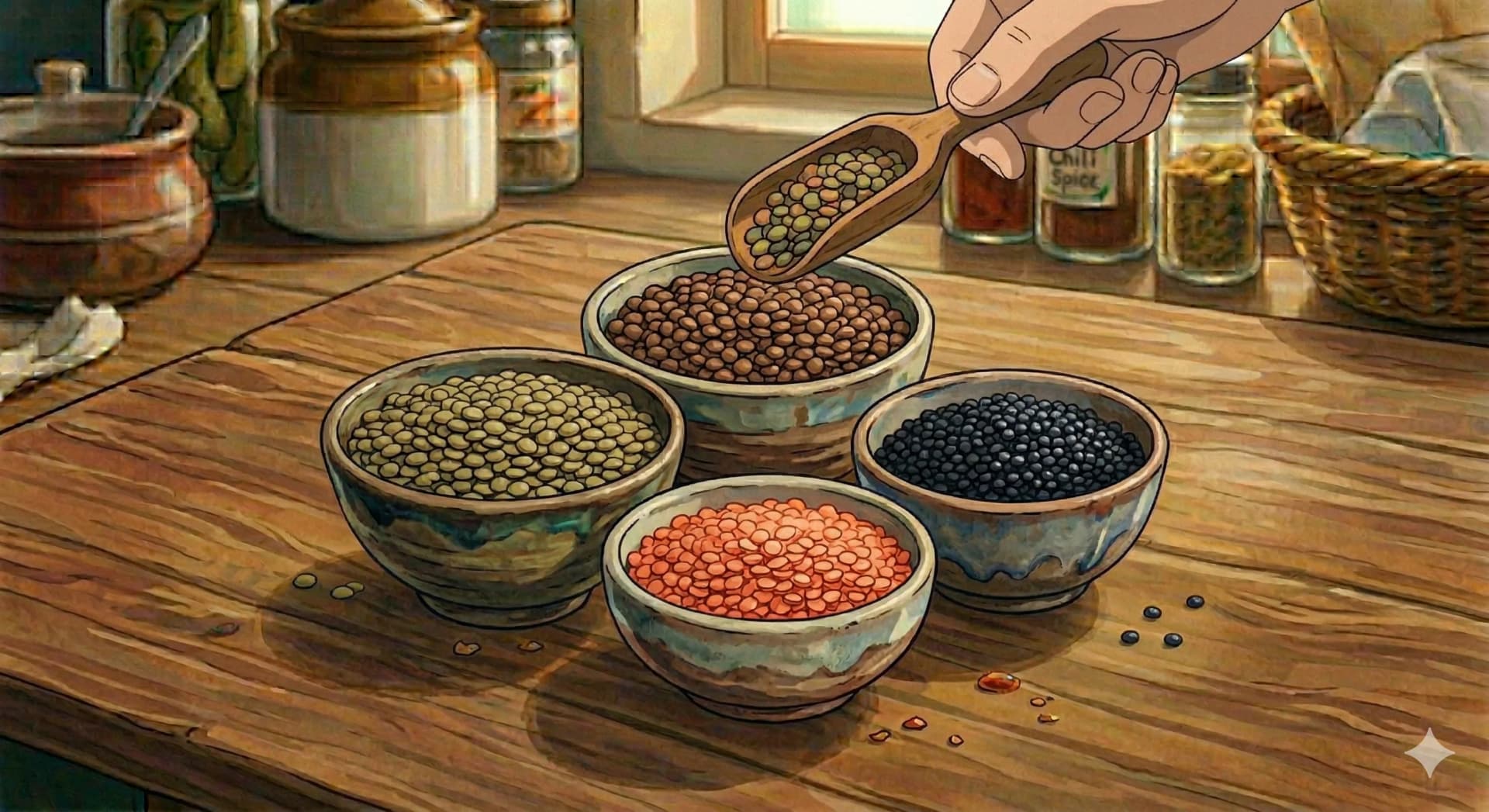
"Lentil" is not a single ingredient. It is a family of legumes, all members of the species Lens culinaris, that vary so significantly in color, size, texture, cooking time, and culinary role that treating them as interchangeable is one of the more common mistakes a cook can make.
Red lentils, which are actually orange-pink and sold split, dissolve into a thick puree in 15 to 20 minutes without soaking. French Puy lentils, deep green-black and slate-colored, hold their shape through 30 to 40 minutes of simmering and are the lentil of composed salads. Black beluga lentils look like caviar, cook in about 25 minutes, and remain firm and glossy. Brown lentils, the most common in North America and Europe, cook in 20 to 30 minutes and fall somewhere between.
In South Asia, the word "dal" describes both a specific ingredient (the split and often husked version of any legume) and the concept of a cooked lentil or legume dish. This dual meaning is worth holding in mind when cooking from South Asian sources.
The unifying characteristic of lentils across their varieties is their accessibility: they are inexpensive, shelf-stable, extraordinarily nutritious, and require no soaking to cook in under half an hour.
Key facts at a glance:
- Not one ingredient — a family of legumes varying in color, texture, and cooking time
- Red lentils — dissolve in 15-20 minutes, ideal for soups and smooth dals
- French Puy/beluga — hold shape, ideal for salads and composed dishes
- 18g protein per cup — one of the most nutrient-dense plant foods
- 11,000 BCE origins — among the oldest cultivated crops in human history
Flavor Profile
Origin
Near East, Indian subcontinent, Mediterranean
Traditional Medicine Perspectives
Ayurveda:
In Ayurvedic thought, different lentils have different properties, and they are not treated as a category. Red lentils (masoor) are considered slightly warming and moderately easy to digest. Split and husked moong dal (yellow moong) is considered the most sattvic and easily digestible of all legumes. Brown and green lentils, which retain their husk, are considered more Vata-aggravating and are not recommended for those with weak digestion. The standard Ayurvedic prescription for digestive support is to always cook lentils with digestive spices: cumin, ginger, turmeric, and asafoetida.
Traditional Chinese Medicine:
Lentils are classified as sweet in taste and neutral in temperature, supporting Spleen and Stomach function. They are considered nourishing to Qi and Blood, and are recommended for fatigue, weakness, and poor appetite. Like Ayurveda, TCM emphasizes proper cooking and seasoning to support digestibility.
Modern Scientific Research
Lentils sit at the top of the plant-based protein league table. A cooked cup provides roughly 18 grams of protein, 16 grams of fiber, and significant amounts of folate, iron, manganese, and B vitamins, at a cost of under a dollar.
Their fiber is split between soluble fiber (which lowers LDL cholesterol and feeds gut microbiota) and insoluble fiber (which supports bowel regularity). Studies from the Canadian Lentil Clinical Trial program have produced consistent evidence that regular lentil consumption reduces glycemic response to subsequent meals — an effect called the "second meal effect."
The iron in lentils is non-heme iron, less bioavailable than heme iron from animal sources, but pairing lentils with vitamin C (tomatoes, lemon juice) significantly increases absorption — a combination embedded in South Asian cooking long before anyone understood the biochemistry.
Cultural History
Lentils are among the most ancient cultivated crops in human history. Archaeological sites in the Fertile Crescent have produced lentil remains dating to 11,000 BCE. Lentils appear in the Bible: Esau trades his birthright for a bowl of red lentil pottage. They were a staple of ancient Egyptian cooking, found in excavated tombs. Roman soldiers carried dried lentils as field rations.
In India, lentils arrived with or alongside early agricultural development, and dal in its various forms became the protein backbone of a vegetarian culture spanning a billion people. The classic formula of dal, rice or roti, and vegetable side dish provides a complete amino acid profile, iron, complex carbohydrates, and fiber in a single low-cost meal.
Mujaddara, the Syrian and Lebanese preparation of lentils and rice topped with caramelized onions, appears in Arab cookbooks dating to the 13th century and is almost certainly much older.
In Egypt, koshari, the national street food, layers lentils with pasta, rice, and a spiced tomato sauce. In Turkey, red lentil soup seasoned with cumin and a butter-paprika drizzle is served to a sick person, to a cold person, and at the start of nearly every sit-down meal in Anatolia.
Culinary Uses
Split red lentils (masoor dal) are the fastest-cooking and most dissolving variety, ideal for soups and thickened dals. They require no soaking and are ready in 15 to 20 minutes. They cannot hold their shape and should not be used in salads.
French Puy lentils and black beluga lentils are the salad lentils. They hold their shape, have a pleasant peppery flavor, and pair well with vinaigrette, roasted vegetables, and soft-boiled eggs.
Brown and green lentils fall in the middle: they can make a decent soup or a thick, chunky dal, but they will partially break down.
Preparation Methods
Split red lentils (masoor/moong dal): Rinse thoroughly until water runs clear. Add to 2.5 to 3 parts water. Bring to a boil, skim any foam, then simmer 15 to 20 minutes until completely soft. Season with salt at the end. Finish with a tadka (tempering) of whole spices fried in ghee or oil.
Whole brown/green lentils: Rinse. No soaking required. Simmer in well-salted water for 25 to 35 minutes until tender but holding shape. Drain immediately to prevent overcooking.
French Puy/beluga lentils: Rinse. Simmer in lightly salted water or stock for 25 to 35 minutes. These can be slightly undercooked (al dente) for salad use. Dress while still warm for best flavor absorption.
Tadka (tempering) for Indian dal: Heat ghee in a small pan until shimmering. Add whole cumin seeds and let sputter 30 seconds. Add dried chilies, a pinch of asafoetida, minced garlic, and let cook until garlic is golden. Pour the entire hot mixture over the cooked dal. Stir to combine.
Traditional Dishes
- Dal tadka
- Dal makhani
- Masoor dal (Indian)
- Mujaddara (Syrian/Lebanese)
- Turkish red lentil soup (Mercimek corbasi)
- Egyptian koshari
- French lentil salad with Dijon vinaigrette
- Dhaba-style dal fry
- Ethiopian misir wot (red lentil stew)
- Nepali dal bhat
- Lentil soup (Greek fakes)
- Maa Chana Dal
Comments
Share your thoughts on this ingredient.
Sign in to comment0 Comments