Nutmeg
Also known as: Jaiphal, Jatiphala, Myristica fragrans, Noix de Muscade
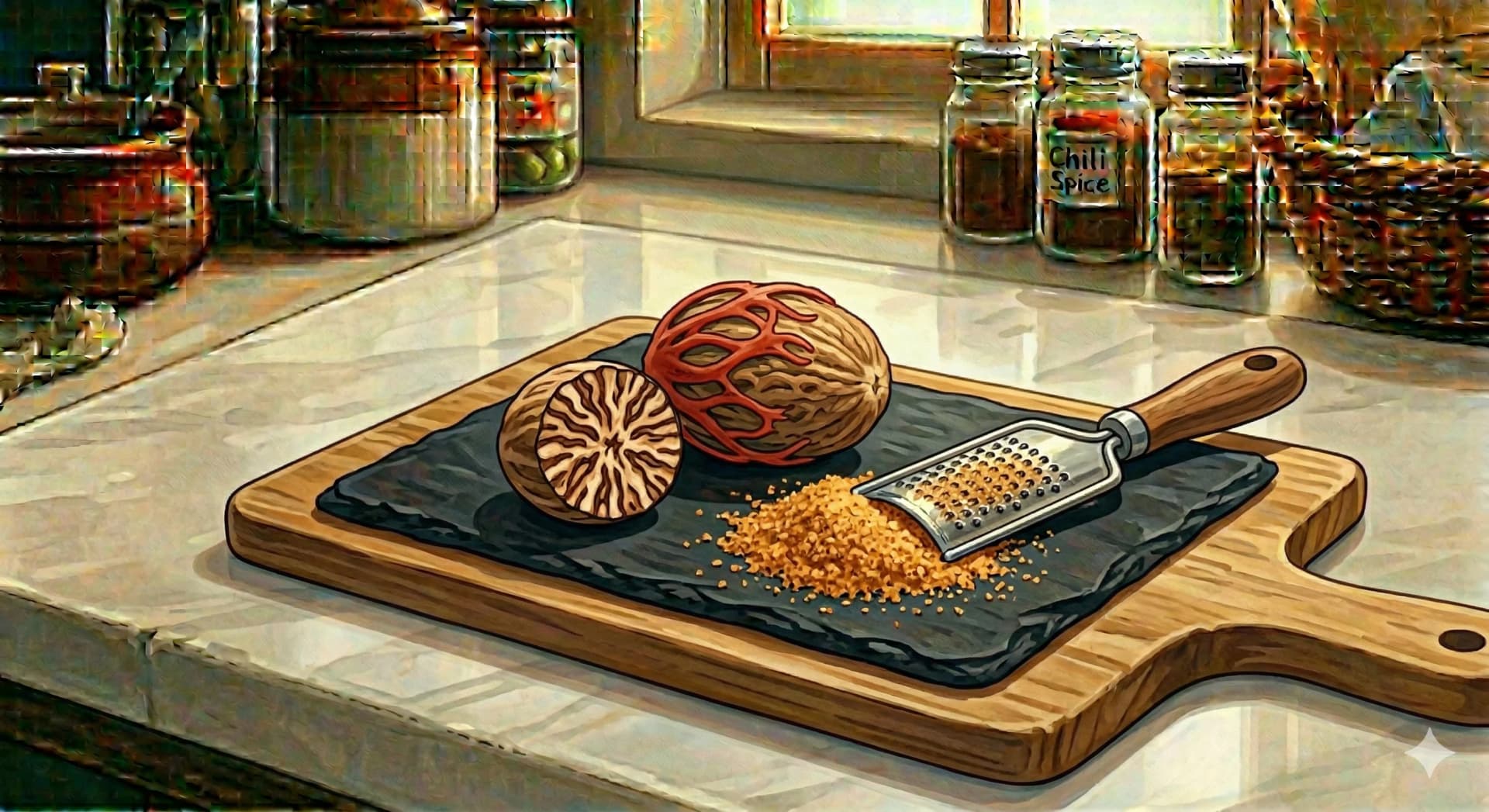
Nutmeg is the dried seed kernel of the fruit of Myristica fragrans, a tropical evergreen tree native to the Banda Islands of eastern Indonesia. The fruit itself resembles a small peach or apricot when ripe: it splits open to reveal a seed encased in a vivid red lacy membrane called the aril. That aril is mace, the more delicate and expensive sibling spice. The seed beneath, when dried and its outer shell removed, is nutmeg. A single tree produces both, making Myristica fragrans the only plant in the world that yields two distinct commercial spices from the same fruit.
The flavor of freshly grated nutmeg is one of the most complex in the spice world: warm and sweet at the front, woody and slightly resinous in the middle, with a faint bitterness at the back of the palate and a persistent warmth that lingers. This complexity collapses rapidly when nutmeg is pre-ground. The volatile aromatic oils that carry almost all of its flavor and aroma oxidize and evaporate quickly after grinding, leaving behind a flat, dusty shadow of what the whole seed offers. This is one of the most meaningful practical distinctions in all of spice cookery: freshly grated nutmeg from a whole seed is categorically different from pre-ground nutmeg from a tin. A microplane or traditional nutmeg grater turns a whole seed into fine powder in seconds and is entirely worth the small effort.
Nutmeg occupies a remarkable culinary position as one of very few spices that work equally well in sweet and savory applications. In Indian cooking it appears in garam masala blends and Mughlai gravies. In Western cooking it appears in béchamel sauce, eggnog, apple pie, and spiced cakes. This dual-register versatility made it uniquely prized across multiple food cultures, contributing to its extraordinary historical value.
Key facts at a glance:
- Dried seed of Myristica fragrans — native to Indonesia's Banda Islands
- Only plant yielding two spices — nutmeg (seed) and mace (aril) from the same fruit
- Freshly grated vs. pre-ground — categorically different in flavor and aroma
- Works in sweet and savory — from garam masala to béchamel to eggnog
- Once valued at ounces of gold per pound — drove colonial violence and monopoly trade
- Contains myristicin — psychoactive at very high doses, safe in culinary amounts
Flavor Profile
Origin
Banda Islands (Indonesia), Maluku (Spice Islands), Grenada, Kerala
Traditional Medicine Perspectives
Ayurveda:
Nutmeg is known in Ayurveda as Jaiphal or Jatiphala, a name with a poetic etymology: "jati" relates to a net or interlace (a reference to the mace aril that surrounds it), and "phala" means fruit. It is classified as having hot potency (ushna virya), making it useful for Vata and Kapha conditions while needing moderation in Pitta constitutions. Classically it has been used as a digestive stimulant, warming the gut and treating cold-type diarrhea. In traditional texts it appears as an ingredient in formulations for insomnia (small amounts are considered sleep-inducing), as an aphrodisiac, and for the treatment of fevers of the cold variety. It is considered particularly useful for children's digestive complaints in very small doses, though this is a traditional application that requires appropriate qualification.
Traditional Chinese Medicine:
In TCM, nutmeg is called Rou Dou Kou and is classified as acrid and warm, entering the spleen, large intestine, and stomach meridians. Its primary indication is warming the middle and lower warmer to treat diarrhea caused by cold deficiency patterns, particularly the "cock-crow diarrhea" that occurs in the early morning from kidney-spleen Yang deficiency. It is also used for cold-induced stomach pain and food stagnation. Contraindicated in damp-heat patterns and in those with constipation or heat conditions. Combined with other warming herbs, it forms part of formulas for cold-type digestive weakness.
Modern Scientific Research
The most-studied compound in nutmeg is myristicin, a phenylpropene volatile that constitutes a significant portion of nutmeg essential oil. Myristicin and its companion compound elemicin have psychoactive properties at very high doses, a fact that has been documented for centuries and has attracted modern pharmacological research. Ingesting extremely large quantities of whole nutmeg (typically cited as two or more whole seeds) can produce a range of psychoactive and toxic effects including hallucinations, tachycardia, nausea, and anxiety. This is relevant context but not a culinary concern: the amount of myristicin in a culinary dose of freshly grated nutmeg is a small fraction of any pharmacologically relevant amount.
Safrole, another compound present in small amounts in nutmeg, has received regulatory attention due to its classification as a probable carcinogen in high isolated doses, but again, the amounts present in culinary use are far below any threshold of concern.
On the more therapeutically promising side, nutmeg extracts have demonstrated antimicrobial activity against several bacterial species, and animal research has suggested sedative and anxiolytic properties at sub-toxic doses — potentially offering a pharmacological basis for the traditional use in treating insomnia.
Anti-inflammatory activity has also been documented in cell and animal models.
Cultural History
During the 17th century, a pound of nutmeg was valued at multiple ounces of gold in European markets. This was not hyperbole or merchant exaggeration: the scarcity of nutmeg was genuine and the demand was immense. Europeans used nutmeg not only in food but as a medicine, a preservative, and a status symbol. Carried in small silver graters that doubled as jewelry, freshly grated nutmeg at the table signaled wealth and access in the same way that truffles or saffron might today.
The Dutch East India Company (VOC) understood the value of controlling the only source of this commodity. After the Portuguese reached the Banda Islands in 1512 and the subsequent scramble between European powers for the spice trade, the Dutch secured monopoly control through a campaign of devastating violence. In 1621, Governor-General Jan Pieterszoon Coen directed the massacre and displacement of the indigenous Bandanese people, a population of roughly 15,000, reducing it by approximately 90 percent through killing, forced labor, and famine. The islands were then repopulated with Dutch colonists and enslaved workers under VOC-controlled plantation conditions. This monopoly, enforced through violence for decades, is one of the starkest examples of the human cost underlying the European spice trade.
The British eventually broke the Dutch monopoly by transplanting nutmeg trees to Penang, Bencoolen, and Grenada — today Grenada, nicknamed the Spice Isle, is one of the world's largest nutmeg producers, a direct legacy of British colonial botany.
In India, nutmeg cultivation took hold in Kerala's spice gardens, and it remains an important crop there. In Indian cooking, nutmeg arrived through trade routes and was fully integrated into Mughal court cuisine by the 16th century, appearing in the complex spice blends that define biryanis, kormas, and the slow-cooked stews of the Mughal tradition.
Culinary Uses
In Indian cooking, nutmeg's most important function is as part of garam masala, where it contributes warm, sweet top notes to the blend. It also appears in biryanis, added toward the end of cooking or in the dum (sealed slow-cooking) stage where it perfumes the rice. In Mughlai korma, a pinch of freshly grated nutmeg added off the heat at the end deepens and rounds the richness of the cream and almond base without announcing itself overtly. In nihari, the slow-cooked beef shank stew associated with old Delhi and Lahore, nutmeg is one of the spices that goes into the nihari masala that defines the dish's complex, warming character.
In Western cooking, nutmeg is most at home in béchamel sauce, where it cuts through the richness of butter and flour and milk with its warm complexity. It is nearly always used in eggnog and in spiced mulled wine. For apple and pumpkin pies, nutmeg and cinnamon are the foundational aromatic pair.
The consistent recommendation from every serious cook who uses nutmeg is to keep a whole seed and a small grater and use it fresh: the difference between freshly grated nutmeg and the pre-ground version is significant enough that they should be considered almost different ingredients.
Preparation Methods
Freshly grating: Hold the whole nutmeg seed against a fine microplane or dedicated nutmeg grater and grate only what you need. A single seed will last through many uses. The outermost layer of the seed has the most intense concentration of aromatic oils.
Adding to garam masala: Grate a small amount of nutmeg into the spice blend at the end of grinding, as nutmeg's volatile oils are best not subjected to prolonged heat in a spice grinder.
Finishing Mughlai dishes: Add a small pinch of freshly grated nutmeg off the heat at the very end of cooking a korma or biryani gravy. This preserves the top notes that would otherwise cook off.
Béchamel: Add a generous pinch of freshly grated nutmeg to the finished sauce off heat. Nutmeg is one of the few flavors that actively improves béchamel, cutting the richness and adding complexity.
Storage: Whole nutmeg seeds keep for 3-4 years in an airtight container. Pre-ground nutmeg should be replaced every 6-12 months.
Traditional Dishes
- Biryani
- Mughlai Korma
- Nihari
- Garam Masala
- Béchamel Sauce
- Eggnog
- Apple Pie
- Spiced Pound Cake
- Mulled Wine
- Shahi Paneer
- Lamb Rogan Josh
- Haleem
Comments
Share your thoughts on this ingredient.
Sign in to comment0 Comments