Okra
Also known as: Bhindi, Lady's Finger, Bhendi, Okro, Abelmoschus esculentus
Okra is a vegetable with a split personality. Beloved across India, West Africa, the American South, and the Middle East, it is simultaneously one of the most divisive ingredients in global cooking. The source of that division is mucilage: a natural, water-soluble fiber found concentrated in the pods that turns viscous and ropy when cut and exposed to moisture. Depending on where you are eating, that slippery, gel-like quality is either the entire point of the vegetable or a problem to be engineered around. Both camps have developed sophisticated, deeply traditional techniques in service of their position.
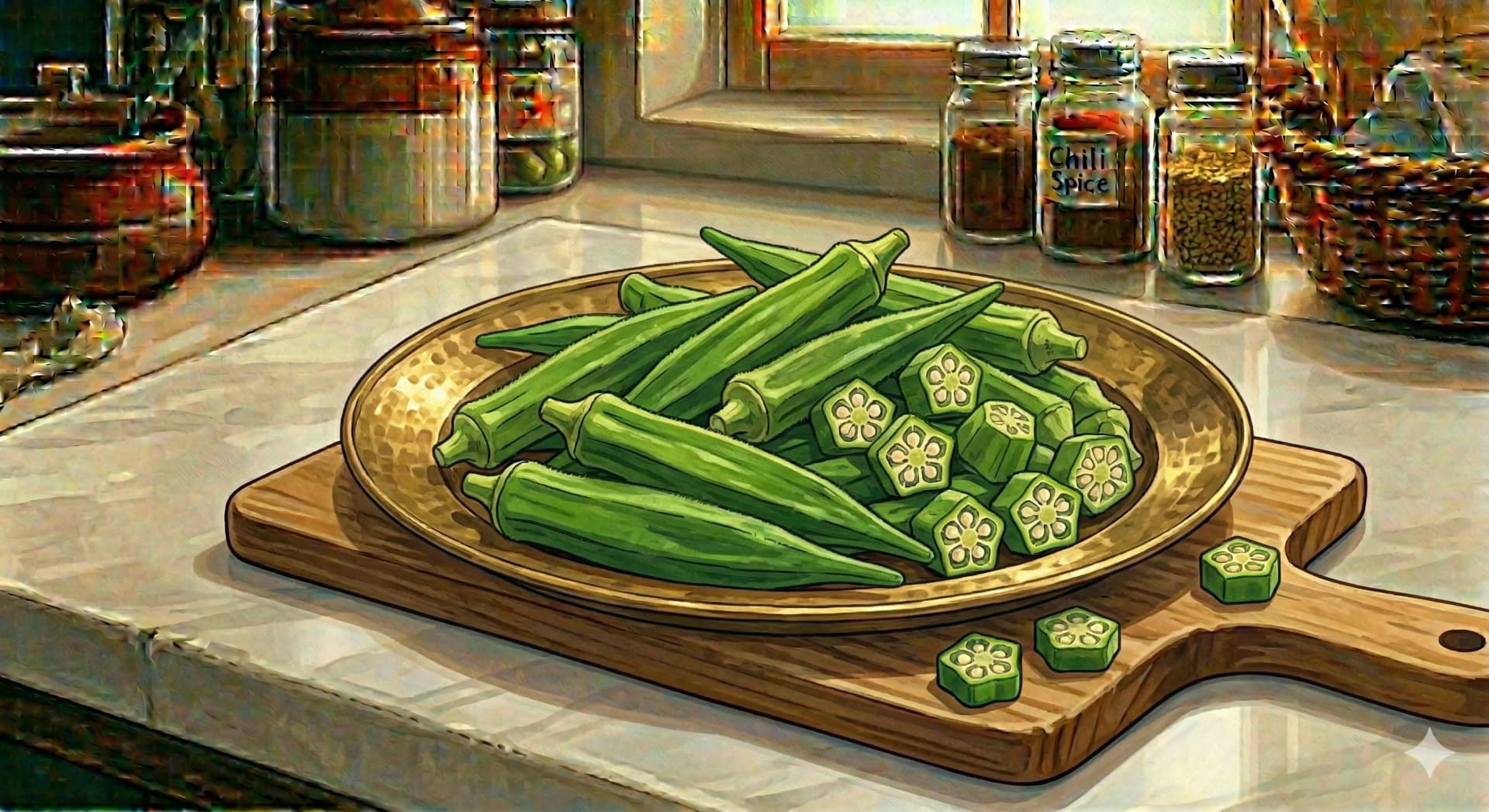
The pods are green, ridged, and taper to a point. When young and freshly harvested, they are tender, mildly sweet, and faintly grassy. As they age on the plant, the pods become larger, woodier, and more aggressively mucilaginous. The quality of okra in the kitchen begins at the market: small to medium pods, no longer than about 8 to 10 cm, that snap crisply when bent. Larger pods that bend without snapping have already turned fibrous and are better avoided.
Okra belongs to the mallow family, closely related to hibiscus and cotton, and the flowers of the plant are edible and striking. It arrived in India centuries ago from its origin in the northeastern African highlands, and it has since become so deeply integrated into South Asian cooking that many cooks consider it an Indian vegetable. In India it is known almost universally as bhindi, and it appears in daily home cooking with a frequency that reflects genuine affection.
Key facts at a glance:
- Divisive because of mucilage — beloved as a thickener in gumbo, minimized through dry-cooking in Indian cuisine
- Origin in Ethiopian highlands — spread globally via Arab traders and the transatlantic slave trade
- Known as bhindi in India — one of the most popular everyday vegetables
- Rich in soluble fiber — including rhamnogalacturonans and glucomannans
- The word "gumbo" derives from Bantu — "ki ngombo," meaning okra
- Select pods under 10 cm — that snap crisply when bent
Flavor Profile
Origin
Northeast Africa, Ethiopia, South Asia, Americas, Caribbean
Traditional Medicine Perspectives
Ayurveda:
In Ayurvedic texts, okra is classified as a vegetable with cooling, demulcent properties. The mucilage itself is considered beneficial for the digestive tract, soothing the gut lining and supporting healthy digestion. It is recommended for individuals with pitta imbalances, particularly those experiencing heat-related digestive issues. Okra is also considered a tonic for the reproductive system and is used in formulations for general debility and weakness. It is classified as an easily digestible food when cooked simply, making it appropriate for convalescent diets.
Traditional Chinese Medicine:
Okra is not native to China and entered Chinese cooking relatively recently, but it has been adopted enthusiastically in southern provinces. In contemporary Chinese wellness frameworks, it is classified as a food that clears heat, moistens dryness, and supports kidney function. The mucilaginous quality is associated with its nourishing, moistening action.
Modern Scientific Research
The mucilage in okra is predominantly made up of soluble dietary fiber, particularly polysaccharides called rhamnogalacturonans and glucomannans. Research has shown that these compounds can help stabilize blood sugar by slowing glucose absorption in the gut, making okra of interest in studies on Type 2 diabetes management. The soluble fiber also contributes to healthy cholesterol levels by binding bile acids in the digestive tract.
Okra contains meaningful amounts of vitamin C, vitamin K, folate, and magnesium, along with antioxidant flavonoids including quercetin and kaempferol.
Anti-inflammatory properties have been documented in several studies, with okra extracts showing activity against markers of chronic inflammation.
The seed protein of okra contains a compound called lectin that has been studied for potential anti-tumor properties, though this research remains in early stages. The overall nutritional profile supports okra's traditional classification as a beneficial, health-supporting food.
Cultural History
The wild ancestors of cultivated okra are traced to the Ethiopian highlands, where the plant was likely first domesticated before spreading across Africa and into the Middle East. By the 12th century, Arab traders had introduced it to the Mediterranean and the Indian subcontinent. From India, it spread further into Southeast Asia.
The transatlantic slave trade carried okra seeds to the Americas and the Caribbean, where enslaved Africans brought not only the plant but the culinary knowledge of how to use it. The word "gumbo" itself derives from the Bantu word for okra, "ki ngombo," a reminder of that history embedded in the name of Louisiana's most iconic dish.
In West Africa, okra has been a staple for millennia. Stews thickened with okra mucilage form the backbone of cooking across Nigeria, Ghana, Senegal, and beyond. When enslaved people from West and Central Africa were brought to the American South, they carried seeds with them, and okra became foundational to Southern American cooking. The vegetable connected the diaspora to their food traditions and eventually transformed Louisiana Creole and Cajun cooking into what it is today.
In India, bhindi became a beloved everyday vegetable across all regions — the cultural relationship with okra is overwhelmingly positive, without the polarization that can exist in Western contexts where mucilage is more often encountered and more often rejected.
Culinary Uses
Indian dry-cooking methods for bhindi represent one of the most successful strategies for minimizing mucilage. The fundamental rule is dryness at every stage: the okra must be washed and thoroughly dried before cutting, the pan must be dry, no water is added during cooking, and the flame is kept moderate to high so that moisture evaporates quickly rather than pooling. Bhindi masala is cooked until the pieces are slightly crisp at the edges and the mucilaginous slick has completely dried out. The result is nutty, concentrated, and deeply savory. Acidic ingredients, such as tomatoes, tamarind, or amchur (dried mango powder), also reduce mucilage by breaking down the polysaccharide chains.
Louisiana gumbo takes the opposite approach. Here, okra is added to the pot specifically to thicken the broth, its mucilage dissolving into the liquid and creating the dense, glossy texture that defines a proper gumbo. The long cooking time allows the slippery quality to fully integrate into the sauce rather than coating individual pieces.
Middle Eastern bamia (okra stewed with tomatoes and lamb or chicken) occupies a middle ground: slow-cooked until tender, with the mucilage softened but still present — each tradition has arrived at a coherent, satisfying answer to the same vegetable.
Preparation Methods
For Indian dry preparations (bhindi masala, bhindi fry): Wash okra and spread on a clean towel. Dry thoroughly, at least 20 to 30 minutes, or pat completely dry with paper towels. Cut off the crown and tip, then slice into rounds or diagonal pieces. Work with dry hands and a dry knife. Heat oil in a wide pan (cast iron or heavy stainless works well) over medium-high heat. Add okra in a single layer if possible, without crowding. Do not cover the pan. Stir occasionally and allow the pieces to dry out and become slightly golden. Add spices once the sliminess has dissipated, after about 8 to 10 minutes.
For gumbo and stews: Slice okra into rounds and add directly to the pot. A long, slow simmer of 30 to 45 minutes will fully incorporate the mucilage into the broth. No special preparation is needed; the sliminess is the thickener.
For quick sautéing: High heat and a hot, dry pan will quickly sear the cut surfaces and seal in some of the mucilage. Adding a small amount of vinegar or lemon juice to the finished dish brightens the flavor and reduces any residual slipperiness.
Traditional Dishes
- Bhindi masala
- Bhindi do pyaza
- Bhindi fry (crispy)
- Vendakkai kootu (South Indian
- with lentils and coconut)
- Vendakkai sambar
- Gumbo (Louisiana Cajun and Creole)
- Bamia (Middle Eastern okra stew)
- Bamia bil lahma (Egyptian okra with meat)
- Ugali na bamia (East African)
- Okra soup (West African)
Comments
Share your thoughts on this ingredient.
Sign in to comment0 Comments