Punjabi · Indian Cuisine
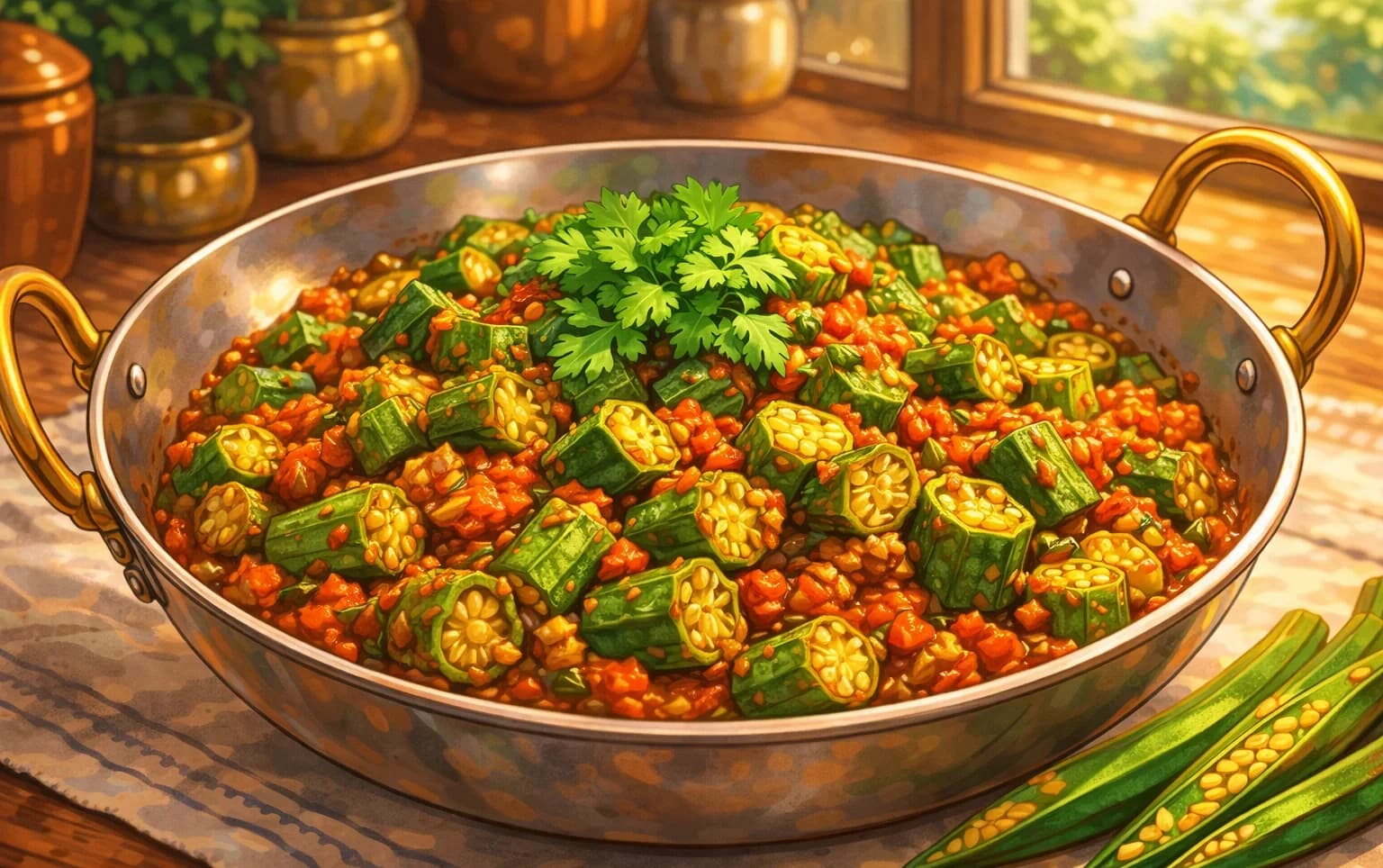
Bhindi Masala
Crisp okra tossed in a dry spiced onion and tomato masala
The question with okra is always the same: how do you avoid the slime? The answer, in this Punjabi preparation, is simple and effective. Wash and dry the okra completely before cutting. Cook it over high heat without a lid. Do not add water at any point. And do not stir it constantly. These four rules produce bhindi that is golden, crisp at the edges, and completely free of the mucilaginous texture that turns many cooks away from this vegetable.
Bhindi masala is one of the most common dry vegetable dishes (sabzi) in the Punjabi kitchen. It appears on thalis alongside dal and rice, fills a roti for a quick lunch, or stands as a side dish at larger meals. The preparation is deliberately unfussy: the okra is the star, and the masala exists to season and complement it rather than to smother it.
The technique produces two textures. The okra pieces develop a light crust from the dry, high-heat cooking, becoming almost chip-like at the thinnest edges. The interior remains tender, with the seeds providing a slight pop. The onion-tomato masala that finishes the dish is quick and dry, adding just enough moisture to coat the okra without making it slippery.
The addition of amchur (dried mango powder) at the end is important. Its sour, fruity acidity acts as a counterpoint to the richness of the oil and the earthiness of the spices, and it brightens the finished dish in a way that salt alone cannot achieve. If you have amchur in your pantry, this is one of the dishes where it earns its place most clearly.
At a Glance
Yield
Serves 4
Prep
15 minutes
Cook
25 minutes
Total
40 minutes
Difficulty
Easy
Ingredients
- 1 lbfresh okra (bhindi)
- 3 tbspneutral oil
- 2⅓ tspcumin seeds
- —A pinch of asafoetida (hing)
- 1medium onion (150 g), finely sliced
- 2green chillies, slit lengthwise
- 5½ oztomatoes (about 1–1½ tomatoes), finely chopped
- 2¾ tspcoriander powder
- 1⅓ tspcumin powder
- 2¾ tspred chilli powder
- 1⅛ tspturmeric
- 2 tspamchur (dried mango powder, about 1 teaspoon)
- ⅞ tspsalt
- 1⅔ tspgaram masala
- ½ cupfresh coriander, roughly chopped
Method
- 1
Wash and dry the okra thoroughly. Wash the okra (500 g) under running water and spread on a clean cloth or paper towels. Pat each piece dry individually. The okra must be completely dry before cutting. Any moisture on the surface will cause the mucilage inside the okra to activate during cooking, producing the slimy texture that this method is designed to avoid. Leave the okra to air-dry for 10 to 15 minutes if needed.
- 2
Cut the okra. Trim off the stem end of each okra, removing only the very tip. Cut each pod into pieces about 2 cm long. If the okra is very small and tender, you can cut it in half lengthwise instead. Use a sharp knife and a dry cutting board.
- 3
Cook the okra. Heat 30 ml of the oil in a wide pan or kadai over medium-high heat. When the oil shimmers, add the okra pieces in a single layer (you may need to do this in two batches if your pan is not wide enough). Spread them out and let them cook undisturbed for 3 to 4 minutes. The underside should begin to turn golden and slightly crisp. Stir gently, then cook for another 3 to 4 minutes, stirring occasionally. The okra should be golden on most sides, slightly shrunken, and firm rather than soft. The edges of the thinner pieces will be charred and crisp. Remove to a plate.
- 4
Start the masala. Add the remaining oil (15 ml) to the same pan over medium heat. Add the cumin seeds (5 g) and asafoetida (a pinch). Let the cumin crackle for 10 seconds.
- 5
Cook the onions. Add the sliced onion (150 g) and green chillies (2). Cook for 4 to 5 minutes over medium heat, stirring occasionally, until the onion is soft and lightly golden. This is a quick cook, not the deep browning of a curry masala.
- 6
Add spices. Add the coriander powder (5 g), cumin powder (3 g), red chilli powder (5 g), and turmeric (3 g). Stir for 30 seconds to coat the onions and toast the spices briefly. Add the salt (5 g).
- 7
Add the tomatoes. Add the chopped tomatoes (150 g) and stir well. Cook over medium heat for 3 to 4 minutes until the tomatoes soften and break down. Do not cook to a paste; some texture in the tomato is desirable. The mixture should be thick and dry, not saucy.
- 8
Return the okra. Add the cooked okra back to the pan. Toss gently to coat the okra pieces in the onion-tomato masala. Cook for 2 to 3 minutes over medium heat, stirring gently. The masala should cling to the okra rather than pooling at the bottom of the pan. If the mixture seems wet, increase heat slightly and cook for another minute.
- 9
Add amchur and garam masala. Sprinkle the amchur (5 g) and garam masala (5 g) over the bhindi. Toss gently to distribute. The amchur should provide an immediate fruity sourness that lifts the entire dish. Cook for 30 seconds more.
- 10
Check the seasoning. Taste an okra piece. Adjust salt, chilli, or amchur as needed. The dish should be well-seasoned, slightly tangy from the amchur, and dry in consistency.
- 11
Finish with coriander. Remove from heat. Scatter the fresh coriander (10 g) over the top. Toss once and serve immediately.
Key Ingredient Benefits
Okra (bhindi, Abelmoschus esculentus) is rich in dietary fibre, vitamin C, vitamin K, and folate. The mucilage that makes okra challenging to cook is itself a soluble fibre that research suggests may contribute to digestive health and blood sugar regulation. In Ayurvedic tradition, okra is considered cooling and is often recommended during warmer months. The seeds inside the okra provide a small amount of protein and healthy fats.
Amchur (dried mango powder) is made from unripe green mangoes that are sun-dried and ground. It is a source of vitamin C and provides acidity without moisture. In traditional Indian dietary practice, sour foods are considered stimulating to appetite and digestion.
Asafoetida (hing) is a pungent resin traditionally added to legume and vegetable dishes in Indian cooking. It has been used in Ayurvedic medicine for centuries, traditionally associated with reducing flatulence and aiding digestion. Research has explored its potential antimicrobial properties, though clinical evidence remains limited.
Why This Works
The critical technique in this dish is managing the mucilage in okra. Okra produces a viscous, slippery substance (primarily composed of polysaccharides) when its cells are ruptured in the presence of moisture. Drying the okra completely before cutting minimizes the initial moisture. Cooking over high heat without a lid causes any released moisture to evaporate quickly rather than being trapped against the okra. Not stirring constantly allows the surface of the okra to sear and form a crust, which further prevents moisture release. Together, these steps produce okra that is crisp and golden rather than slimy.
Cooking the okra separately from the masala and combining them at the end is a structural decision. If the raw okra were added to the wet onion-tomato masala, the moisture from the tomatoes would activate the mucilage and produce exactly the texture this method avoids. By pre-cooking the okra to a dry, crisp state, then tossing it briefly in a dry masala, the okra retains its texture.
Amchur provides acid without liquid. This is its key advantage over lime juice or tamarind paste in a dry preparation like bhindi masala. Adding liquid acid to already-cooked, crisp okra would soften it and reintroduce the moisture problem. Amchur delivers the sourness in powder form, which is absorbed into the oil-coated surface of the okra without disrupting its texture.
Substitutions & Variations
Bhindi do pyaza: Double the onion quantity and add half at the beginning (cooked until soft) and half at the end (barely cooked, retaining crunch) for a version where onion plays a larger role.
Stuffed bhindi: Instead of cutting the okra into pieces, slit each pod lengthwise without cutting through, and stuff with a mixture of the ground spices, amchur, and a pinch of gram flour. Cook the stuffed okra in a single layer, turning occasionally, until golden and tender. This is more time-consuming but produces a different, more elegant presentation.
Without amchur: Substitute a squeeze of lime juice added at the very end, or a teaspoon of chaat masala, which provides both sourness and additional spice.
Frozen okra: Frozen okra can be used but will not achieve the same crispness as fresh. Cook it from frozen (do not thaw, as this releases moisture) in a very hot pan, spreading in a single layer.
Serving Suggestions
Bhindi masala is a dry side dish (sabzi) and is meant to be part of a larger meal. The classic Punjabi pairing is with dal, rice, and roti. It also works well alongside a wetter curry (paneer makhni, chicken curry, rajma) where the dry texture of the okra provides contrast. Bhindi masala is excellent rolled into a roti or paratha for a quick lunch, or served as part of a thali with pickles, raita, and papadum.
Storage & Reheating
Bhindi masala is best eaten on the day it is made, as the crisp texture softens over time. It can be refrigerated for up to 1 day. Reheat in a pan over medium-high heat (not in the microwave, which makes it soggy) to restore some of the crispness. Adding a small drizzle of oil to the pan while reheating helps. Freezing is not recommended, as okra becomes very soft after thawing.
Cultural Notes
Bhindi masala (भिंडी मसाला, "spiced okra") is the Punjabi and broader North Indian dry stir-fried okra preparation in which okra pods are cut into rounds and stir-fried with onions, tomatoes, ginger-garlic, ground spices, and amchur (dried mango powder) until the okra is tender and the dish has reduced to a dry coated finish. The dish is one of the most common everyday vegetable preparations across the North Indian household kitchen and one of the dishes that home cooks most often face the technical challenge of cooking okra without producing the slimy texture that the vegetable releases when handled improperly.
The slime management is the technical focus. Okra (called bhindi or bhindi) releases a viscous mucilage when cut and exposed to moisture, which can produce an unpleasant slippery texture in the finished dish. Several techniques minimize this: (1) thoroughly drying the okra after washing (any surface moisture exacerbates the slime), (2) not adding any water during the cooking (the okra cooks in its own internal moisture plus the moisture from tomatoes and onions), (3) keeping the heat high enough that the okra surfaces sear and dry rather than steam, and (4) adding a touch of acid (lemon juice, amchur, or yogurt) which cuts the mucilage and produces a clean dry texture. Skilled Punjabi cooks combine all four techniques to produce a bhindi masala with no detectable slime.
The technique is a quick stir-fry. Cumin seeds are tempered in oil, then sliced onions are cooked to soft golden, then ginger-garlic paste, then ground turmeric, coriander, cumin, and red chili powder. Chopped tomatoes go in and cook until they break apart, then the cut okra (rounds about half an inch thick, dried thoroughly after washing) is added and stir-fried over moderate-high heat for fifteen to twenty minutes uncovered, with periodic gentle stirring (vigorous stirring breaks the okra apart). Amchur or lemon juice is added near the end for tang, and the dish is finished with garam masala and a scatter of fresh cilantro. The pairing with roti or with dal and rice is the standard Punjabi home meal serving format. The dish appears at countless home dinner tables across Punjab, Haryana, Delhi, and the broader north India region as one of the rotation of everyday vegetable sabzis.
Nutrition Facts
Calories: 145kcal (7%)|Total Carbohydrates: 18g (7%)|Protein: 4g (8%)|Total Fat: 8g (10%)|Saturated Fat: 1.2g (6%)|Cholesterol: 0mg (0%)|Sodium: 503mg (22%)|Dietary Fiber: 6.7g (24%)|Total Sugars: 4.9g
You Might Also Like

Ratings & Comments
Ratings & Comments
Ratings
Share your thoughts on this recipe.
Sign in to rate and comment