Olive Oil
Also known as: Extra Virgin Olive Oil, EVOO, Zaitoon ka Tel, Roghan-e-Zaitoon, Ganlan You, Olea europaea oil, Aceite de oliva extra virgen
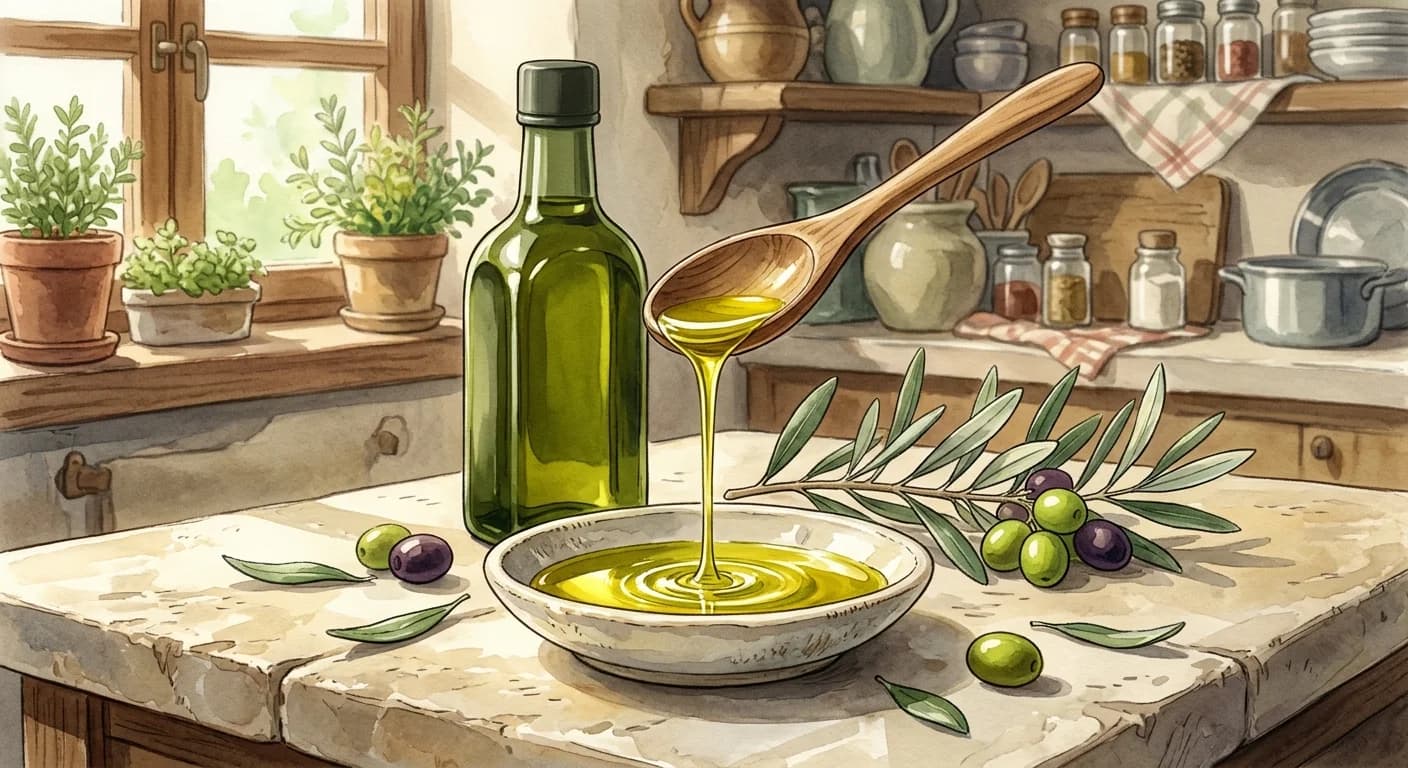
Olive oil is pressed from a fruit, and good olive oil tastes like one. Sesame, mustard and peanut oil come from seeds; olive oil comes from the flesh of the olive (Olea europaea), and a bottle of fresh extra virgin smells of cut grass and green tomato, turns a little bitter on the tongue, and catches at the back of the throat.
In the cuisines this site cooks most, it arrived late. Indian, Korean, Chinese, Japanese and Southeast Asian kitchens were built on ghee, mustard, sesame, coconut and peanut oil. Olive oil came in through trade and empire: the Portuguese in Goa, the Spanish in Mexico, Unani physicians in Delhi and Lucknow, and lately the import aisle of every supermarket.
Key facts at a glance:
- The grade on the label matters more than the brand. Extra virgin, virgin, plain "olive oil," light and pomace are different products, separated by how they are made and by acidity limits set by the International Olive Council.
- You can cook with extra virgin. Its smoke point runs from about 177 to 210°C (350 to 410°F), and its fat profile and polyphenols make it slow to break down under heat.
- The peppery sting has a name. It comes from oleocanthal, a compound found in fresh extra virgin oil and lost in refining.
- "Light" describes flavor and color. Light olive oil is refined and mild, with about the same calories as any other oil.
Flavor Profile
Origin
Eastern Mediterranean, Levant, Spain, Italy, Greece, Baja California, Sonora
Traditional Medicine Perspectives
Unani Tibb
Unani medicine grew out of Greek medicine through Arab and Persian physicians and came to the Indian subcontinent with them; it is still practised and officially recognized in India. It calls olive oil roghan-e-zaitoon and uses it mainly on the body: for massage (dalk), on stiff joints, on dry skin and scalp, and as a base oil for medicated preparations. Its standing is reinforced by Islamic tradition, since the Qur'an names the olive a blessed tree and a hadith recorded by al-Tirmidhi tells believers to eat the oil and anoint themselves with it.
Folk Practice
In many North Indian and Pakistani homes, warm olive oil is the standard choice for baby massage and for oiling hair before washing. Around the Mediterranean, a spoonful taken in the morning is a household habit for regularity, and a few drops of warm oil are used to soften ear wax. These are household traditions passed down in families, not medical advice.
Greek and Roman Medicine
Greek and Roman physicians used olive oil as the base for ointments and plasters, rubbed it into sore muscles, and applied it to dry or broken skin. Galen's cooling ointment of olive oil, beeswax and rose water, the ceratum refrigerans, is the direct ancestor of cold cream. Athletes oiled themselves before exercise and scraped the oil off afterward with a strigil.
Modern Scientific Research
About 73% of olive oil's fat is monounsaturated, mostly oleic acid, with about 14% saturated and 11% polyunsaturated. Every grade shares that profile. It is the basis of a qualified health claim the FDA allowed in 2004: limited and not conclusive evidence suggests that about 2 tablespoons (23 g) a day may reduce the risk of coronary heart disease, as long as the oil replaces saturated fat and doesn't add calories. "Qualified" means the agency judged the evidence suggestive, not settled.
What separates extra virgin from refined oil is the small fraction that refining strips out: polyphenols such as hydroxytyrosol and oleocanthal. A 2005 paper in Nature by Gary Beauchamp's team reported that oleocanthal blocks the same COX enzymes as ibuprofen, and that it causes the throat sting of fresh oil. The amounts in a normal diet are small, and a salad dressing is not a painkiller. The European Union allows a polyphenol claim only on oils with at least 5 mg of hydroxytyrosol and related compounds per 20 g, which refined oils don't reach.
The best-known trial is PREDIMED, which assigned older Spanish adults at high cardiovascular risk to a Mediterranean diet with extra virgin olive oil or nuts, or to a lower-fat control diet. The 2013 paper was retracted in 2018 after randomization problems surfaced at some sites, and a reanalysis was republished the same year. The olive oil group still had roughly 30% fewer major cardiovascular events, though Cochrane reviewers have said the trial's methodological problems call for caution. The fair reading: olive oil in place of butter or lard is a sound choice, and the bigger promises go further than the data.
Cultural History
Olives were domesticated in the eastern Mediterranean and the Levant thousands of years ago, and pressing them became one of the region's central industries. The oil lit lamps, softened skin, carried perfumes and medicines, and dressed food. The tree runs through Jewish, Christian and Islamic scripture, and the Qur'an calls it a blessed tree.
Spain carried olives to the Americas in the sixteenth century. Missionaries needed oil for sacraments as well as for cooking, and groves went in around mission sites in New Spain, including the Jesuit missions of Baja California, where an old olive tree still grows behind the mission at San Javier, outside Loreto. The crown did not want a rival to Spanish exports, though, and colonial decrees restricted olive planting and oil pressing in New Spain. Mexican cooking settled on lard and, later, vegetable oil. Olive oil stayed in dishes with plain Spanish roots, like pescado a la veracruzana, with its olives and capers, and the bacalao a la vizcaína of the Christmas table. Mexico's groves today are mostly in Baja California and Sonora, with small mills around Ensenada pressing Mexican oil.
In Asia the story is shorter. Portuguese Goa took olive oil into dishes like caldo verde. In North India, zaitoon ka tel was known for generations as a massage and hair oil before anyone fried onions in it. Japan's government planted trial groves in three prefectures in 1908, and only the trees on Shōdoshima, an island in the Seto Inland Sea, thrived; the island is still the center of Japanese olive growing. Korea and China took it up late in the twentieth century, mostly as an imported health product. The Chinese name, ganlan you, borrows the word for the Chinese olive (Canarium album), an unrelated native fruit.
Culinary Uses
In the cuisines this site covers, olive oil is mostly a substitute, and it works better in some dishes than others. A mild or refined olive oil fries onions for a curry or blooms cumin for a dal tadka without complaint; the flavor reads as clean rather than Mediterranean. Extra virgin is another matter. Its grassy bitterness fights with ghee-rich North Indian dishes and with the toasted-sesame finish of Korean namul, but it sits comfortably in Goan cooking, which already leans on vinegar, garlic and chili, and in cold dressed dishes like Korean muchim where a neutral oil is the usual choice.
Where olive oil is the native fat, it does everything. Spanish cooks fry potatoes for tortilla española in it and rub it onto bread with tomato for pan con tomate. Italian cooks warm garlic slowly in it for aglio e olio. Levantine kitchens pour it over hummus and labneh at the table, where its bitterness balances the richness underneath. In Mexico it carries the dishes with Spanish ancestry: the tomato, olive and caper sauce of pescado a la veracruzana, and the slow-cooked salt cod of bacalao a la vizcaína.
A practical kitchen keeps two bottles. Use a good extra virgin for finishing, dressing and gentle cooking, where you can taste it, and a cheaper olive oil or a neutral oil for everyday frying, where you can't.
Preparation Methods
Reading the label. The International Olive Council sets the grades, and free acidity is one of the main tests. Extra virgin is pressed mechanically, without heat or chemicals, must pass a tasting panel with no flavor defects, and has a free acidity of 0.8% or less. Virgin is made the same way but may have slight defects, up to 2.0%. Plain olive oil, sometimes sold as "pure," is refined olive oil blended with some virgin oil, up to 1.0%. Light or extra light is a marketing term for a similar refined blend, paler and milder, not a separate grade. Olive pomace oil is extracted with solvents from the pulp and pits left after pressing, then refined and blended, and it cannot legally be sold as plain olive oil. In India, pomace and refined olive oils are often sold specifically for everyday cooking.
Cooking with extra virgin. The North American Olive Oil Association puts its smoke point at about 177 to 210°C (350 to 410°F), depending on grade and freshness. That covers sautéing and most frying, which happens between 175 and 190°C. Oleic acid resists oxidation, and the polyphenols add protection: a 2018 Australian study, run by an olive-industry laboratory, heated ten oils and found extra virgin produced the fewest breakdown products, and that smoke point did not predict how an oil held up. Heat does cost flavor, though, since the fruity, peppery notes fade. For searing above 230°C, refined olive oil (smoke point about 242°C / 468°F) or a dedicated high-heat oil is the better tool.
Buying and storing. Look for a harvest date and dark glass or a tin, and finish an opened bottle within a few months. Keep it away from the stove. Fresh oil smells green; rancid oil smells like crayons or stale walnuts, and no cooking will hide it.
Traditional Dishes
- Caldo Verde
- Pescado a la Veracruzana
- Bacalao a la Vizcaína
- Tortilla Española
- Pan con Tomate
- Hummus
- Spaghetti Aglio e Olio
Comments
Share your thoughts on this ingredient.
Sign in to comment0 Comments