Goan · Indian Cuisine
Portuguese Kale Soup (Caldo Verde)
Goa's gentle potato and spinach soup — a Portuguese import softened with milk and local green
In Portugal, caldo verde (literally "green broth") is the national soup: potatoes, olive oil, and thinly ribboned collard greens (couve galega), with a coin of chouriço floating on top. It is farmhouse food, the kind of thing that requires almost nothing and rewards you with something deeply comforting.
The Goan version arrived via the Portuguese colonial presence that shaped Goa for four hundred years. Catholic Goan kitchens absorbed this soup and adapted it with characteristic ease: collard greens, not always available on the Konkan coast, gave way to spinach; a generous pour of milk came in at the end, softening the character from rustic to something almost velvety; and the chouriço was often left out, making the soup friendly to non-pork-eating guests at a mixed table.
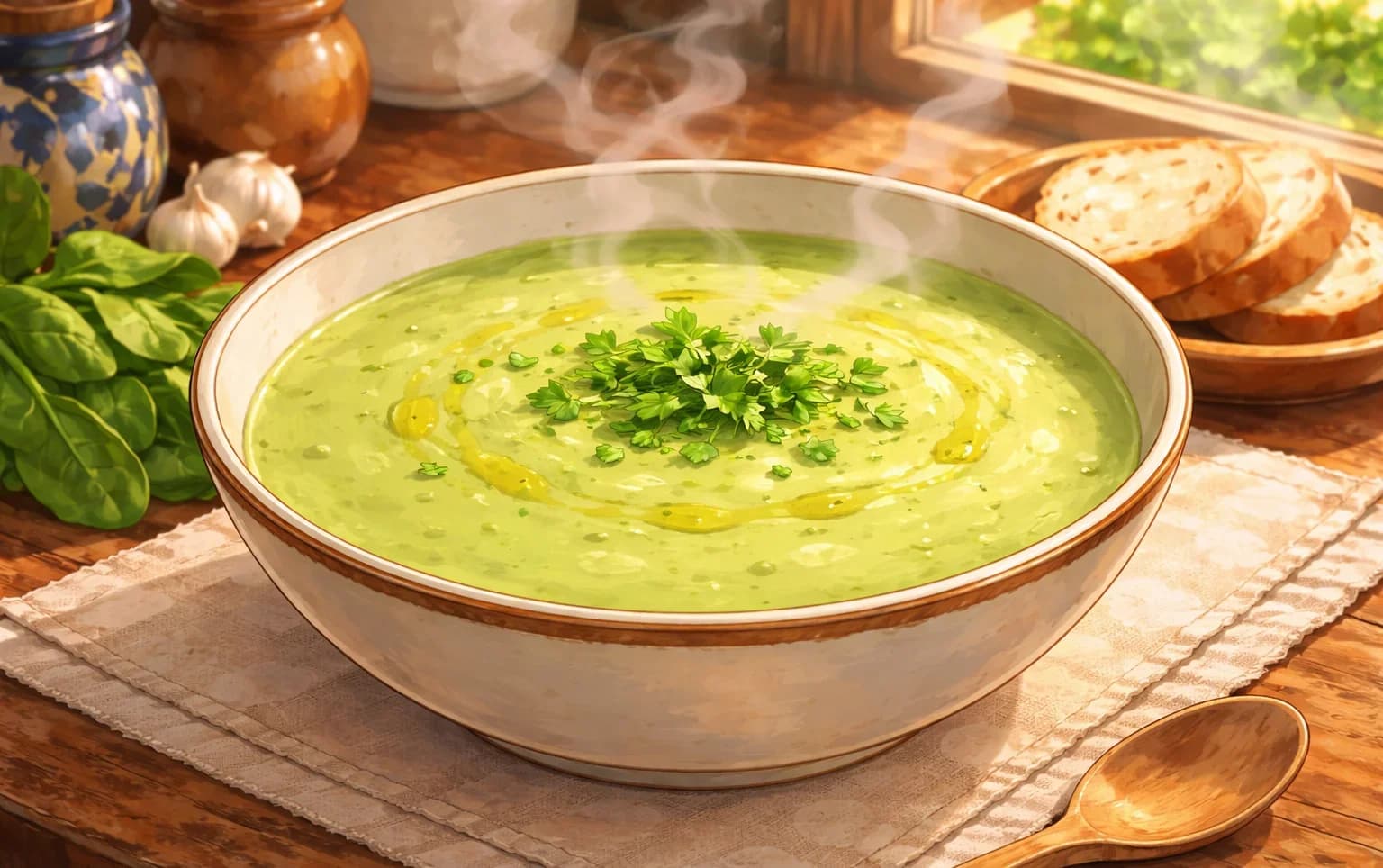
What results is simpler than the Portuguese original but not lesser. A quiet, restorative soup built on the classic duo of potato and onion, cooked in good chicken stock until tender, then mashed and returned to the pot with handfuls of spinach. The milk finish is crucial: it rounds the flavour and gives the soup a pale, jade-tinged colour that is distinctly its own.
This is a good-weather-or-bad soup. In Goa's monsoon months, when the rain falls in long grey curtains and the coast turns cool and damp, caldo verde appears on tables as a kind of remedy. It asks very little of the cook and asks even less of the eater. Just a bowl, a spoon, and a few minutes of quiet.
The only thing to watch: do not let the soup boil after the milk goes in. A rolling boil will cause the milk to separate and the texture to become grainy. Bring it to a gentle, quivering heat and serve immediately.
At a Glance
Yield
4 servings
Prep
10 minutes
Cook
25 minutes
Total
35 minutes
Difficulty
Easy
Ingredients
- ¾ lbpotatoes (about 2 potatoes), peeled and quartered
- 1 lbspinach leaves, washed (baby spinach or regular spinach)
- 2¾ ozonion (about 1 medium onion), finely chopped
- 1⅓ tbspneutral oil (or a mild olive oil if available)
- 3 cupgood chicken stock (or vegetable stock for a vegetarian version)
- ⅓ cupfull-fat milk
- —Salt to taste
Method
- 1
Sweat the onion (1 medium onion). Warm the oil in a medium heavy-bottomed pot over medium heat. Add the chopped onion and a pinch of salt, and cook gently, stirring occasionally, for 6–8 minutes until the onion is soft, translucent, and completely tender with no raw bite remaining. Do not allow it to colour; this soup should stay pale and clean-tasting.
- 2
Add stock and potatoes (300 g). Pour in the chicken stock and bring to a simmer. Add the quartered potatoes. Cook, partially covered, until the potatoes are completely tender, about 15 minutes. A knife should slide through a potato piece with no resistance.
- 3
Mash the potatoes. Remove the cooked potato pieces with a slotted spoon. Pass them through a potato ricer, or mash them thoroughly with a fork. You want a smooth mash with no large lumps. Return the mashed potato to the pot and stir to incorporate into the stock. The soup will thicken noticeably.
- 4
Add the spinach. Bring the thickened soup to a gentle simmer and add the spinach leaves (400 g). Stir and cook for 3–4 minutes, until the spinach is completely wilted and tender. The soup will turn a pale, muted green.
- 5
Finish with milk. Reduce the heat to very low. Pour in the milk and stir gently. Allow the soup to come just to the point of steaming, not boiling. Season with salt to taste. Serve immediately.
Key Ingredient Benefits
Spinach is dense with iron, folate, magnesium, and vitamins A and K. Its iron is non-haem iron (the plant form), which is less readily absorbed than the haem iron in meat. Consuming spinach alongside a source of vitamin C (there's a small amount in the onion and potato) improves absorption. Traditional medicine across South Asia has long used spinach as a blood-building and cooling food.
Potatoes are a legitimate source of potassium, vitamin C, and resistant starch (particularly when cooked and cooled). They are often maligned unfairly. The issue is generally what is added to them, not the potato itself. As a thickening agent in this soup, they replace flour entirely, keeping the dish light and naturally gluten-free.
Chicken stock made from bones contributes gelatin and minerals. The depth it provides here is significant: the same soup made with water is noticeably flatter. If using store-bought stock, choose a low-sodium variety and adjust salt at the end.
Why This Works
Using mashed rather than puréed potato is important. A blender introduces too much starch agitation and makes a gluey, gummy soup. Mashing keeps the potato starch intact enough to thicken without becoming stodgy, and the texture stays slightly uneven. Not fully smooth, which would feel heavy.
The milk added at the end is both a textural and flavour decision. Full-fat milk contributes just enough fat to round the stock's savouriness and soften the spinach's slightly grassy edge. It also cools the soup slightly, making the temperature at serving more pleasant than a stock-only finish would be.
Cooking the onion slowly and thoroughly before adding liquid ensures the sweetness of the onion is fully developed and no sharp, raw allium taste lingers in the background.
Substitutions & Variations
- Greens: The Portuguese original uses couve galega (collard greens or cavolo nero), thinly ribboned. This makes a more textured, earthier soup. Kale is a good substitute. If using tougher greens, increase cooking time to 8–10 minutes.
- Stock: Vegetable stock makes this fully vegetarian without significant loss of flavour if it is a well-made stock. Water is a last resort and should be supplemented with a parmesan rind or a piece of dried mushroom for umami.
- Milk: Coconut milk (thin extract) works here in the Goan context and gives the soup a slightly different character: subtly sweet and aromatic. Use 50 ml coconut milk to 50 ml water to keep the flavour from becoming too dominant.
- Chouriço: To include the traditional Portuguese element, add two thin slices of Goan chouriço (or Portuguese linguiça) to the pan when sweating the onions. Remove them before adding stock and float a fried slice on each finished bowl.
Serving Suggestions
Serve in deep, warmed bowls. The soup cools quickly and tastes best very hot. Goan pão (soft bread rolls) is the traditional accompaniment; any crusty white bread serves the same purpose. A thin thread of good olive oil drizzled over each bowl at the table adds a Portuguese touch.
The soup is light enough to serve as a starter before a richer Goan main, or substantial enough (with good bread) for a simple lunch. In Goan households it is often served as a corrective meal: after a day of rich festival food, caldo verde offers a quiet, uncomplicated reprieve.
Storage & Reheating
The soup stores in the refrigerator for up to 2 days. The potato thickening will cause it to set solid when cold; this is normal. Reheat slowly over low heat, stirring in a splash of stock or water to loosen it to the desired consistency. Do not boil. Re-season with salt before serving, as the flavour will have mellowed during storage.
The soup does not freeze well; the milk and potato texture suffers on thawing.
Cultural Notes
Caldo verde ("green broth") is the Portuguese soup of finely shredded collard greens or kale cooked in a potato-and-onion broth with sliced chouriço (Portuguese-style cured pork sausage) added near the end, finished with a drizzle of olive oil. The dish is one of the most strongly Portuguese of all Portuguese soups and traveled to Goa during the Portuguese colonial era, where it was adopted into the Goan Christian cooking tradition as a Sunday lunch or special-occasion preparation. The dish appears at Goan Catholic homes, at the small Indo-Portuguese restaurants of Panjim and Margao, and at the broader Goan diaspora restaurants in Mumbai, Bangalore, and beyond.
The dish's Portuguese identity is foundational and worth describing. Caldo verde originated in the Minho region of northern Portugal as a peasant soup made from the most basic available ingredients: cabbage or collard greens (the cool-weather hardy vegetables of the region), potatoes (introduced to Europe from the New World in the sixteenth century), onions, and a small amount of cured pork sausage for flavor and protein. The soup became one of the national dishes of Portugal and is now treated as a Portuguese culinary identity marker, served at restaurants worldwide that present Portuguese cuisine.
The Goan adaptation makes small modifications. The Portuguese caldo verde uses the specific couve galega (Portuguese collard, a kind of kale with thick blue-green leaves), which Goan cooks substitute with locally available greens (Indian spinach, amaranth leaves, or other dark leafy greens). The Portuguese chouriço is replaced with the Goan version called Goan chouriço, a pork sausage cured with kashmiri red chili, palm vinegar, and Indian spices that gives the Goan caldo verde a distinctly different flavor profile than the Portuguese original. The potato-and-onion base is the same in both traditions. The technique simmers the potatoes and onions in water until tender, then purées them with an immersion blender to form a smooth thick base, then adds the finely shredded greens and the sliced chouriço for the final ten minutes of simmering. The dish is served hot with a drizzle of olive oil and a few drops of vinegar at the table.
Nutrition Facts
Calories: 126kcal (6%)|Total Carbohydrates: 20g (7%)|Protein: 5g (10%)|Total Fat: 4g (5%)|Saturated Fat: 0.9g (5%)|Cholesterol: 4mg (1%)|Sodium: 289mg (13%)|Dietary Fiber: 4.1g (15%)|Total Sugars: 3.1g
You Might Also Like

Ratings & Comments
Ratings & Comments
Ratings
Share your thoughts on this recipe.
Sign in to rate and comment