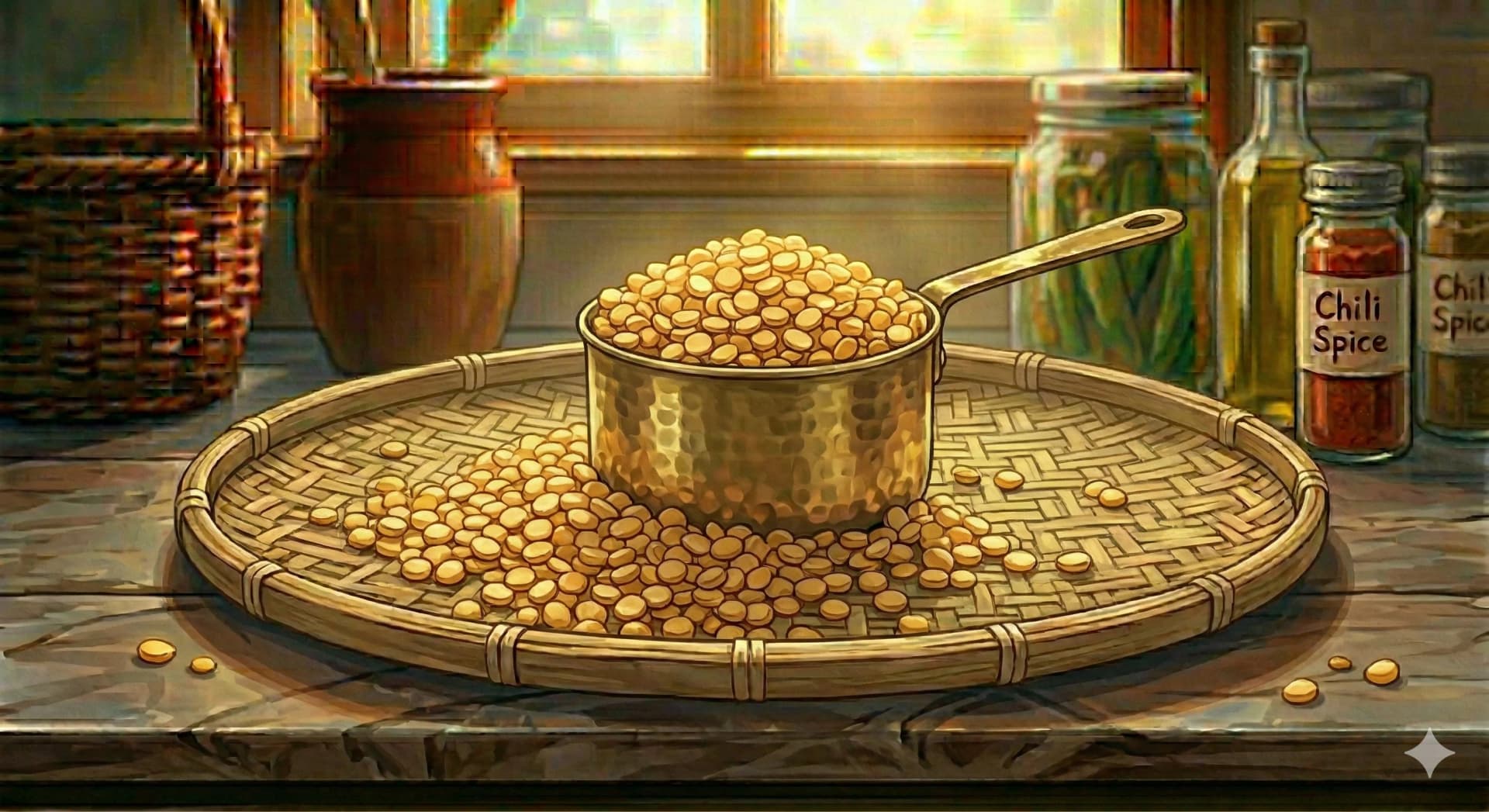
Split Chickpeas
Also known as: Kabuli Chana Dal, Split Kabuli Chana, Split White Chickpeas
Split chickpeas are the kabuli chickpea, the large, pale cream-colored variety familiar from hummus and Middle Eastern cooking, split along their natural seam and sold without the husk. The result is a large, ivory-yellow split pea with a mild, slightly nutty flavor and a creamy texture when cooked.
They are not the same as chana dal, which is the more common split chickpea in Indian cooking and deserves clear distinction: chana dal is split desi chickpeas, smaller and darker, with a more assertive, earthy flavor. Split kabuli chana is split from the large, mild kabuli variety and is noticeably larger and more delicate in flavor.
The distinction matters when cooking from specific recipes. Chana dal is the dal of dal baati churma and Bengali chana dal preparations, with its characteristic sweetness and firm texture. Split kabuli chana is milder, cooks slightly faster due to the thinner skin of the kabuli variety, and produces a creamier, less textured result.
In practice, many cooks use the two interchangeably in mixed dal preparations where the individual dal's character will be diluted by the other components anyway, but in preparations where the dal's specific flavor is central, the difference is perceptible.
Key facts at a glance:
- Split kabuli chickpeas — larger, milder, and creamier than chana dal (split desi chickpeas)
- Not the same as chana dal — important distinction for recipe accuracy
- Approximately 20g protein per 100g dry — with significant fiber and folate
- Introduced via Central Asia and Afghanistan — arrived later than the desi variety in South Asia
- Best in mixed dal preparations — adds body and substance without dominating
Flavor Profile
Origin
Middle East, Indian subcontinent
Traditional Medicine Perspectives
Ayurveda:
Split kabuli chana shares the general properties of chickpeas in Ayurvedic classification: moderately Vata-aggravating, balancing for Pitta and Kapha. The husking and splitting process removes some of the fiber that makes whole chickpeas harder to digest, making split kabuli chana somewhat lighter than the whole form. Cooking with cumin, asafoetida, and ginger is the standard recommendation. It is considered less nourishing and less therapeutically significant than chana dal (desi variety) in traditional Ayurvedic texts.
Modern Scientific Research
Nutritionally, split kabuli chana is broadly similar to other chickpea preparations: high in protein (approximately 20 grams per 100g dry), significant fiber (though lower than whole chickpeas due to husk removal), good levels of folate and iron, and a low to moderate glycemic index.
The milder flavor and slightly faster cooking time compared to chana dal do not represent meaningful nutritional differences. For culinary purposes, the choice between split kabuli chana and chana dal is a matter of flavor preference and recipe tradition rather than nutritional distinction.
Cultural History
The split kabuli chickpea is less common in Indian cooking than the desi-derived chana dal, reflecting the relative newness of the kabuli variety in South Asia.
Kabuli chickpeas are believed to have been introduced to the Indian subcontinent from Central Asia and Afghanistan during the medieval period, arriving later than the desi variety. Their larger size and milder flavor made them popular for whole-chickpea preparations like chole and for Middle Eastern dishes like hummus, but they are less commonly split and sold as a dal ingredient in South Asian markets.
In the Middle East and North Africa, split chickpeas appear in certain traditional preparations, particularly as a thickener for stews and as an ingredient in mixed legume dishes. Their mild flavor makes them useful as a background ingredient that adds protein and body without dominating the dish.
Culinary Uses
Split kabuli chana is most useful in mixed dal preparations, where its mild, creamy character adds body and substance without dominating. In panchmel dal or similar mixed preparations, it cooks at roughly the same rate as chana dal and provides a gentle counterpoint to more assertively flavored dals.
It can also be used as a soup thickener in the same way that red lentils are used, though it does not dissolve as completely and will leave small intact pieces.
In some regional Indian sweets, split chickpeas (both desi and kabuli) are cooked with jaggery or sugar and ghee as a filling for stuffed breads or as a halwa-style preparation. The mildness of split kabuli chana makes it more adaptable to sweet preparations than chana dal.
Preparation Methods
Soaking: Soak in cold water for 1 to 2 hours before cooking. Unlike chana dal, split kabuli chana is large enough that soaking makes a meaningful difference in cooking evenness.
Pressure cooker: 1 cup soaked split kabuli chana to 2.5 cups water. 2 to 3 whistles on stovetop (or 12 to 15 minutes high pressure with natural release). The dal should be soft throughout but pieces still mostly intact.
For mixed dals: Add split kabuli chana with other dals of similar cooking time (chana dal, toor dal). If combining with quick-cooking dals like masoor or moong, add those separately and combine after cooking.
Traditional Dishes
- Panchmel dal (as one component)
- Mixed dal preparations
- Dal baati (as a substitute for or addition to chana dal)
- Sweet halwa-style preparation with jaggery
- Chickpea and vegetable stew (Middle Eastern style)
Comments
Share your thoughts on this ingredient.
Sign in to comment0 Comments