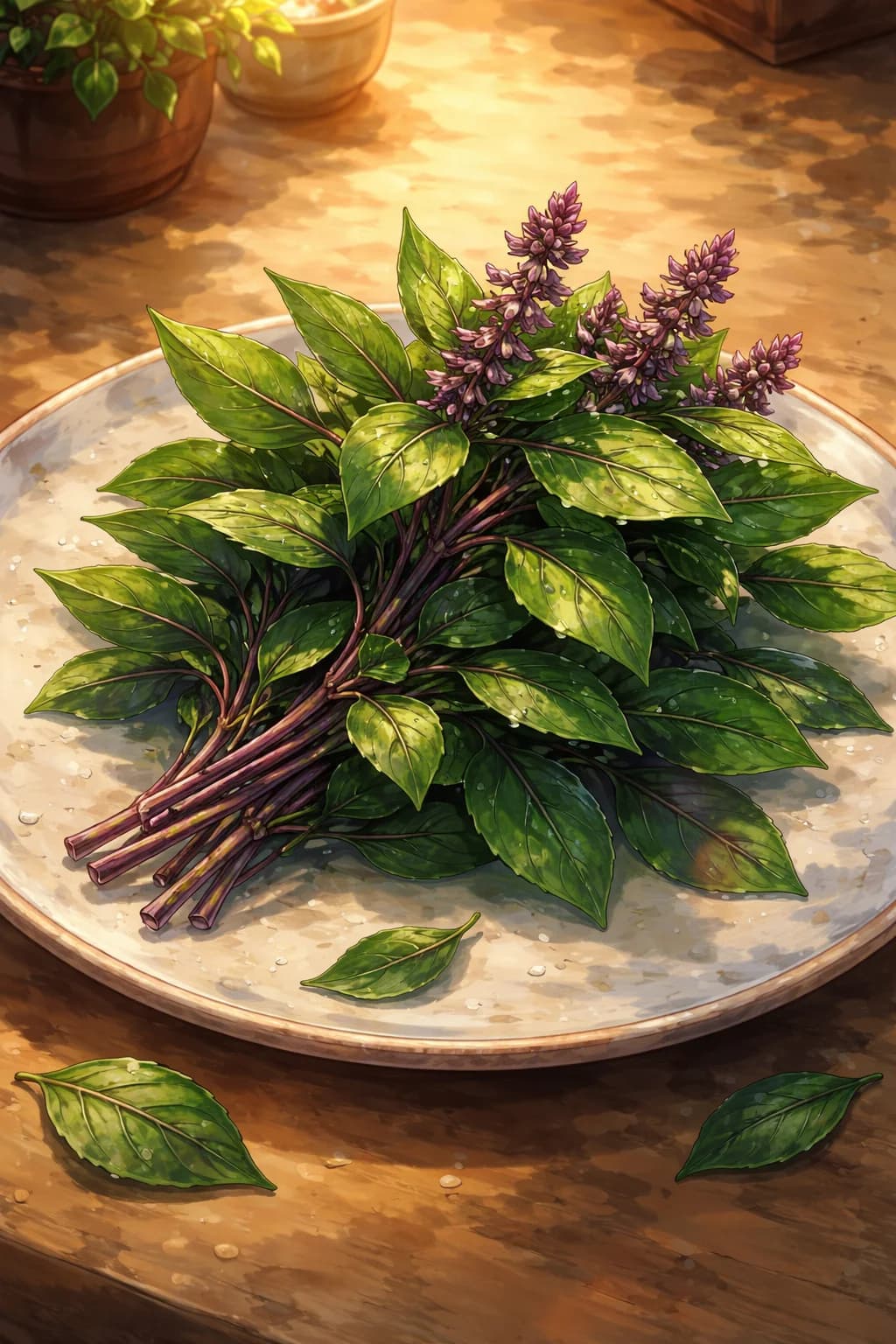
Thai Basil
Also known as: Horapha, Húng Quế, Bai Horapha, Ocimum basilicum var. thyrsiflora, Asian Basil, Rau Quế
Thai basil is a different creature entirely from the sweet basil you find in Italian cooking. Tear a leaf and the aroma hits with a sharp anise-licorice punch layered over a peppery, slightly spicy base — nothing like the rounded, clove-scented softness of Genovese basil.
The plant itself is visually distinctive: sturdy purple stems, narrow pointed leaves with a glossy sheen, and tight purple flower clusters. It is sturdier than sweet basil in every way — the leaves are tougher, the stems are woodier, and crucially, it holds up to high heat without wilting into a sad, blackened mess. This heat tolerance is not incidental. It is why Thai basil works in stir-fries and curries where Italian basil would disintegrate.
The flavor is defined by estragole (methyl chavicol), the same compound found in tarragon and anise. But in Thai basil, it is backed by a complex supporting cast of terpenes that give the herb its characteristic brightness and spice.
Key facts at a glance:
- Ocimum basilicum var. thyrsiflora — a distinct variety of basil, not a substitute for Italian sweet basil
- Anise-licorice dominant flavor — with peppery, slightly spicy undertones
- Purple stems and flower clusters — visually distinctive from sweet basil
- Heat-stable — holds its structure and flavor in high-heat cooking
- Used in 13 recipes on the site — from pad kra pao to pho
Flavor Profile
Origin
Southeast Asia, Thailand, Vietnam, Cambodia, Laos, Indonesia, India
Traditional Medicine Perspectives
Ayurveda
Basil varieties are revered in Ayurvedic tradition, though Tulsi (holy basil) receives the most attention. Thai basil shares some classification with other Ocimum species. It is considered warming in energy, pungent and bitter in taste, and is associated with Kapha and Vata balancing. Basil is traditionally used to support respiratory health and digestion in Ayurvedic practice.
Thai Traditional Medicine
In Thai traditional medicine, basil varieties including horapha are considered warming and carminative. They are used in traditional preparations intended to support digestion, ease nausea, and promote appetite. The essential oil is used in traditional inhalation remedies for respiratory congestion. The seeds of Thai basil are sometimes soaked in water (where they develop a gelatinous coating) and consumed as a cooling drink.
Modern Scientific Research
Thai basil's primary aromatic compound is estragole (methyl chavicol), which constitutes 50-80% of the essential oil depending on growing conditions. Estragole is also found in tarragon, fennel, and anise, which explains the flavor overlap between these botanically unrelated plants.
The essential oil also contains significant amounts of linalool, eugenol, and 1,8-cineole, which contribute the peppery, spicy, and fresh notes respectively. Research published in the Journal of Agricultural and Food Chemistry has characterized the volatile profile and shown that the balance of these compounds shifts significantly with growing conditions, harvest timing, and cultivar selection.
Studies on Ocimum basilicum varieties have demonstrated antimicrobial and antioxidant properties in laboratory settings. The rosmarinic acid content, a polyphenol found in many Lamiaceae family herbs, has shown anti-inflammatory activity in cell culture studies. However, these findings are from concentrated extracts and their applicability to dietary herb consumption requires further investigation.
Cultural History
Thai basil (horapha) is one of the three basils used in Thai cooking, each with a distinct role. Horapha (Thai basil) brings the anise note and is used in curries and stir-fries. Holy basil (krapao) is hotter and more peppery, essential for pad kra pao. Lemon basil (maenglak) is lighter and citrusy, used in soups and salads. Confusing these three is one of the most common mistakes in Thai cooking outside Thailand.
In Thailand, Thai basil's role is structural. A green curry without it is incomplete. The leaves are added in generous handfuls during the final moments of cooking, where the heat draws out the essential oils without destroying the fresh quality. In pad kra pao, the national stir-fry, the correct basil is actually holy basil (krapao), not Thai basil — but Thai basil is the variety most readily available outside Southeast Asia, and so it has become the common substitute.
In Vietnamese cooking, Thai basil (hung que or rau que) is one of the essential herbs in the fresh herb plate (dia rau song) that accompanies pho, bun, and many other dishes. It is eaten raw, stuffed into rice paper rolls, and added to soups at the table. The Vietnamese use of Thai basil as a raw, finishing herb contrasts with the Thai use in cooked dishes — both approaches are valid expressions of the herb's versatility.
Culinary Uses
In Thai green curry and red curry, Thai basil is added in generous handfuls during the last minutes of cooking. The residual heat is enough to wilt the leaves slightly and release the essential oils into the coconut milk broth without destroying the fresh, bright quality. A good Thai curry should have visible whole basil leaves throughout — they are part of the dish, not just a garnish.
Pad kra pao — the quintessential Thai stir-fry of meat with chilies and basil — technically calls for holy basil (krapao), but Thai basil is the most common substitute outside Thailand. The basil is added to the screaming-hot wok at the very end, stirred through just until wilted. The heat of the wok concentrates the anise flavor and melds it with the garlic, chili, and oyster sauce.
In Vietnamese pho, Thai basil is served raw on the side herb plate alongside bean sprouts, lime wedges, and sliced chilies. Diners tear leaves into their steaming bowl, where the heat of the broth partially wilts them and releases their fragrance. The same raw application appears with bun bo Hue, banh mi, and fresh spring rolls.
Thai basil also works beautifully in non-traditional applications. Its anise character pairs well with fruit-based cocktails and desserts. It can be blended into Southeast Asian-style pestos (substituting for Italian basil) or infused into simple syrups. The flowers are edible and make a striking purple garnish.
Preparation Methods
Always add Thai basil at the end of cooking. Even though it is more heat-stable than Italian basil, extended cooking will dull its brightness and turn the leaves dark. The goal is to wilt, not to cook through. In stir-fries, add the leaves after you kill the heat and toss quickly. In curries, stir them in just before serving.
For raw use (pho, herb plates, spring rolls), pick leaves from the stems and serve whole or torn. The stems are edible but woody and are usually discarded in table service. Wash and dry gently — bruised leaves blacken quickly.
To store fresh Thai basil, do not refrigerate if you can avoid it — cold temperatures accelerate blackening. Stand the bunch in a glass of water on the counter, like cut flowers, loosely covered with a plastic bag. It will keep 3-5 days this way. If you must refrigerate, wrap loosely in damp paper towels and use within 2 days.
Thai basil does not dry well. The volatile oils that define its character evaporate during drying, leaving behind a flat, hay-like herb that bears little resemblance to the fresh product. For preservation, the leaves can be frozen (blanch briefly first) or blended into oil or paste and frozen in ice cube trays.
Comments
Share your thoughts on this ingredient.
Sign in to comment0 Comments