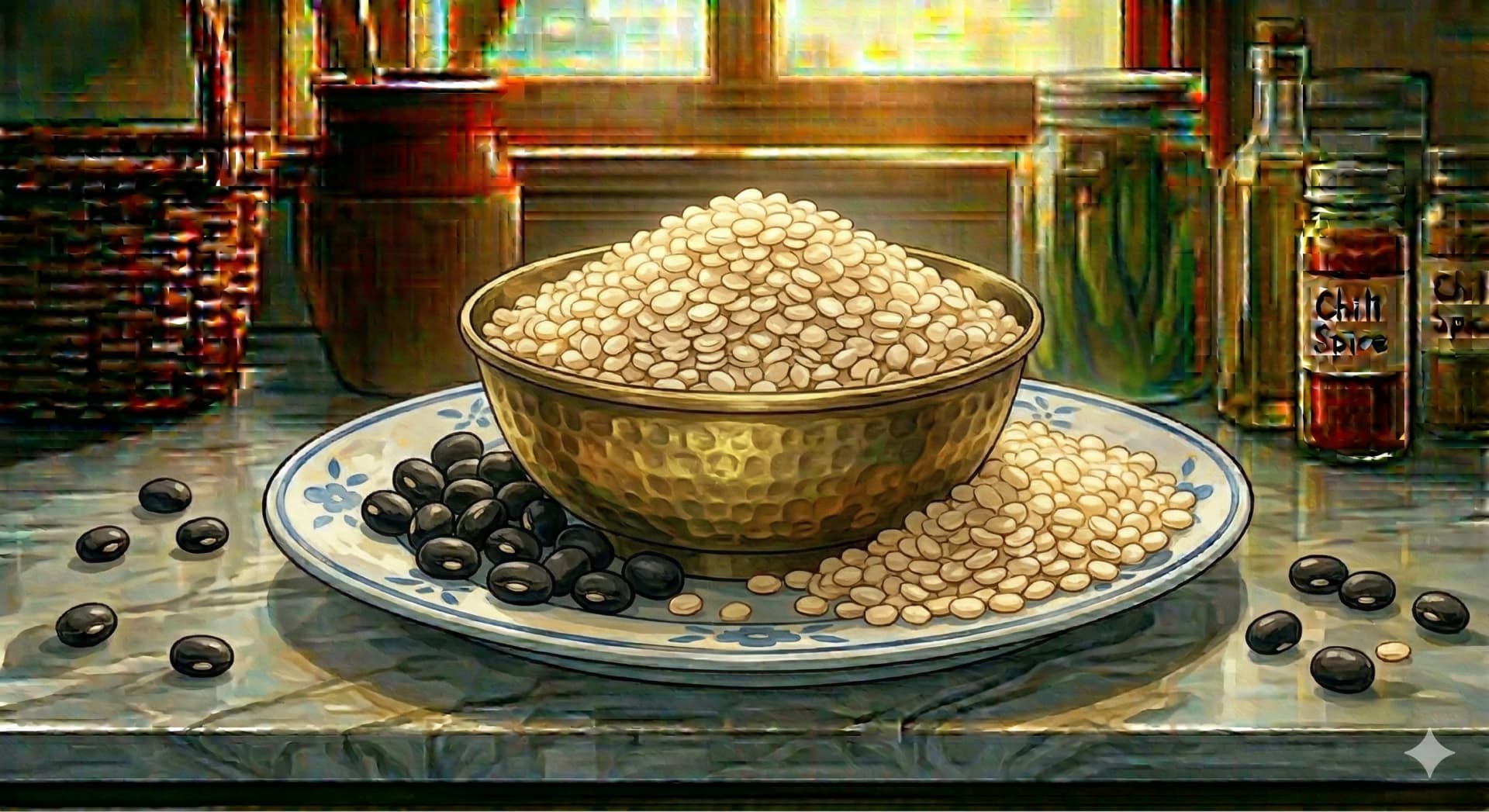
Urad Dal
Also known as: Black Gram, Vigna mungo, White Lentil, Kali Dal, Maa Ki Dal
Urad dal is technically one ingredient, but in practice it functions as three distinct ingredients depending on how it is processed, and understanding the differences is essential to cooking with it correctly.
In its whole form, with the black skin intact, it is sabut urad or whole black gram: the dal of maa ki dal and the overnight-cooked dal that becomes dal makhani. Split with the black skin on, it is chilka urad: less common, used in some thick dal preparations. Split and skinned, revealing the white interior, it is dhuli urad or white urad: the lentil of idli and dosa batter, medu vada, and many South Indian preparations. Each form behaves differently and cannot be freely substituted for the others.
The defining characteristic of urad dal across all its forms is its remarkably high mucilage content. When soaked and ground, urad dal releases a thick, viscous, sticky substance that gives idli batter its particular binding quality and produces the characteristic crispness of a well-made dosa.
When slow-cooked whole, this mucilage breaks down over many hours into an extraordinarily silky, almost unctuous texture. Dal makhani, made from whole black gram cooked for 8 or more hours, achieves a richness and creaminess that no other legume can replicate, even before the butter and cream are added.
The protein content of urad dal is among the highest of any dal, approximately 25 grams per 100g dry weight, and it is particularly rich in the amino acid lysine, which makes it an excellent complement to rice (which is limiting in lysine).
Key facts at a glance:
- Three distinct forms — whole (sabut urad), split with skin (chilka), and split skinned (dhuli)
- Remarkably high mucilage content — gives idli batter its binding quality and dosa its crispness
- 25g protein per 100g dry weight — among the highest of any dal, rich in lysine
- Dal makhani requires 8+ hours of cooking — the extended time releases starches and mucilage
- Essential for idli and dosa batter — provides the microorganisms that drive fermentation
- Cultivated since at least 1500 BCE — referenced in the Charaka Samhita
Flavor Profile
Origin
Indian subcontinent
Traditional Medicine Perspectives
Ayurveda:
Urad dal is considered one of the most Vata-pacifying foods in the Ayurvedic system. Its heavy, unctuous (snigdha) quality is precisely what makes it grounding and nourishing for Vata-dominant constitutions. It is recommended for building strength, supporting the nervous system, and nourishing reproductive tissues (shukra dhatu). For this reason, it appears in many rejuvenation preparations (rasayanas). However, it is considered very heavy and is not recommended for those with weak digestive fire (agni), active infections, or Kapha imbalance. It is one of the few foods recommended for athletes and those recovering from debility.
Traditional Chinese Medicine:
Black gram is classified as sweet and warm, tonifying to the Kidney Yang and Spleen. It is used traditionally to address fatigue, lower back weakness, and deficient Kidney energy. The warming quality aligns with its Ayurvedic classification as a Vata-pacifying food.
Modern Scientific Research
The fermentation of urad dal in idli and dosa batter has been the subject of decades of nutritional research. Fermentation increases the bioavailability of minerals by breaking down phytic acid, which binds iron, zinc, and calcium in unfermented legumes. A 2010 study by Ghosh and Chattopadhyay in the Journal of Food Science and Technology tracked these changes through standard idli batter fermentation and documented a substantial drop in phytate alongside rising B-vitamin content as the lactic acid bacteria multiplied.
The mucilage in urad dal is primarily composed of arabinoxylan polysaccharides with prebiotic properties. These fibers resist digestion and reach the colon largely intact, where they feed beneficial Bifidobacterium and other gut bacteria. This combination of pre-digested protein, increased mineral availability, and prebiotic fiber is one reason fermented urad-and-rice dishes have been the breakfast staple of South India for as long as they have been recorded.
Cultural History
Urad dal has been cultivated in India since at least 1500 BCE and is referenced in Charaka Samhita, one of the foundational texts of Ayurvedic medicine, as both a food and a medicinal plant.
In South India, its role in fermented foods goes back centuries. Idli, the steamed fermented rice cake that is the breakfast food of South India, is made from a batter of urad dal and rice that is allowed to ferment overnight. The chemistry of this fermentation is worth understanding: the urad dal provides the microorganisms (primarily Leuconostoc mesenteroides and Enterococcus faecalis) and the proteins that support fermentation; the rice provides the substrate. The result is a batter that doubles in volume, develops a pleasantly sour flavor, and produces light, porous, easily digestible cakes.
In the Punjab, whole black gram cooked slowly with butter and cream became dal makhani, the dish that arguably best represents the richness of the Punjabi culinary tradition. The dish is associated with the Moti Mahal restaurant in Delhi, where Kundan Lal Gujral is credited with codifying and popularizing it after Partition, but whole black gram cooked with aromatics was a Punjabi preparation long before the restaurant version crystallized it. The overnight slow cook, traditionally done in a tandoor's residual heat, is what transforms the dal from merely good to extraordinary.
The cultural weight of urad dal in South India cannot be overstated. Medu vada, the savory fried doughnut made from ground urad dal, is a ritual breakfast food and a temple offering. Papad (poppadum), the thin crisp wafer ubiquitous across Indian meals, is most commonly made from urad dal flour. The dal is woven into the ceremonial, everyday, and celebratory food of the subcontinent in ways few other single ingredients achieve.
Culinary Uses
For dal makhani, whole black gram (sabut urad) must be soaked overnight and then cooked for a very long time: 8 hours minimum on a very low flame, or 30 to 45 minutes in a pressure cooker followed by 1 to 2 hours of stovetop simmering with butter and cream.
The extended cooking is non-negotiable. The dal needs this time to release its starches and mucilage into the cooking liquid, building the sauce from within. Restaurant versions are often cooked in large batches over many hours. Kidney beans (rajma) are sometimes added in small amounts (25 to 30 percent of the dal volume) for body and color.
For idli and dosa batter, white urad dal (dhuli urad) is soaked for 4 to 6 hours, then ground to a very fine, aerated paste using a wet grinder or powerful blender. Separately, idli rice or parboiled rice is soaked and ground. The two are combined and left to ferment at room temperature (25 to 28 degrees Celsius is ideal) for 8 to 14 hours until the batter has risen noticeably and smells pleasantly sour. Cold weather slows fermentation significantly; a slightly warm oven (with the light on) helps.
Preparation Methods
For dal makhani (whole black gram): Soak overnight in ample cold water. Drain. Pressure cook with fresh water, salt, and a halved tomato for 20 to 25 minutes on high pressure. The dal should be very soft.
Transfer to a heavy-bottomed pot with butter, cream, tomato puree, and ginger-garlic paste. Simmer on the lowest possible flame for at least 1 hour, stirring occasionally. The final dal should be thick, almost creamy, with no separation between the liquid and the dal.
For idli/dosa batter: Soak 1 part white urad dal and 3 to 4 parts idli rice (or parboiled rice) separately for 4 to 6 hours. Grind the urad first until completely smooth and aerated, adding cold water gradually. Grind the rice to a slightly coarser texture. Combine both with 1 teaspoon salt and a small amount of poha (flattened rice) soaked in the rice water for extra fermentation support. Ferment 8 to 12 hours.
For medu vada: Soak white urad dal for 3 to 4 hours. Grind with minimal water to a thick, fluffy paste. Add salt, minced ginger, green chili, and curry leaves. Shape with wet hands into rings and deep-fry at 175 degrees Celsius until golden.
Traditional Dishes
- Dal makhani
- Maa ki dal (whole black gram overnight dal)
- Idli
- Dosa (plain
- masala
- set)
- Medu vada
- Urad dal papad
- Urad dal khichdi
- Punjabi urad dal tadka
- Urad dal halwa
- Iyer-style paruppu (South Indian urad preparations)
Comments
Share your thoughts on this ingredient.
Sign in to comment0 Comments