Ayurveda · Wellness
Ajwain Water (Digestive Infusion)
The North Indian home remedy for indigestion, bloating, and colic
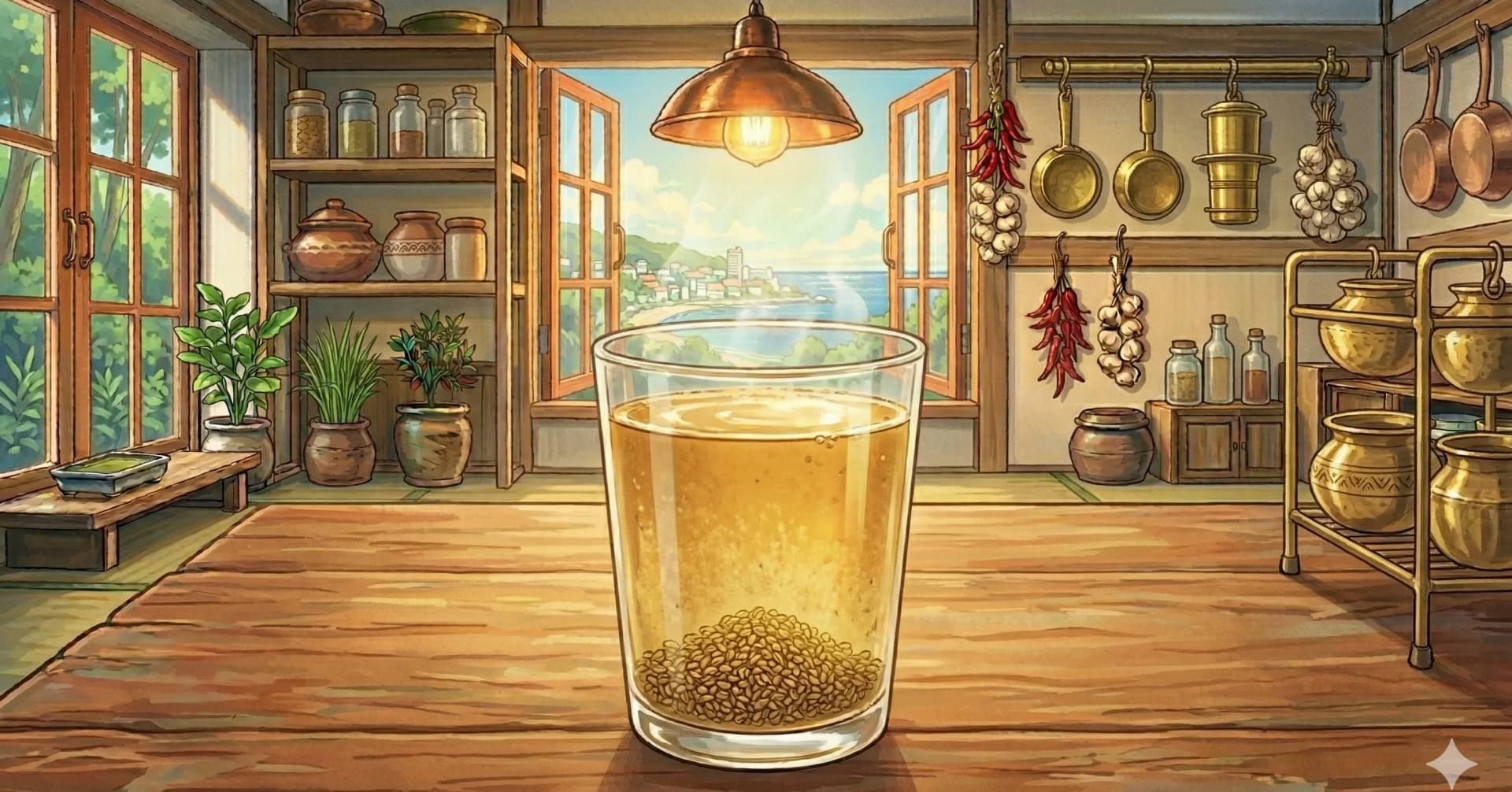
Somewhere between a kitchen remedy and a ritual of care, ajwain water is one of those preparations that crosses the line between food and medicine without announcement. In North Indian and Pakistani households, it has been made the same way for generations: a small spoonful of carom seeds dry-roasted until fragrant, steeped in hot water, strained, and drunk warm. Mothers make it for infants with colic. Grandmothers press it on anyone who has overeaten at a wedding. It is the quiet, practical response to a stomach that has turned difficult.
The flavor is unlike most herbal infusions. Ajwain water is sharp and camphorous, with the thyme-adjacent punch that makes carom seeds so distinctive. The dry roasting step is not optional — it rounds out the raw medicinal edge and brings a slightly nuttier, warmer quality to the steep. Without it, the infusion tastes more austere, almost clinical. With it, there is enough complexity that drinking it feels intentional rather than corrective.
This recipe scales easily. For a larger batch, multiply the seeds and water proportionally and strain into a thermos. It keeps for a few hours and can be sipped throughout the day after meals or at the first sign of bloating or cramping.
At a Glance
Yield
1–2 servings
Prep
1 minute
Cook
6 minutes
Total
7 minutes
Difficulty
Easy
Ingredients
- 1 tspwhole carom seeds (ajwain)
- 2 cupswater
- 1small pinch rock salt (kala namak or sendha namak), optional
- 1 tspraw honey, added after cooling, optional
Method
- 1
Place a small saucepan or skillet over medium heat. Add the carom seeds (1 tsp) and dry-roast, stirring constantly, for about 60 seconds — until the seeds darken slightly and release a warm, thyme-like fragrance. They are ready when the raw, sharp edge softens and the aroma becomes fuller and nuttier. Do not walk away; they can scorch quickly.
- 2
Transfer the toasted seeds immediately to a small saucepan. Add the water (2 cups) and bring to a boil over medium-high heat.
- 3
Once boiling, reduce to a low simmer and cook for 4 to 5 minutes. The water will take on a faint golden tinge and smell distinctly of thymol — earthy, aromatic, herbal.
- 4
Strain through a fine mesh strainer into a cup or small teapot, pressing the seeds lightly against the strainer to extract all the liquid.
- 5
Add a pinch of rock salt if using. Let cool for a minute or two before stirring in honey if desired — adding honey to very hot liquid destroys some of its beneficial compounds, so let the temperature drop first.
- 6
Drink warm, ideally within 30 minutes of a heavy meal or when digestive discomfort begins.
Key Ingredient Benefits
Carom seeds (ajwain): In Ayurvedic medicine, ajwain is classified as deepana (kindling digestive fire) and pachana (aiding digestion of unprocessed matter). It is considered among the fastest-acting of the digestive spices. Research on Trachyspermum ammi extracts has found significant antispasmodic effects on smooth muscle in the gastrointestinal tract — a mechanism that would explain its traditional use for cramping and colic. Thymol, the primary active compound, also shows documented antimicrobial activity against a broad range of bacteria and fungi.
Rock salt: Optional but traditional. Kala namak (black salt), with its sulphurous, mineral character, is the most commonly used salt in Ayurvedic digestive preparations. Sendha namak (rock salt) is the common substitute. Either can be used; neither is essential to the core effect of the infusion.
Honey: Added only after the infusion cools slightly. In Ayurvedic practice, honey is not heated — it is believed to become inert or even harmful at high temperatures. Modern research has confirmed that heat destroys many of the antimicrobial and enzymatic compounds that give raw honey its activity, so the traditional caution is practically sound.
Why This Works
The dry roasting step is the functional heart of this recipe. Carom seeds contain thymol as a major volatile constituent, and heat activates the release of these aromatic oils, making them more bioavailable in the water. Roasting also breaks down some of the harsher raw compounds, which is why the infusion made with toasted seeds tastes noticeably warmer and rounder than one made with raw seeds steeped directly.
Hot water extraction is the right method here. The active compounds in carom seeds — thymol, gamma-terpinene, beta-pinene — are volatile oils that extract readily into hot liquid. A cold steep would yield very little of the functional character of the seed.
Rock salt (particularly kala namak) is added in some traditional preparations and is understood in Ayurvedic terms to stimulate digestive secretions. Modern research confirms that sodium chloride at low concentrations can gently stimulate gastric acid production, which supports this practice as plausible rather than merely symbolic.
Substitutions & Variations
The classic preparation uses carom seeds alone, which is the recommended starting point. That said, a few variations are traditional in different households:
With ginger: A small slice of fresh ginger added to the water as it simmers provides additional warming support and deepens the digestive action. This is particularly useful for cold-natured digestion or in winter. The resulting infusion will be sharper and more stimulating.
With black pepper: A few whole peppercorns added during the simmer add mild pungency and are sometimes used when the primary complaint is respiratory congestion or sluggish cold-weather digestion, since pepper's volatile oils have mild bronchodilatory effects.
With fennel: Half a teaspoon of fennel seeds alongside the ajwain softens the overall flavor and adds a cooling, carminative element. This is a gentler variation appropriate for more sensitive constitutions or for children.
Ajwain alone, without roasting: Some households skip the roasting and steep raw seeds directly. The flavor is more intense and less rounded — acceptable, but the dry-roasting version produces a noticeably better result.
Serving Suggestions
Drink warm, in a small cup, after meals — particularly after a meal that is heavy, rich, or high in oil. One cup is the standard preparation. It does not need accompaniment, though some people find it pleasant to pair with a small square of jaggery or a date on the side to balance the sharp herbal notes.
For digestive prevention (rather than relief), drink it in the 20 minutes following a large meal, before any heaviness sets in. For active indigestion or bloating, sip slowly over 10 to 15 minutes and rest afterward if possible.
Storage & Reheating
Ajwain water is best consumed fresh and warm. The volatile oils that give it its character begin to dissipate as it sits.
If making a larger batch, pour into a thermos immediately after straining — this preserves the heat and aroma for 3 to 4 hours. Reheat gently on the stove if it has gone cold; do not microwave in a metal thermos.
Do not store overnight. The infusion will lose most of its potency and the flavor will become flat and slightly stale.
Cultural Notes
Ajwain water crosses religious and regional lines in a way that few home remedies do. It is equally common in Hindu, Muslim, and Sikh households across North India and Pakistan, in urban kitchens and rural ones. The preparation barely varies: a spoonful of seeds, hot water, a strainer. That consistency across centuries and communities says something about how deeply it has been observed to work.
In classical Ayurvedic medicine, ajwain water is one of the most direct applications of the seed's deepana (digestive fire-kindling) property. The same preparation, using the same seed and the same hot-water method, appears in Charaka Samhita texts composed roughly two thousand years ago. For infant colic, the preparation is typically made weaker — half a teaspoon of seeds to two cups of water, and a pinch of rock salt — and given in small spoonfuls. This use of ajwain water for colic is one of the most widespread and consistently reported traditional practices associated with the spice.
Nutrition Facts
Calories: 14kcal (1%)|Total Carbohydrates: 4g (1%)|Protein: 0g (0%)|Total Fat: 0g (0%)|Saturated Fat: 0g (0%)|Cholesterol: 0mg (0%)|Sodium: 100mg (4%)|Dietary Fiber: 0g (0%)|Total Sugars: 3g
You Might Also Like


Ratings & Comments
Ratings & Comments
Ratings
Share your thoughts on this recipe.
Sign in to rate and comment