Punjabi · Indian Cuisine
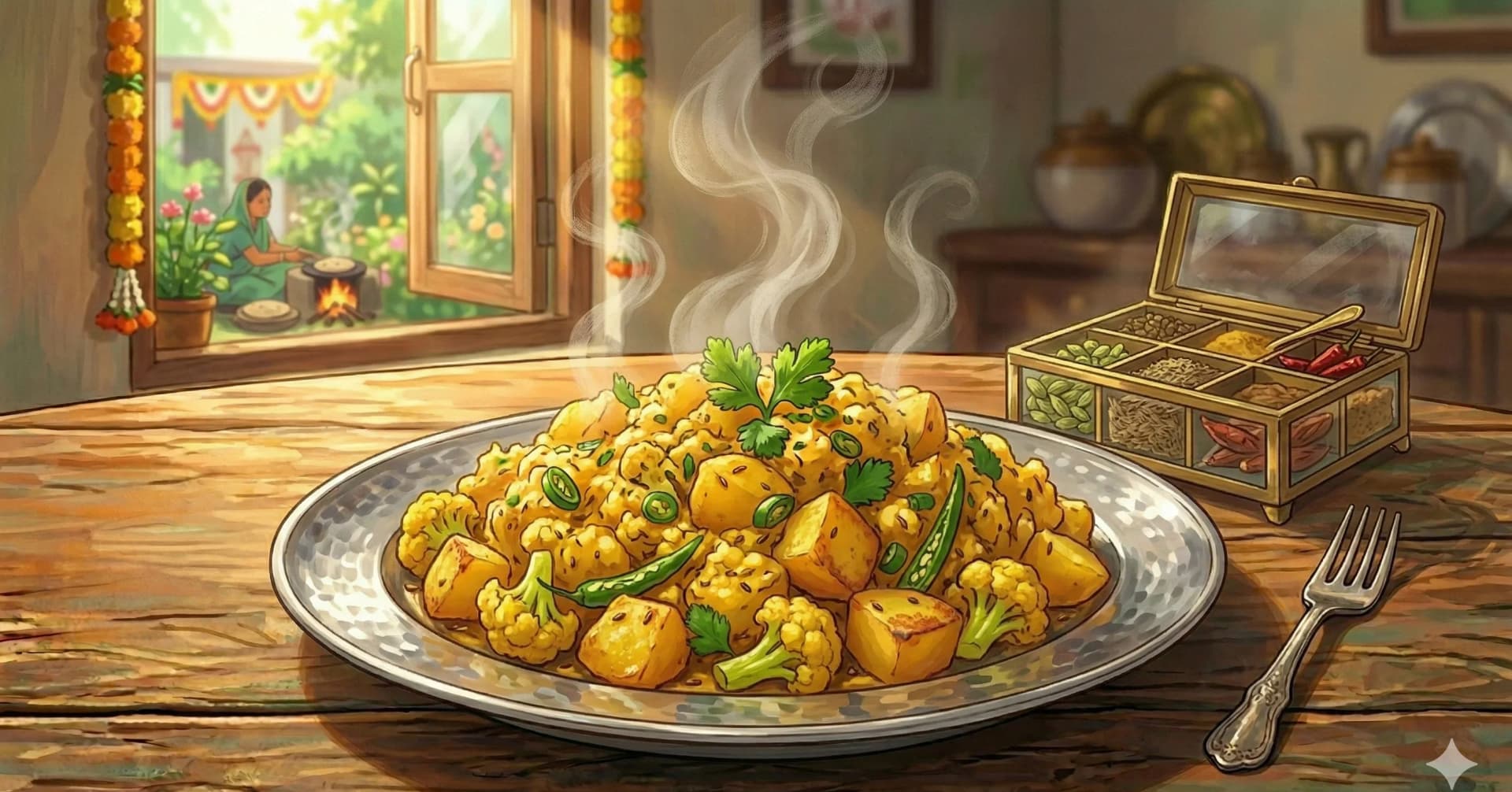
Aloo Gobi
Cauliflower and potato dry-fried with cumin and coriander
Aloo gobi is, on its face, a humble thing: two vegetables, a handful of spices, an iron pan. It is also one of the most recognisable dishes in the Punjabi kitchen, the kind of sabzi that appears at weekday lunches, tiffin boxes, and dhabas in equal measure. Its appeal is not in complexity but in a particular quality of texture: cauliflower that has softened through dum cooking but still holds its shape, potato that has absorbed the spiced oil, both coated in the fragrant residue of turmeric, coriander, and cumin.
The technique matters more than the ingredient list. Cauliflower is added raw to the hot spiced oil, then covered and cooked on low heat. This is the dum principle applied to a dry sabzi, letting the vegetable steam gently in its own moisture while the exterior picks up colour and spice. The potato, boiled separately before being folded in at the end, contributes a yielding creaminess against the florets' firmer bite.
The ginger (chopped, not pasted) is added near the end with green chillies, so it stays bright and sharp rather than cooking down into the base. This small sequencing choice keeps the finished dish from tasting flat. The fresh coriander at the end does the same work: added just before serving, it brings a clean, grassy top note that rounds the earthy warmth of the cooked spices.
Serve with hot chapati or paratha and a simple dal for a complete Punjabi lunch.
At a Glance
Yield
Serves 4–6
Prep
15 minutes
Cook
30 minutes
Total
45 minutes
Difficulty
Easy
Ingredients
- 1½ lbcauliflower (about 1–1½ heads), cut into medium florets
- ¾ lbpotatoes (about 2–2½ potatoes)
- ¼ cupneutral oil
- 1⅓ tspcumin seeds
- 3½ oztomatoes (about ½–1 tomato), roughly chopped
- 2 tspginger paste
- 2 tspgarlic paste
- 1⅔ tspred chilli powder
- ¾ tspturmeric powder
- 1¼ tbspcoriander powder
- 2½ tspgreen chillies (about 2 small chillies), thinly sliced
- 1¾ tbspfresh ginger, finely chopped
- 1 cupfresh coriander, roughly chopped
- ⅔ tspfine salt, plus a pinch for boiling
Method
- 1
Boil the potatoes (350 g). Place the potatoes in a pot with cold water and a pinch of salt (¾ teaspoon). Bring to a boil and cook until just tender; a knife should meet slight resistance at the centre, not slide through completely. Drain, peel, and cut into 2 cm dice. Set aside.
- 2
Prepare the aromatics. Chop the tomatoes (100 g). Slice the green chillies (2 small chillies). Finely chop the fresh ginger (10 g). Keep all three separate; they go in at different stages.
- 3
Fry the spices. Heat the oil in a wide kadhai or heavy-based pan over medium-high heat. Add the cumin seeds (¾ teaspoon) and wait. Within 30 seconds they will splutter and darken slightly, smelling nutty and sharp. Add the garlic paste (10 g) and stir-fry for 1 minute until it loses its raw smell and turns lightly golden at the edges.
- 4
Add the cauliflower (700 g). Add the cauliflower florets to the pan and sprinkle over the turmeric (½ teaspoon), red chilli powder (½ teaspoon), coriander (20 g) powder (2 teaspoons), and salt. Stir well to coat every surface with the spiced oil. Reduce the heat to low, cover with a tight-fitting lid, and cook on dum for 12–15 minutes. The cauliflower will steam in its own moisture, becoming tender while picking up a little colour where it touches the pan. Check occasionally and stir gently. If it seems very dry and is catching, add 2 tablespoons of water.
- 5
Add tomato. Remove the lid, increase the heat to medium, and add the chopped tomatoes. Stir and cook for 5 minutes until the tomatoes have broken down and their liquid has largely evaporated.
- 6
Fold in the potatoes. Add the diced boiled potato and the ginger paste (10 g). Mix gently; use a wide spatula rather than vigorous stirring to keep the florets intact. Add the chopped fresh ginger and green chillies. Taste and adjust seasoning. Cook for another 2–3 minutes, letting everything come together.
- 7
Finish and serve. Scatter the fresh coriander over the top just before serving.
Key Ingredient Benefits
Cauliflower (Brassica oleracea) belongs to the cruciferous vegetable family. It is a source of vitamin C, folate, and dietary fibre, and like other brassicas contains glucosinolates, compounds that have been studied for their relationship to cellular health. Ayurvedic tradition classifies cauliflower as light and easily digestible when cooked with warming spices, which is precisely how this recipe approaches it.
Cumin (Cuminum cyminum) is one of the oldest cultivated spices, appearing in Indian cooking for thousands of years. In Unani and Ayurvedic systems it is considered carminative, traditionally used to ease digestion and reduce gas from heavy meals. Modern research suggests compounds in cumin may support digestive enzyme activity.
Turmeric (Curcuma longa) contains curcumin, which has been studied in a significant body of research for its anti-inflammatory properties. In Ayurvedic cooking, turmeric is used not just for flavour and colour but as a protective spice in dishes containing dense vegetables or legumes.
Why This Works
The dum step (covering the pan and cooking on low heat) is what separates a well-made aloo gobi from a quickly stir-fried one. When the lid goes on, the cauliflower's own moisture creates steam that cooks the vegetable from the inside while the oil-coated surface browns gently from the base up. The result is tender-through florets that still hold their shape, rather than soft, steamed cauliflower that falls apart on the plate.
Boiling the potatoes separately before adding them avoids two problems: raw potato takes significantly longer than cauliflower to cook, so combined cooking produces either underdone potato or overdone cauliflower; and potato dices added raw tend to soak up most of the oil, leaving the cauliflower under-spiced and the pan dry. Pre-boiling keeps both vegetables cooking to their own ideal endpoint.
The sequencing of ginger (paste early, fresh chopped ginger late) layers two distinct notes from the same ingredient. The paste melds into the base and provides depth; the fresh-chopped ginger retains its bright, almost citrusy sharpness as a counterpoint.
Substitutions & Variations
Broccoli for cauliflower: Works well, though broccoli cooks faster. Reduce the covered dum time to 8 minutes and watch carefully.
Dry versus semi-dry: This is a dry sabzi by tradition, but some households prefer a slightly looser version. If so, add 100 ml of water along with the tomatoes and cook uncovered until the sauce is just coating the vegetables.
Add paneer: 150 g of diced paneer, fried separately until golden, can be folded in at the end alongside the potato for a more substantial dish.
Spice adjustments: For a gentler version, omit the green chillies and reduce the red chilli powder to ¼ teaspoon. For more heat, add a pinch of black pepper along with the other dry spices.
Serving Suggestions
Aloo gobi sits at the centre of a simple North Indian meal: a chapati or paratha to wrap and scoop, a dal or curd on the side, and perhaps a wedge of lemon to squeeze over at the table. It travels well and is one of the classic tiffin dishes; the spiced oil means it holds its texture for several hours after cooking, making it a good candidate for packed lunches. At a larger spread, it works as a supporting sabzi alongside a richer meat or paneer preparation.
Storage & Reheating
Store covered in the refrigerator for up to 3 days. To reheat, warm in a dry pan over medium heat with a splash of water to loosen, stirring gently, for 3–4 minutes. Avoid the microwave if possible; the cauliflower becomes soft and loses its texture. The dish does not freeze well, as both cauliflower and potato become grainy on thawing.
Cultural Notes
Aloo gobi (आलू गोभी, "potato and cauliflower") is the dry Punjabi sabzi of potatoes and cauliflower florets stir-fried with cumin, ginger, garlic, turmeric, garam masala, and chopped cilantro. The dish is one of the most basic vegetable preparations of north Indian home cooking, appearing on countless weeknight dinner tables across Punjab, Haryana, Delhi, and the broader north India region as the everyday vegetable course alongside dal, rice, and roti. The dish is typically "dry" rather than gravy-based: the vegetables are coated in a small amount of oil and spice with no added water or tomato base, and the moisture in the cauliflower itself provides whatever steam is needed to cook the vegetables through.
The technical balance is in the cooking sequence. Cumin seeds are tempered first in hot oil until fragrant, then chopped onion (if used; some versions skip onion entirely), then ginger-garlic paste, then ground turmeric and a touch of red chili powder. The potatoes go in next as small cubes (cut to roughly the same size as the cauliflower florets so the timing matches), cooked partially until they begin to soften and pick up the spice. The cauliflower florets follow, and the whole pan is covered and steamed over low heat for ten to fifteen minutes, with occasional gentle stirring to keep the vegetables from sticking but without breaking them apart. The dish is finished with garam masala, amchur or fresh lemon juice for sharpness, and a generous scatter of chopped cilantro.
The dish has cultural significance as one of the foundational Punjabi vegetarian preparations and as a frequent travel companion: the dry preparation keeps without refrigeration for several hours and packs well in tiffin lunchboxes and on train journeys. The dish also crossed over into the British and American Indian restaurant tradition as a heavily ordered vegetarian option, often presented with more onion-tomato base than the home Punjabi version. Madhur Jaffrey's Indian Cooking (1982) introduced the home Punjabi version to English-language readers, and the dish has since appeared in countless cookbooks and home cooking columns, with regional variations that swap the spice blend (Kashmiri versions add fennel and ginger; South Indian variants add curry leaves and mustard seeds; Bengali variants include panch phoron in the tempering).
Nutrition Facts
Calories: 203kcal (10%)|Total Carbohydrates: 29g (11%)|Protein: 6g (12%)|Total Fat: 9g (12%)|Saturated Fat: 1.3g (7%)|Cholesterol: 0mg (0%)|Sodium: 452mg (20%)|Dietary Fiber: 7.1g (25%)|Total Sugars: 5g
You Might Also Like
Ratings & Comments
Ratings & Comments
Ratings
Share your thoughts on this recipe.
Sign in to rate and comment