Bengali · Indian Cuisine
Potato in Poppy Paste (Aloo Posto)
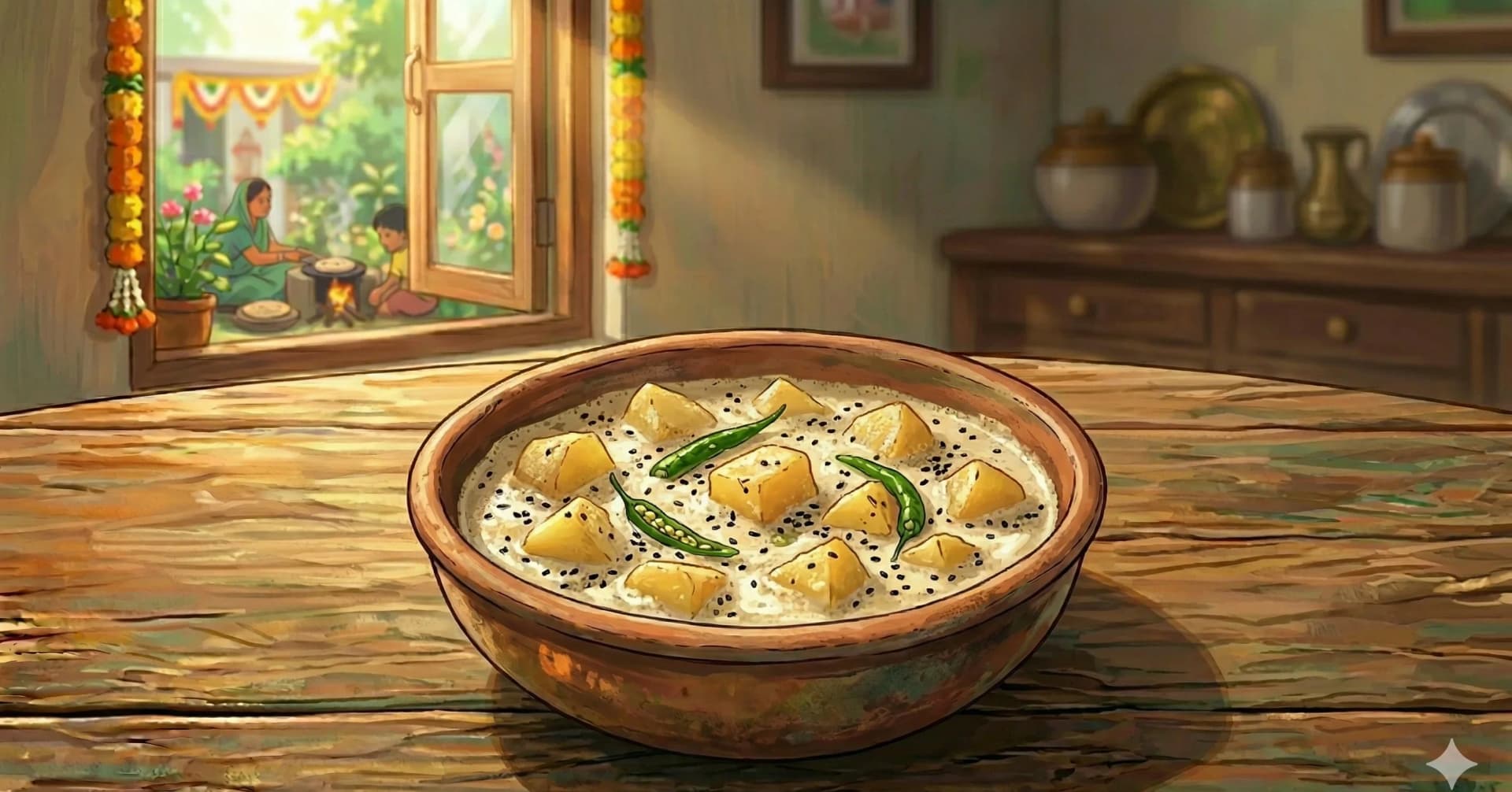
Potatoes cooked in poppy seed paste, the quiet soul of Bengali home cooking
There are dishes that announce themselves and dishes that settle into you. Aloo posto is the second kind. Its colour is a pale, almost grey-white. Its aroma is subtle: the low, faintly nutty warmth of poppy seeds, the sharp cut of mustard oil, the bright punctuation of green chilli. It is a dish that the Bengali home cook makes not for guests or occasions, but for a weekday lunch with plain rice, because it is true and satisfying and because posto (poppy seed paste) is what the kitchen always has.
Posto is the Bengali word for khus khus or white poppy seeds, and it is used in Bengali cooking in a way that has no close equivalent elsewhere in Indian cuisine. It appears in fish preparations, in vegetables, in side dishes, always doing the same thing: introducing a faint, milky creaminess and a hushing quality that rounds and mutes the sharpness of whatever surrounds it. Where most Indian cooking might use yogurt or cream for this effect, Bengali cooking reaches for posto. The result is different: less tangy, less rich, more subtle, with a particular texture that is almost imperceptibly gritty in the best possible way.
Aloo posto begins with poppy seeds soaked briefly in water and then ground to a paste, either on a traditional stone grinder (the shil nora, a rectangular stone slab with a heavy cylindrical rolling stone) or in a small blender. The paste should be as smooth as patience allows. Perfectly ground posto is pale, creamy, and slightly cohesive. The quality of the grinding determines the quality of the dish.
Mustard oil is the only appropriate fat. The dish is finished with a drizzle of raw mustard oil just before serving, and this last step is what lifts the dish from simple to complete. The raw oil's pungency against the quiet paste creates the contrast that makes aloo posto memorable long after the plate is cleared.
At a Glance
Yield
Serves 3–4 as a side
Prep
15 minutes (plus 20 minutes soaking)
Cook
20 minutes
Total
55 minutes
Difficulty
Easy
Ingredients
Poppy Paste Ingredients
- ⅔ cupwhite poppy seeds (*posto / khus khus*), soaked in cold water for 20 minutes
- 3–4green chillies, roughly chopped (for the paste)
- 4–5 tbspcold water, for grinding
Potato Ingredients
- 1 lbwaxy potatoes (about 3–3½ potatoes), peeled and cut into 2 cm cubes
- 3 tbspmustard oil, plus 1 teaspoon for finishing
- —½ teaspoon nigella seeds (*kalo jeera / kalonji*)
- 2–3green chillies, slit lengthways
- —½ teaspoon turmeric powder
- 1 tspfine salt, or to taste
- —½ teaspoon sugar
Method
- 1
Soak and grind the posto. Drain the soaked poppy seeds (80 g) and transfer to a small blender or grinder. Add the chopped green chillies and 4 tablespoons of cold water. Grind to as smooth a paste as possible. Stop and scrape down the sides repeatedly. If the paste feels coarse, add another tablespoon of water and continue grinding. The paste should be pale, cohesive, and creamy — this step cannot be rushed. Set aside.
- 2
Heat the mustard oil (3 tablespoons). Pour the mustard oil into a heavy-based pan or karahi and heat over high heat until wisps of white smoke appear. Remove from heat and allow to cool for 1–2 minutes. This removes the raw sharpness of the oil. Return to medium heat.
- 3
Temper. Add the nigella seeds (½ teaspoon) to the hot oil. They will pop and sputter within seconds, releasing their characteristic sharp, onion-like fragrance. Allow them to sizzle for 20–30 seconds.
- 4
Fry the potatoes. Add the cubed potatoes to the pan and turn to coat in the tempered oil. Add the turmeric (½ teaspoon) and stir gently to coat the potatoes evenly in yellow. Increase heat to medium-high and fry the potatoes, turning occasionally, for 8–10 minutes until lightly golden on the outside and about three-quarters cooked through. They should resist a skewer but not be hard at the centre.
- 5
Add the posto paste. Reduce heat to medium-low. Add the posto paste to the pan. Stir to coat the potatoes, being gentle to avoid breaking them. Add 3–4 tablespoons of water to help the paste spread and prevent it from scorching. Add the slit green chillies, salt (1 teaspoon), and sugar (½ teaspoon). Stir everything together.
- 6
Cook through. Cover the pan with a lid and cook over low heat for 6–8 minutes until the potatoes are completely tender when pierced with a skewer. The paste will coat the potatoes and dry down. There should be very little pooling sauce. Remove the lid for the last 2 minutes if the mixture seems too wet; the paste should cling rather than pool.
- 7
Finish. Taste for salt and adjust. Drizzle 1 teaspoon of raw mustard oil over the surface just before serving. Do not stir this in — let it sit on top as an aromatic finish. Serve immediately.
Key Ingredient Benefits
Poppy seeds (Papaver somniferum) used in cooking contain no psychoactive compounds at culinary quantities. The white variety common in South Asian kitchens is rich in linoleic acid, calcium, phosphorus, and zinc. Their primary contribution is textural and flavour-based: a mild, nutty, slightly oily creaminess that is unique among seed pastes. In Ayurvedic tradition, white poppy seeds are considered cooling and slightly sedative, used in preparations for digestive complaints. Research on their fatty acid profile is generally considered favourable, though work on their anti-inflammatory markers is still preliminary.
Mustard oil: see notes in Sorshe Ilish and Kasha Mangsho. At normal cooking quantities, its erucic acid content is not a concern, and its omega fatty acid profile is one of the more favourable among cooking fats used regularly in the subcontinent.
Potatoes are a source of resistant starch when cooked and cooled, which functions as a prebiotic dietary fibre. In freshly cooked form they provide readily available energy, potassium, and vitamin C. The waxy variety (Charlotte, Nicola, or similar) is used here rather than floury types because they hold their shape during the two-stage cooking process.
Nigella seeds (Nigella sativa) contain thymoquinone and have a long history in Unani and Ayurvedic medicine as digestive aids and anti-inflammatory agents. In cooking, their role is primarily aromatic. A brief tempering in oil unlocks a complex, slightly bitter, onion-like fragrance that is one of the defining notes of Bengali vegetable cooking.
Why This Works
Soaking the poppy seeds before grinding is not optional. Dry poppy seeds have a hard, oily exterior that resists grinding to smoothness; soaked seeds absorb water, soften slightly, and release their oils more readily. A paste made from unsoaked seeds will always be slightly gritty. Ten to twenty minutes of soaking transforms the texture of the final dish.
Frying the potatoes before adding the paste serves two purposes. First, it parcooks the potato, giving it the structural integrity to absorb the paste without dissolving during the final minutes of low-heat cooking. Second, it creates a lightly golden exterior on each cube — a thin seal that holds the potato together and gives a faint textural contrast to the creamy paste coating.
The finishing drizzle of raw mustard oil is the signature of Bengali vegetable cooking. Posto paste is by nature quiet and muted. Raw mustard oil, sharp and pungent with a characteristic heat that hits the back of the throat, acts as an aromatic counterpoint that wakes the entire dish up. Without it, aloo posto is pleasant. With it, the dish has the push-pull of flavour that defines Bengali cooking at its best.
The small addition of sugar is characteristic of Bengali home cooking. Almost every savoury Bengali dish contains a whisper of sugar, not to make the food sweet but to round it, to lift the other flavours and prevent the spice and salt from reading as flat.
Substitutions & Variations
Poppy seed paste alternatives: If poppy seeds are unavailable, a paste of raw cashew nuts soaked in water and ground similarly will produce a creamy, mild coating. Different in character but reasonably close in function. The dish will be richer and less subtle.
No posto, no cashew: A paste of unsweetened desiccated coconut ground with water produces yet another version, sweeter and more textured, but the method remains the same. Not traditional, but a reasonable adaptation.
Panch phoron instead of nigella: Some households temper with panch phoron (equal parts fenugreek, nigella, cumin, black mustard, and fennel seeds) rather than nigella alone. This produces a slightly more complex base fragrance.
With onion: A minority of households add a single small onion, finely sliced and fried until soft before adding the posto paste. The orthodox Bengali home cook may object, but the version with onion is richer and more textured.
Spice level: Three green chillies (two in the paste, one slit in the pan) produces a dish with mild, background warmth. For more heat, increase to five or six total.
Serving Suggestions
Aloo posto is eaten as part of a Bengali vegetarian lunch: plain steamed white rice, a little dal (masoor or moong), and this dish, with perhaps a scoop of begun bhaja alongside. The pairing with rice is non-negotiable. The paste-coated potatoes need the neutral canvas of plain rice to make sense. A squeeze of lime over the entire plate is not traditional but is very good. This is not a starter or a side in the Western sense; it is the centrepiece of a quiet, vegetarian midday meal.
Storage & Reheating
Aloo posto keeps in the refrigerator for up to 2 days in a sealed container. The paste firms up considerably on chilling. To reheat, transfer to a pan over low heat with 2–3 tablespoons of water, cover, and warm gently, stirring once or twice. Add a fresh drizzle of raw mustard oil before serving. The dish does not freeze well. The poppy seed paste separates and the potato texture becomes granular.
Cultural Notes
Aloo posto (আলু পোস্ত, "potato with poppy") is the Bengali dish of potatoes cooked with a ground poppy seed paste, green chilies, mustard oil, and minimal additional spicing. The dish is one of the most strongly Bengali and most defining of the Bengali Hindu home cooking tradition, with the poppy seed paste (posto) serving as the textural and flavor backbone that produces a creamy off-white dish unlike anything else in the broader Indian regional repertoire. The dish has been a Bengali home staple for centuries and continues to define the Bengali household meal in a way that few other regional dishes match.
The poppy seed paste is the technical heart. White poppy seeds (the small ivory-colored seeds, different from the dark blue-black seeds of European baking) are soaked in warm water for thirty minutes to soften, then ground with green chilies and a small amount of water to form a thick smooth paste. The paste has a faint nutty sweetness, a slight creaminess from the natural oils released by grinding, and a delicate flavor that pairs uncommonly well with starchy vegetables like potato, gourd, or eggplant. The freshness of the grind matters: the paste is best used within hours of grinding, since the oils oxidize and the flavor turns flat with longer storage.
The technique cooks the potatoes simply. Cubed potatoes (the Bengali preference is for the small new potatoes called aloo in Bengali, peeled or skin-on depending on the family tradition) are fried briefly in mustard oil with a tempering of nigella seeds (kalonji), bay leaf, and slit green chilies until the surfaces turn lightly golden. The ground poppy seed paste is added with a small amount of water, turmeric, and salt, and the dish simmers covered for ten to fifteen minutes until the potatoes are tender and the paste has thickened into a creamy coating around them. A final drizzle of raw mustard oil and a scatter of fresh green chilies on top completes the dish. The pairing with plain steamed rice and dal is universal at Bengali home lunches. The dish has cultural significance as one of the dishes most strongly identified with Bengali culinary identity, especially among the Bengali Hindu bhadralok community whose continuous home cooking tradition has kept the dish at the center of the regional repertoire.
Nutrition Facts
Calories: 338kcal (17%)|Total Carbohydrates: 37g (13%)|Protein: 8g (16%)|Total Fat: 19g (24%)|Saturated Fat: 2.1g (11%)|Cholesterol: 0mg (0%)|Sodium: 663mg (29%)|Dietary Fiber: 8.8g (31%)|Total Sugars: 2.6g
You Might Also Like
Ratings & Comments
Ratings & Comments
Ratings
Share your thoughts on this recipe.
Sign in to rate and comment