Tamil Nadu · Indian Cuisine
Idly
Steamed fermented rice and lentil cakes from Tamil Nadu
There is a moment, somewhere around the tenth hour of fermentation, when the batter begins to smell faintly sour and alive — a clean, yogurt-like tang that tells you the culture is working. Lift the lid and the surface will have risen, domed slightly, become almost spongy. This is the smell of breakfast in South India: the early kitchen, the first heat of the day, the promise of something that will be tender and light and ready by seven in the morning.
Idly is one of the oldest and most refined forms of fermented cooking in India. It belongs to the tiffin culture of Tamil Nadu and Karnataka, a tradition of morning meals that are neither heavy nor insubstantial — dishes designed to sustain a person through a long morning without weighing them down. The idly achieves this through a process that is both biological and technical: soaking the rice and lentils separately, grinding them to specific textures, combining them, and allowing wild fermentation to develop both flavour and rise.
The urad dal batter must be ground very fine — almost to a mousse — with cold water, which incorporates air and creates the light, open crumb that gives a good idly its cloud-like quality. The rice batter is kept slightly coarser, which adds a subtle tooth to the finished cake. Poha (flattened rice) is the small but important addition that keeps the idly white, soft, and tender even after it cools slightly. Fenugreek seeds, soaked and ground with the urad dal, act as a fermentation catalyst and contribute a faint bittersweet depth.
The practical insight worth holding: fermentation temperature matters more than timing. In a warm South Indian kitchen, 8 hours is enough. In a cold climate, the batter may need up to 14 hours, or the help of a warm oven with only the light on. The batter is ready when it has risen by at least a third and smells pleasantly sour — not sharp or alcoholic, but gently tangy. That smell is the signal.
At a Glance
Yield
Makes 20–24 idlis (serves 4)
Prep
30 minutes active, plus 6 hours soaking and 8–12 hours fermentation
Cook
12 minutes per batch
Total
Approximately 20–24 hours (mostly hands-off)
Difficulty
Medium
Ingredients
Method
- 1
Soak the grains. Rinse the parboiled rice (300 g) under cold water until it runs clear. Place in a large bowl with fresh cold water and soak for 6 hours. In a separate bowl, combine the urad dal (100 g), poha (30 g), and fenugreek seeds (1 teaspoon). Cover with cold water and soak for 6 hours. Keep both bowls at room temperature.
- 2
Grind the urad dal. Drain the urad dal mixture and transfer to a wet grinder or high-powered blender. Add cold water in small additions — start with about 50 ml — and grind continuously for 15–20 minutes, scraping down the sides periodically. The finished batter should be extraordinarily smooth, light, and airy: it should look and feel almost like a stiff mousse, clinging to a spoon in soft peaks. Cold water (even a few ice cubes added to a blender) helps prevent the motor from heating the batter and killing the natural cultures. Transfer to a large, deep bowl.
- 3
Grind the rice. Drain the soaked rice and transfer to the grinder or blender. Add cold water gradually (about 80–100 ml in total) and grind to a slightly coarse, gritty texture — not as smooth as the dal batter. This gentle coarseness is deliberate: it gives the idly a faint bite and helps the steamed cake hold its shape.
- 4
Combine and ferment. Add the ground rice batter to the urad dal batter in the large bowl. Add the salt (1 teaspoon). Using your clean hand, mix the two batters together thoroughly with a circular folding motion for 2–3 minutes — this hand-mixing is not just practical, the warmth of your hand and the motion itself encourage aeration and the introduction of wild yeasts from your skin, which contributes to fermentation. The combined batter should feel slightly thick and airy. Cover the bowl with a loose lid or cloth and leave in a warm place (ideally 28–32°C) for 8–12 hours. The batter is ready when it has risen noticeably, the surface looks domed and slightly porous, and it smells gently sour.
- 5
Prepare for steaming. Lightly grease each hollow of the idli moulds with a little oil or ghee. Fill each hollow to about three-quarters full with fermented batter — the idlis will expand slightly as they steam. Do not overfill.
- 6
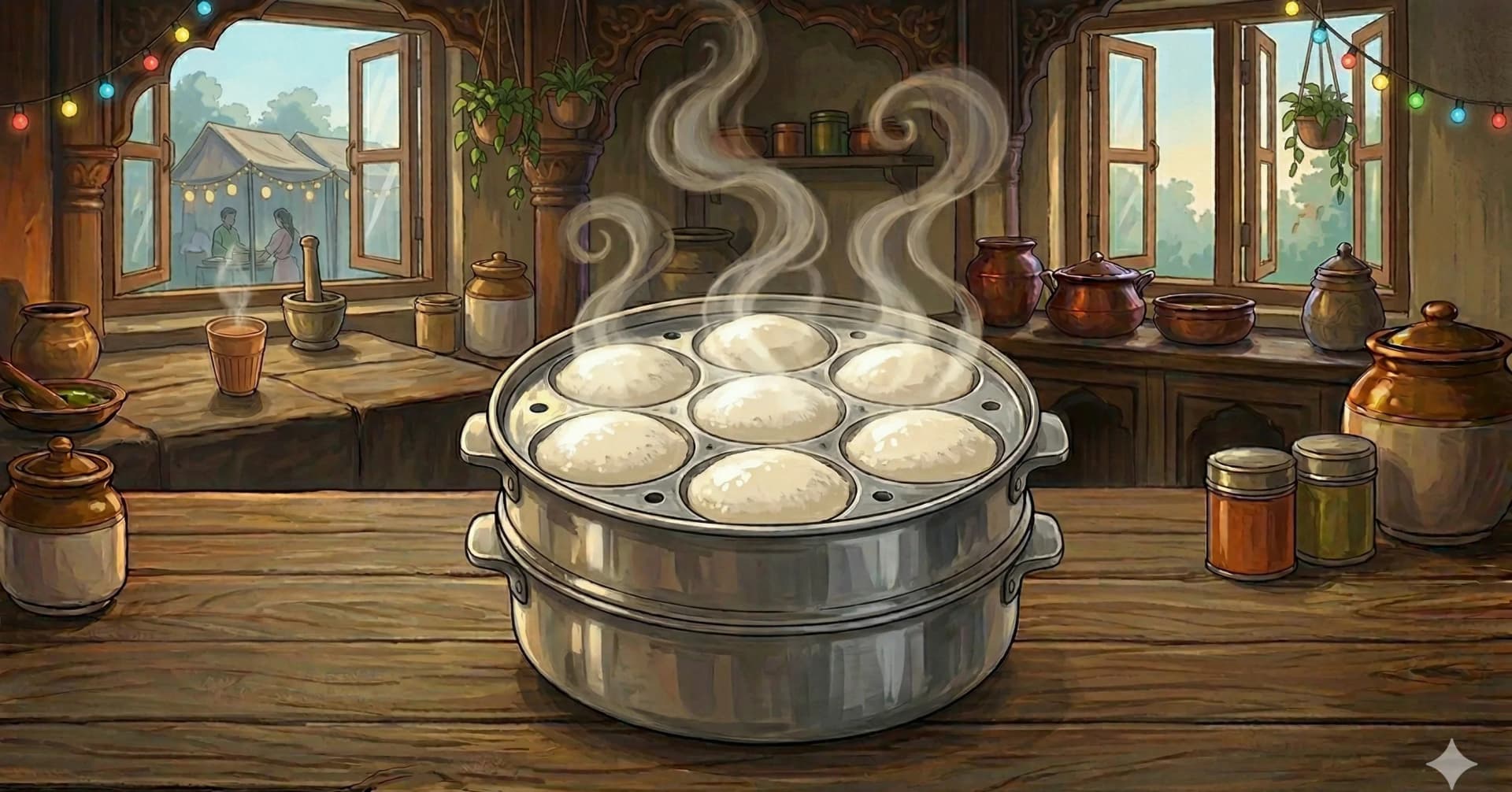
Steam. Pour water into the base of your idli steamer or a large pot with a tight-fitting lid. Bring to a rolling boil. Stack the filled idli plates into the steamer rack, lower the rack into the steamer, cover tightly, and steam on high heat for 10–12 minutes. The idlis are done when a toothpick inserted into the centre of one comes out clean, and the surface of each idli looks set and faintly shiny.
- 7
Rest and unmould. Remove the rack from the steamer and allow the idlis to rest for 2 minutes — this brief rest allows the steam trapped inside to settle and makes unmoulding cleaner. Use a small wet spoon or spatula to gently ease each idli out. The finished idly should be perfectly round, cloud-white, and spring back very slightly when pressed.
- 8
Serve immediately with sambar and coconut chutney alongside.
Key Ingredient Benefits
Urad dal (hulled black lentil) is among the highest-protein legumes in South Asian cooking, and is particularly valued in Tamil Nadu and Karnataka cuisines for its unique grinding properties. It is rich in dietary fibre and B vitamins. In Ayurvedic tradition it is classified as strengthening and nourishing, and is traditionally associated with supporting musculature and sustained energy.
Parboiled rice differs from raw rice because it has been partially boiled in the husk before milling. This process drives some of the nutrients from the bran into the grain's interior, meaning the final milled rice retains more B vitamins and minerals than standard white rice. It also gives idli rice a slightly firmer texture when ground, which contributes to the idly's structure.
Fermented batter — the product of 8–12 hours of wild lacto-fermentation — introduces live cultures of lactobacillus bacteria and wild yeasts. Research suggests that regular consumption of fermented foods is associated with improvements in gut microbiome diversity, though this varies by individual. Traditional South Indian diets have incorporated fermented rice and lentil preparations as a daily staple for centuries.
Fenugreek seeds contain soluble fibre (fenugreek galactomannan) which research suggests may be associated with improved blood sugar regulation after meals. In Tamil Nadu cuisine they appear in very small quantities as a background spice in many fermented and braised preparations, contributing a barely perceptible bitter warmth.
Why This Works
The two-batter approach — grinding rice and dal separately, then combining — is the structural core of the idly method. Urad dal, when ground with sufficient water for sufficient time, develops a viscous, foam-like quality from its mucilaginous proteins. This creates the light, spongy interior of a good idly. Rice ground to a slightly coarser texture provides the grain and bite that prevents the idly from becoming too dense or glutinous. The two textures together (dal's airiness and rice's gentle grain) produce the idly's characteristic crumb.
Fenugreek seeds serve a fermentation function as much as a flavour one. Their mucilage provides food for the fermenting microorganisms, accelerating and stabilising the rise of the batter. The flavour contribution is subtle — a faint bittersweet note that adds complexity without asserting itself.
Fermentation transforms the batter in several ways. It develops organic acids (primarily lactic acid) that give the idly its characteristic mild sourness. It partially breaks down the starches and proteins in both the rice and lentils, making them easier to digest. And it produces carbon dioxide, which is trapped in the batter's mucilaginous matrix to create the rise.
Substitutions & Variations
No parboiled rice: Regular short-grain raw rice can be substituted, though the idly will be slightly less white and a touch softer. The traditional preference is firmly for parboiled rice.
No poha: Poha is optional but recommended for softness and whiteness. A small amount of cooked plain rice (50 g, cooled) mixed into the rice before grinding achieves a similar effect.
Rava (semolina) idli: For a quicker version that skips fermentation entirely, rava (fine semolina) can be mixed with yogurt and a pinch of fruit salt (eno) just before steaming. The result is quite different in texture — slightly grainier, not as sour — but is a valid and popular everyday shortcut.
Kanchipuram idli: The festival version of idly, made with the same base batter enriched with cumin, black pepper, ginger, ghee, and curry leaves mixed in before steaming. It is offered as prasad at the Varadaraja Perumal temple in Kanchipuram and has a more complex, peppery flavour.
Serving Suggestions
The classic pairing is sambar — the tamarind and lentil vegetable stew — and freshly ground coconut chutney, served alongside. A small amount of ghee drizzled over the hot idlis is a traditional finishing touch that adds richness and a faint nuttiness. In Tamil Nadu, idlis are also served with tomato chutney, peanut chutney, and molaga podi (gun powder chutney) mixed with sesame oil for dunking. For a complete South Indian breakfast, serve three to four idlis per person, with at least two chutneys and a bowl of sambar.
Storage & Reheating
Fermented batter keeps well refrigerated for 3–4 days — and in fact improves slightly in flavour over the first couple of days as the fermentation continues slowly. Do not add salt to the batter until just before steaming if you plan to store it.
Steamed idlis are best eaten fresh and hot. Leftovers can be stored in an airtight container in the refrigerator for up to 2 days. To reheat, place in the steamer for 3–4 minutes, or wrap in a damp paper towel and microwave for 30–45 seconds. Reheated idlis can be pan-fried in a little oil or ghee to make a crisp breakfast variation.
Cultural Notes
Idli (इडली, iṭṭu in Tamil; also spelled idly) is the South Indian steamed rice-and-urad-dal cake that anchors the South Indian breakfast alongside dosa. The dish is a soft, white, slightly spongy disc roughly three inches across, served hot from the steamer with coconut chutney, sambar (lentil stew), and sometimes a small dish of tomato-chutney or a smear of ghee. The dish has a long documented history in South Indian food culture, with references in eleventh and twelfth century Kannada and Tamil texts, though scholars including K.T. Achaya have argued the modern form using fermented batter likely developed during the medieval period in southern India.
The technique shares the fermentation foundation with dosa but produces a fundamentally different texture. The batter is similar (raw rice and urad dal soaked separately, ground together with fenugreek), but for idli the proportion of urad dal is higher and the consistency is slightly thicker, since the batter has to hold its shape in the steaming mold rather than spreading thin on a griddle. After eight to twelve hours of fermentation, the batter is poured into greased idli molds (small concave discs in a tiered steamer rack), and the molds are steamed over boiling water for ten to twelve minutes until the idlis puff up and turn matte white with a slight spring to the touch.
The cultural place of idli in South Indian eating is foundational. The dish is the easiest of the standard South Indian breakfasts to make at scale, the most digestible (the steamed format is gentle on the digestive system in a way that fried or griddled foods are not), and the most associated with home cooking and small breakfast tiffin restaurants rather than fancier restaurant fare. Idli is the dish that South Indian mothers and grandmothers prepare for children, that South Indian families eat for breakfast multiple times a week, and that South Indian travelers carry on long train journeys because the dish keeps well for several hours. The dish was named "best Indian breakfast item" in a 2008 ranking by the World Idli Day organization, and the South Indian state of Tamil Nadu observes World Idli Day annually on March 30 with celebrations and idli-making competitions across the state.
Nutrition Facts
Calories: 379kcal (19%)|Total Carbohydrates: 80.3g (29%)|Protein: 12.2g (24%)|Total Fat: 0.9g (1%)|Saturated Fat: 0.2g (1%)|Cholesterol: 0mg (0%)|Sodium: 10mg (0%)|Dietary Fiber: 5.3g (19%)|Total Sugars: 0g
You Might Also Like

Ratings & Comments
Ratings & Comments
Ratings
Share your thoughts on this recipe.
Sign in to rate and comment