Indian Cuisine
Spiced Puffed Rice Snack (Jhal Muri)
Bengali spiced puffed rice tossed with mustard oil, chilli, potato, and raw coconut
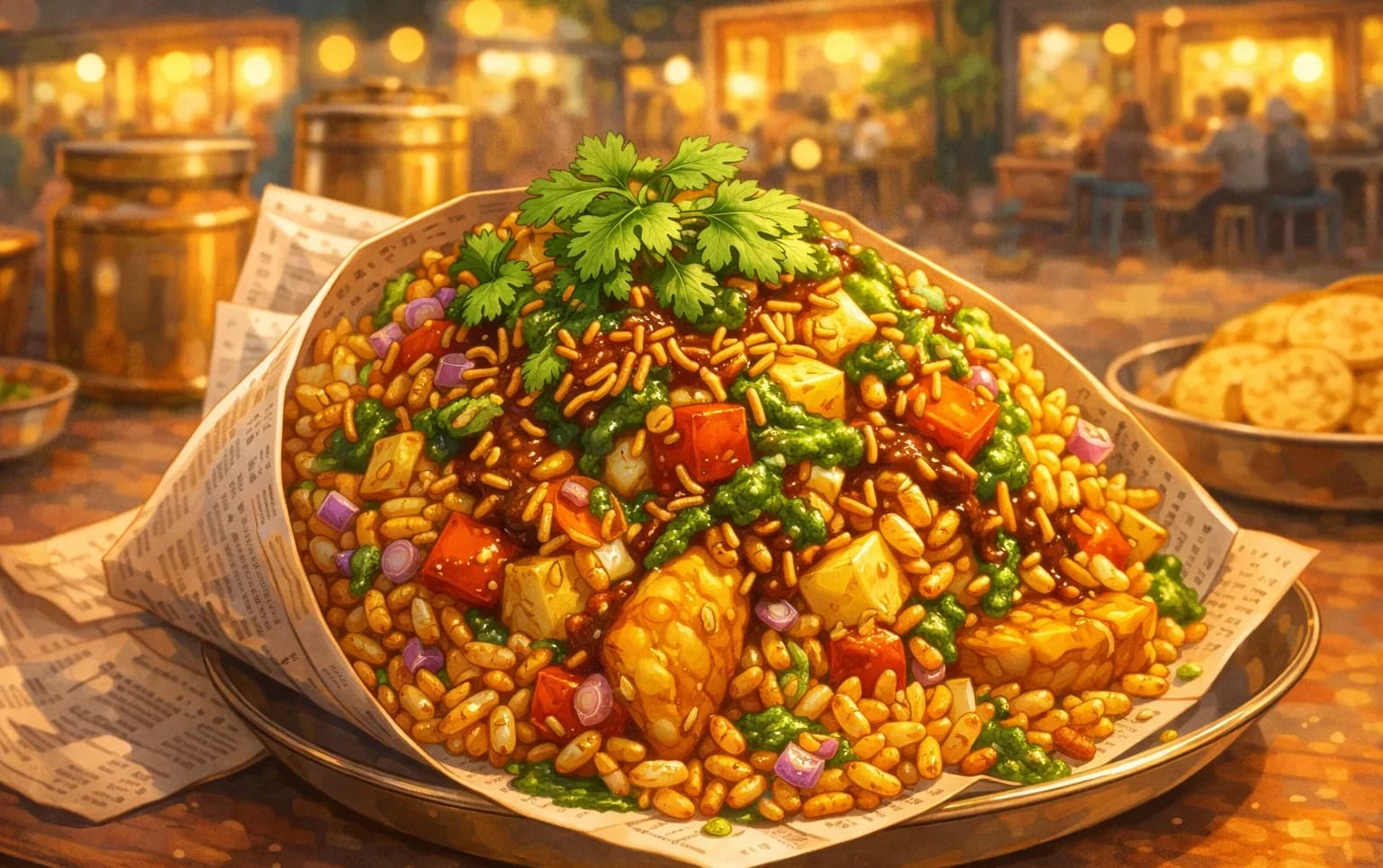
The muri vendor is a fixture of every Bengali street corner and train station: a wiry person with a large metal tin of puffed rice and a series of small canisters containing the ingredients that transform it into jhal muri. In a few swift moves, the ingredients are combined in a large bowl, tossed with expert efficiency, and handed over wrapped in newspaper. The whole transaction takes forty-five seconds.
Jhal means hot or spicy in Bengali. The name is aspirational rather than absolute. Heat here comes from green chilli, but the dish's character is actually defined by the raw mustard oil. Its pungent, almost horseradishy sharpness coats every grain of puffed rice and wakes up every other element. This is the ingredient that makes jhal muri taste like jhal muri rather than just puffed rice with toppings.
Boiled potato adds chew and substance. Bhujia provides crunch and seasoned depth. Fried peanuts add protein and fat. Coconut, sliced thin rather than grated, provides something cool and slightly sweet. The whole assembly, tossed once and eaten immediately, is one of India's great snacks: completely no-cook after the potato is boiled, ready in two minutes, and deeply satisfying in a way that requires no explanation.
At a Glance
Yield
Serves 2–3
Prep
10 minutes
Cook
None (potato pre-boiled)
Total
10 minutes
Difficulty
Easy
Ingredients
- 7 ozpuffed rice (*muri*)
- 1¾ ozyellow onion, finely chopped
- 1¾ tbspgreen chillies (about 2–3 chillies), finely chopped
- 1¾ ozpotatoes, boiled, peeled, cut into small cubes
- 1¾ ozbhujia (thin sev / fried chickpea-flour noodles)
- ¾ ozfried peanuts
- 3⅓ tbspraw mustard oil (do not heat it; use it raw)
- 1¾ ozfresh coconut, finely sliced into strips
Method
- 1
Combine. Place the puffed rice (200 g), onion (50 g), green chillies (2–3 chillies), potato, bhujia (50 g), and peanuts in a large bowl.
- 2
Add the mustard oil. Drizzle the raw mustard oil (50 ml) over the mixture. The pungent, sharp smell of raw mustard oil is the signature of this dish.
- 3
Toss well. Mix everything together with your hands or a large spoon, working quickly. The puffed rice begins to lose its crunch within a few minutes.
- 4
Add coconut (50 g). Scatter the sliced coconut over the top and toss once more.
- 5
Serve immediately. Jhal muri must be eaten within 5 minutes of mixing.
Key Ingredient Benefits
Bhujia is a thin, crispy fried snack made from gram flour and spices. The most common variety is Bikaner bhujia, widely available at Indian grocery stores. It provides both crunch and salt.
Raw mustard oil must not be heated for this dish. Non-negotiable. Heating it destroys the volatile compounds that give jhal muri its character.
Why This Works
Raw mustard oil contains allyl isothiocyanate, the same volatile compound responsible for the sharpness of horseradish and wasabi. When the oil is heated, this compound largely dissipates. Used raw, it provides an unmistakable pungency that no other oil replicates. This is the one ingredient that cannot be substituted if you want actual jhal muri.
The mix of textures is structural to the dish: puffed rice (light and crispy), boiled potato (soft and starchy), bhujia (dense and crunchy), fried peanuts (hard and fatty), and fresh coconut (chewy and cool). Every spoonful should contain all five, which is why thorough tossing matters.
Substitutions & Variations
No bhujia: Substitute with thin sev or any crispy fried gram snack.
More heat: Add a small amount of dried red chilli flakes or a teaspoon of chilli sauce in addition to the fresh chilli.
With lime: A squeeze of lime juice added with the mustard oil adds brightness and is how many vendors make it in southern Bengal.
Sweet-sour version: Add a teaspoon of tamarind water and a pinch of black salt for a more complex, chaat-like flavour profile.
Serving Suggestions
Jhal muri is a standalone snack. It needs nothing alongside it. Serve in bowls or cones of newspaper (for authenticity). Eaten with tea in the afternoon, or as a quick pre-dinner snack.
Storage & Reheating
Make and consume immediately. Cannot be stored.
Cultural Notes
Jhal muri (ঝাল মুড়ি, "spicy puffed rice") is the Bengali street food snack of puffed rice mixed at the moment of serving with chopped raw onion, chopped fresh green chilies, mustard oil, a squeeze of lemon, roasted peanuts, sliced cucumber, chopped cilantro, and a sprinkle of chanachur (the Bengali version of sev/spiced fried lentil noodles). The dish is the prototypical Kolkata street snack, sold by ambulant vendors who carry their ingredients in metal containers slung from a wooden pole and assemble each serving to order in a paper cone or small bowl. The dish is the Bengali version of the broader Indian chaat category that includes the related bhel-puri of Mumbai.
The technique is assembly rather than cooking. The vendor scoops puffed rice (muri, the Bengali style of puffed rice that is lighter and crispier than the South Indian variety) into a bowl or paper cone, then adds the assortment of mix-ins from his collection of containers: a tablespoon of finely chopped raw onion, a teaspoon of finely chopped green chilies, a handful of roasted peanuts, sliced cucumber, sometimes pieces of coconut or chickpeas. The mustard oil (the Bengali signature flavor element) is drizzled over the top from a small bottle, the lemon is squeezed in, and the chanachur is sprinkled on as the final crunchy element. The mixture is stirred briefly and handed to the customer to eat with a small wooden spoon or with bare hands.
The cultural place of the dish is the late-afternoon Bengali snack moment. Jhal muri vendors set up their stations at Kolkata's Maidan (the central park), at the riverside ghats along the Hooghly, at the suburban railway platforms during rush hour, and at countless street corners across the city. The dish is meant to be eaten on the move or while sitting briefly on a park bench, and it carries strong cultural associations with Kolkata's identity as a city of intellectuals, students, and political conversation. Jhal muri is the food that fuels long talks on park benches and ghat stones. The British author Angus Sandiford Macleod and Bengali food writer Pritha Sen have both written about jhal muri as one of the most strongly atmospheric foods of Kolkata, and the dish has spread through the Bengali diaspora as a marker of regional identity that travels well because the assembly format requires no specialty cooking equipment.
Nutrition Facts
Calories: 542kcal (27%)|Total Carbohydrates: 69.3g (25%)|Protein: 7.4g (15%)|Total Fat: 26.2g (34%)|Saturated Fat: 7.7g (39%)|Cholesterol: 5mg (2%)|Sodium: 25mg (1%)|Dietary Fiber: 2.8g (10%)|Total Sugars: 2.3g
You Might Also Like
Ratings & Comments
Ratings & Comments
Ratings
Share your thoughts on this recipe.
Sign in to rate and comment