Indian Cuisine
Bengali Crepe Rolls (Patishapta)
Bengali Makar Sankranti Crepes with Coconut, Khoya, and Almond Filling
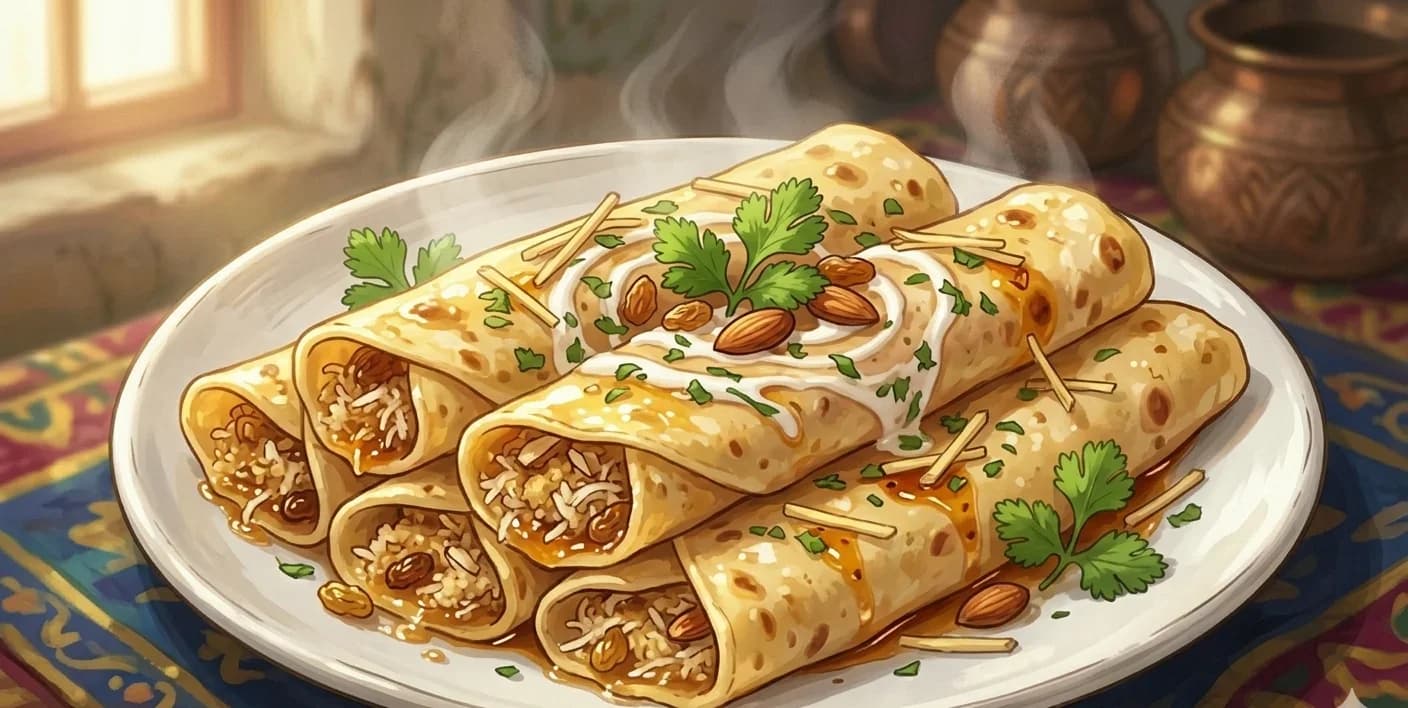
Makar Sankranti (the winter harvest festival that marks the sun's northward journey) has a different sweet in every corner of the subcontinent. In Maharashtra it is sesame and jaggery laddoos. In Andhra it is ariselu. In Bengal it is patishapta: delicate rice flour and refined flour crepes wrapped around a warm, fragrant filling of coconut, khoya, almonds, and raisins, deep-fried until the exterior is golden and the filling is heated through.
Patishapta belongs to the pithe tradition of Bengali winter sweets, a category of preparations made from freshly harvested rice flour and nolen gur (date palm jaggery) that appear only in the winter months when both ingredients are at their peak. The rice flour gives the crepe a faint translucency and a light, slightly chewy texture distinct from a pure refined flour pancake; the touch of bicarbonate of soda gives it lift without bubbles, producing a smooth, even surface that rolls easily around the filling.
The filling is where the richness concentrates. Fresh grated coconut cooked with sugar and soft khoya creates a fragrant, slightly sticky mixture that holds together when rolled but is moist enough to soften into the crepe during the final frying. Almonds and raisins add contrasting textures. The almonds stay firm and nutty through the cooking; the raisins swell slightly and become jammy.
The crepes are made first, filled while still warm, rolled into cylinders, and then deep-fried to seal them and heat the filling through. Serve immediately, while the exterior is crisp and the interior filling is warm, with a spoonful of sweetened fresh cream alongside, or a small cup of date palm jaggery syrup for dipping.
At a Glance
Yield
10–12 crepes
Prep
20 minutes
Cook
30 minutes
Total
1 hour (plus 10-minute batter rest)
Difficulty
Medium
Ingredients
- 1 cuprefined flour (maida)
- 2 ozrice flour
- 1⅛ tspbicarbonate of soda (a scant tsp)
- 1 cupmilk
- —Oil, for pan frying
- 3½ ozfresh grated coconut
- ½ cupsugar
- 3½ ozsoft khoya (mawa), crumbled
- 1¾ ozalmonds, roughly chopped
- 1 ozraisins
Method
- 1
Make the batter. Whisk together the refined flour, rice flour, and bicarbonate of soda in a bowl. Gradually add the milk, whisking to avoid lumps, until you have a smooth, pourable batter. It should be slightly thinner than American pancake batter, closer to a crêpe batter. Strain through a fine sieve to remove any lumps. Rest for 10 minutes.
- 2
Make the filling. Combine the fresh grated coconut, sugar, soft khoya, almonds, and raisins in a shallow, heavy-bottomed pan over medium heat. Stir continuously as the sugar melts and the mixture begins to cook together. Continue stirring until the ingredients come together into a cohesive, fragrant mass that holds its shape when pressed. It should not be wet or runny. Remove from heat and allow to cool slightly. The filling should be warm but not hot when used.
- 3
Make the crepes. Heat a flat tawa or non-stick pan over medium heat and brush lightly with oil. Pour a small ladleful of batter (about 60 ml) onto the pan and spread into a thin round approximately 16–18 cm in diameter. Cook for 1–2 minutes until the surface is set and the edges begin to lift. Flip gently and cook for another 30 seconds. Transfer to a plate. Repeat with remaining batter, stacking the crepes.
- 4
Fill and roll. Place a crepe on a flat surface. Spoon 2–3 tablespoons of filling along one edge, leaving a 1 cm border on the sides. Roll the crepe firmly around the filling, tucking the sides in as you roll, to form a neat cylinder. Press gently to seal.
- 5
Deep fry. Heat oil in a deep pan. When hot, carefully lower the rolled patishapta into the oil. Fry, turning gently, until the exterior is golden-brown. Remove and drain briefly on paper.
- 6
Serve immediately with sweetened fresh cream or date palm jaggery syrup.
Key Ingredient Benefits
Rice flour is the traditional base for Bengali pithe. It is made from freshly harvested winter rice ground at home or from a local mill, with a quality different from commercial rice flour. The starch in fresh-ground rice flour hydrates differently and produces a lighter, more delicate crepe. Commercial rice flour works well but produces a slightly denser result.
Fresh grated coconut is the filling's foundation. It must be fresh. Dried or desiccated coconut lacks the moisture and sweetness needed to combine properly with the khoya. Fresh coconut contains medium-chain fatty acids and provides a natural sweetness and moisture that cooked desiccated coconut cannot replicate.
Khoya (mawa) is whole milk simmered until almost all moisture has evaporated, leaving concentrated milk solids. Its richness and slightly caramelised milk flavour bring depth to the filling that sugar and coconut alone cannot provide. Soft khoya (cooked to a lower dryness than hard khoya) integrates more easily with the coconut mixture.
Almonds provide both texture and mild flavour. They are traditional in Bengali festival sweets as a marker of celebratory preparation, an ingredient that signals occasion.
Why This Works
The combination of refined flour and rice flour in the batter is deliberate. Pure refined flour produces a crepe that is too elastic and chewy; pure rice flour produces one that is too fragile and prone to tearing when rolled. Together they balance elasticity (from the refined flour gluten) with a light, slightly crisp quality (from the rice flour starch), producing a crepe that rolls cleanly around the filling without cracking and holds together during frying.
Bicarbonate of soda, in small quantity, produces a faint lift that makes the crepe slightly more tender and pliable than a purely unleavened batter would be, without creating the bubbles that would make it uneven.
Cooking the filling until it holds its shape before rolling is essential. A wet filling will soften the crepe from inside during frying, making it floppy and prone to splitting. A dry, cohesive filling retains its form through the frying process, and the crepe exterior remains structural.
Substitutions & Variations
- With nolen gur (date palm jaggery): The traditional Makar Sankranti version uses nolen gur in the filling in place of or alongside sugar. Replace some or all of the sugar with grated nolen gur for an earthier, more complex sweetness.
- Without deep frying: Some versions of patishapta are pan-fried rather than deep-fried. The crepe is filled, rolled, and returned to the lightly oiled pan for 2–3 minutes per side. The exterior is softer but the result is lighter.
- With khoya only: Omit the coconut and use 200 g of sweetened khoya as the sole filling, mixed with a little cardamom powder.
- Cream accompaniment: Sweetened fresh cream (lightly whipped with sugar) is the traditional accompaniment in many Bengali households. Its coolness against the warm, fried crepe is the ideal contrast.
Serving Suggestions
Patishapta is traditionally served warm, immediately after frying, as a festival dessert. Two or three per person is typical. Serve with sweetened fresh cream on the side, or with a small cup of warm date palm jaggery syrup for dipping. In Bengali homes at Makar Sankranti, patishapta appears alongside other winter pithe such as puli pithe (rice flour dumplings in coconut milk) and dudh pithe. The combination of warm, fried exterior and fragrant, yielding filling makes it best eaten within minutes of frying.
Storage & Reheating
Unfried, filled, and rolled patishapta can be stored in the refrigerator for up to 24 hours before frying. Fry to order. Already-fried patishapta can be reheated in an oven at 180°C for 8–10 minutes to restore exterior crispness. Do not microwave. The crepe becomes soft and the filling may burst. Best eaten on the day they are made.
Cultural Notes
Patishapta (পাটিসাপটা) is the Bengali sweet crepe made from a thin rice-flour and semolina batter, filled with sweetened coconut and date palm jaggery (nolen gur), then folded into a long roll and served as the central winter festival sweet of the Bengali calendar. The dish is the defining preparation of Poush Sankranti (also called Pous Sankranti), the Bengali harvest festival held in mid-January that marks the harvest of the date palm sap and the broader winter agricultural season. The festival is one of the most distinctly Bengali of all annual celebrations, and patishapta is the food that defines it.
The filling is what gives patishapta its strong seasonal identity. Nolen gur (literally "new molasses," the date palm jaggery harvested in December and January in southern Bengal) has a deep caramel-floral flavor that distinguishes it from the more widely available cane-sugar jaggery. The jaggery is melted briefly with grated fresh coconut, sometimes with a few cardamom pods or a small amount of cinnamon, to form a thick chewy filling. Some families add khoya (reduced milk solids) to the filling for added richness, especially the wealthier Bengali bhadralok households whose Pous Sankranti traditions were documented in nineteenth-century Bengali cookery writing.
The crepe is a thin rice-flour-and-semolina batter cooked in ghee on a hot griddle. The batter is poured in a small circle and spread thin, cooked until just set (the crepe should not develop a heavy crust; the texture should stay soft and slightly chewy), then the filling is placed in a line down the middle and the crepe is folded over the filling into a long cigar-like roll. The patishapta is served slightly warm, sometimes with an additional drizzle of melted nolen gur on top. The dish appears at virtually every Bengali Hindu household during Pous Sankranti and at the larger festival gatherings of Bengali communities in Kolkata, Dhaka, and the diaspora. The food writer Chitrita Banerji has documented the dish's seasonal calendar significance in her writings on Bengali festival foods.
Nutrition Facts
Calories: 606kcal (30%)|Total Carbohydrates: 79.3g (29%)|Protein: 13.4g (27%)|Total Fat: 28.6g (37%)|Saturated Fat: 13.1g (66%)|Cholesterol: 28mg (9%)|Sodium: 48mg (2%)|Dietary Fiber: 5.6g (20%)|Total Sugars: 35.3g
You Might Also Like

Ratings & Comments
Ratings & Comments
Ratings
Share your thoughts on this recipe.
Sign in to rate and comment