Indian Cuisine
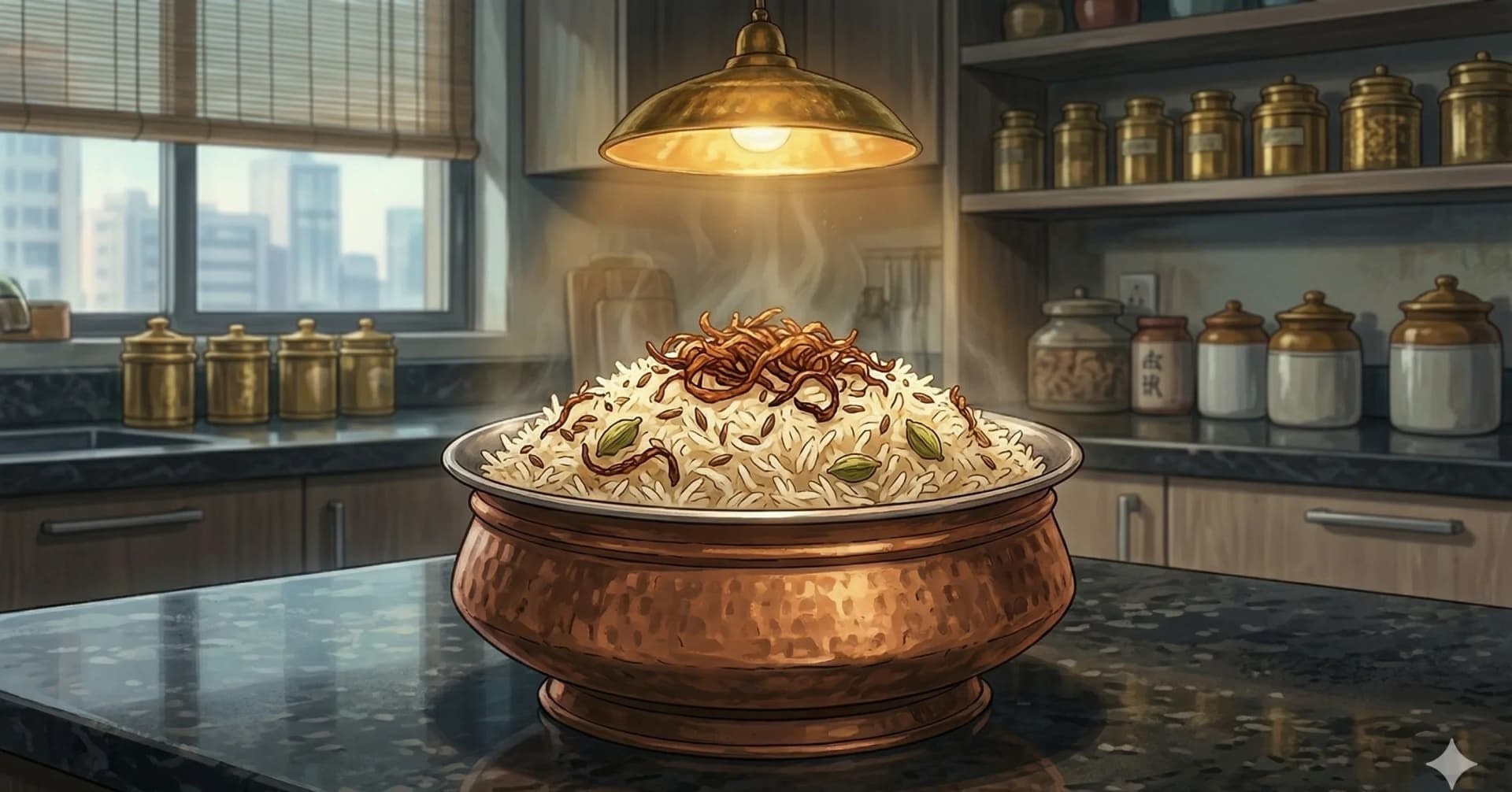
Onion-Fried Rice (Piyazi Chawal)
Caramelised onion rice cooked with whole spices
Piyaz is onion, and piyazi chawal is exactly what the name promises: rice cooked with a generous, unashamed amount of caramelised onion. Where jeera pulao uses a modest quantity of onion as background flavour, piyazi chawal puts the onion at the centre of the dish. The proportions are deliberate: a large quantity of thinly sliced onion, fried slowly until deep golden and sweet, then cooked together with the basmati until every grain is tinged with their colour and flavour.
This is one of the simpler preparations in the Punjabi rice repertoire but also one of the most satisfying. There is no cream, no stock, no protein. Just the chemistry of onion caramelisation applied to rice. When onions are cooked long enough, their sucrose breaks down through Maillard browning into dozens of new aromatic compounds with a sweet, almost caramel depth that plain rice could never achieve. The whole spices (cloves, cinnamon, black cardamom, and the essential cumin) contribute their own fragrance to this base.
The technique is the familiar Punjabi absorption method: oil, whole spices, onion, rice, water in a set ratio, covered on low heat until each grain is separate and fragrant. The dum cloth under the lid keeps the surface grains fluffy. The result is a rice dish that needs nothing alongside it to be interesting, though it is best served with a rich curry that has substantial gravy for contrast.
At a Glance
Yield
Serves 4–6
Prep
35 minutes (includes soaking)
Cook
30 minutes
Total
1 hour 5 minutes
Difficulty
Easy
Ingredients
- ¾ lbbasmati rice
- ½ tspwhole cloves (about 3–4)
- 1 tbspcinnamon sticks (about 2 short sticks)
- ¼ ozblack cardamom pods (about 2 pods)
- 2⅓ tbspneutral oil
- 1 tbspcumin seeds
- ½ lbonion (about 2 large onions), very thinly sliced
- 1⅓ tspsalt
Method
- 1
Soak the rice. Rinse the basmati in cold water until the water runs mostly clear. Cover with fresh cold water and soak for 30 minutes. Drain through a sieve.
- 2
Bloom the whole spices. Heat the oil in a wide, heavy-based pot over medium-high heat. Add the cloves (3–4), cinnamon, and black cardamom pods (2 pods). Stir for 30 seconds until fragrant.
- 3
Fry the onions. Add the cumin seeds (1½ teaspoons) and let them splutter for 20 seconds. Add the thinly sliced onions. This is the critical step: cook the onions over medium-high heat, stirring frequently, for 15–18 minutes until they are deep golden brown — genuinely dark, sweet-smelling, and greatly reduced in volume. They should look almost jammy at the edges. This is more onion (2 large onions) and more frying time than most rice recipes call for; do not rush it.
- 4
Add rice. Add the drained soaked rice and salt (1½ teaspoons). Fold very gently to combine — the oil-coated onion will streak through the rice, which is correct. Stir for 1–2 minutes until the rice is warmed.
- 5
Add water and cook. Add 600 ml of hot water. Stir once, bring to a boil, then reduce to the lowest simmer. Cook uncovered until the water drops just below the rice surface — about 6–8 minutes.
- 6
Dum finish. Place a clean folded kitchen cloth over the pot and cover tightly with the lid. Cook on the lowest heat for 20–22 minutes. Do not lift the lid.
- 7
Rest and serve. Remove from heat, rest covered for 5 minutes. Uncover and fluff gently with a fork. The rice should be deeply golden-tinged, the onion strands woven through every handful.
Key Ingredient Benefits
Onion (Allium cepa) is one of the most studied vegetables in food science. The caramelisation process that creates the golden-brown colour also creates new flavour compounds through the Maillard reaction, as well as breaking down the onion's sulphurous compounds (responsible for their pungency when raw) into milder, sweeter aromatic molecules. In Ayurvedic tradition, onion is considered warming and energising, and is thought to support circulation. Regular onion consumption is associated in epidemiological research with reduced cardiovascular risk markers.
Cumin seeds bloomed in oil before the onions are added do their primary work in the first 30 seconds of contact with hot oil, releasing cuminaldehyde and other volatile compounds into the fat. These distribute through the entire dish as the rice cooks. In Unani medicine, cumin is used as a carminative, thought to ease digestion and reduce flatulence.
Why This Works
The large quantity of onion is not excessive — it is the point. As the onion fries down from its raw bulk to the caramelised, deeply reduced state, it loses approximately 80% of its water weight. What remains is concentrated, sweet, and intensely flavoured. This flavour-dense reduced onion then distributes through the rice during cooking, giving every grain a faint sweetness and depth that a smaller quantity could not achieve.
The additional water (600 ml for 350 g rice, rather than the standard 560 ml) accounts for the extra surface area in the pot from the onion strands. Without slightly more water, the bottom of the pot can run dry before the top layer of rice finishes cooking.
Substitutions & Variations
Ghee for oil: A richer, more fragrant result. Use 2 tablespoons of ghee.
Brown onions (crispy): For a different texture, fry the onions over high heat until very crispy and dark (borderline burnt), then add the rice immediately. This produces a rice with crispy onion shards throughout rather than soft woven strands.
Add ginger: 1 teaspoon of grated fresh ginger added with the onions contributes a warm, bright note.
Serving Suggestions
Piyazi chawal is at its best alongside any preparation with substantial, rich gravy: dal makhni, rajma, lamb curry. The sweet, golden rice is a foil for spiced, savoury gravies. It also works as the rice course at a larger spread. Serve immediately after fluffing.
Storage & Reheating
Refrigerate for 2 days. Reheat covered with a splash of water. The caramelised onion deepens in flavour overnight, making day-two piyazi chawal particularly good.
Cultural Notes
Piyazi chawal (पियाज़ी चावल, "onion rice") is the everyday Awadhi and Lucknowi household rice preparation in which long-grain basmati rice is cooked with deeply caramelized fried onions (birista), whole spices, and ghee. The dish is one of the foundational household pulaos of the Awadhi cooking tradition that developed in the courts of Lucknow during the eighteenth and nineteenth centuries under the patronage of the Nawabs of Awadh. The technique uses the fried onions (birista) as the central flavor agent, providing the sweet caramelized depth that distinguishes Awadhi pulaos from the broader Indian pulao family.
The birista itself is a defining ingredient of Awadhi cooking and is worth describing in detail. Thinly sliced onions are fried slowly in ghee or oil over moderate heat for ten to fifteen minutes, with patient stirring, until they pass through translucent, then golden, then a deep amber brown without crossing into burnt territory. The browning develops Maillard flavor compounds that give the onions a sweet, almost caramel-like depth that fresh onions cannot match, and the fried onions then dissolve partially into the rice during cooking, distributing their flavor throughout the dish. Birista is also the foundational ingredient in hyderabadi-biryani and many other Awadhi and Hyderabadi preparations.
The technique builds the pulao on top of the birista foundation. Whole spices (green and black cardamom, cinnamon, cloves, bay leaf, mace) are tempered briefly in ghee, then a generous handful of birista is added, then the soaked basmati rice goes in for a brief toast in the seasoned ghee. Water or light stock is added at the standard pulao ratio, salt is adjusted, and the pot covers tightly and cooks over low heat for fifteen minutes. The dish is finished with a final scatter of fresh birista on top for visual contrast and a small drizzle of saffron-infused milk for color and aroma. The pulao appears at Awadhi family meals as the everyday rice (where the more elaborate yakhni pulao is reserved for occasions), and the dish has spread through the broader north Indian home cooking tradition as one of the most reliable ways to lift plain basmati rice with minimal effort.
Nutrition Facts
Calories: 280kcal (14%)|Total Carbohydrates: 50.6g (18%)|Protein: 4.7g (9%)|Total Fat: 6.2g (8%)|Saturated Fat: 0.9g (5%)|Cholesterol: 0mg (0%)|Sodium: 1338mg (58%)|Dietary Fiber: 1.6g (6%)|Total Sugars: 2g
You Might Also Like

Ratings & Comments
Ratings & Comments
Ratings
Share your thoughts on this recipe.
Sign in to rate and comment