Punjabi · Indian Cuisine
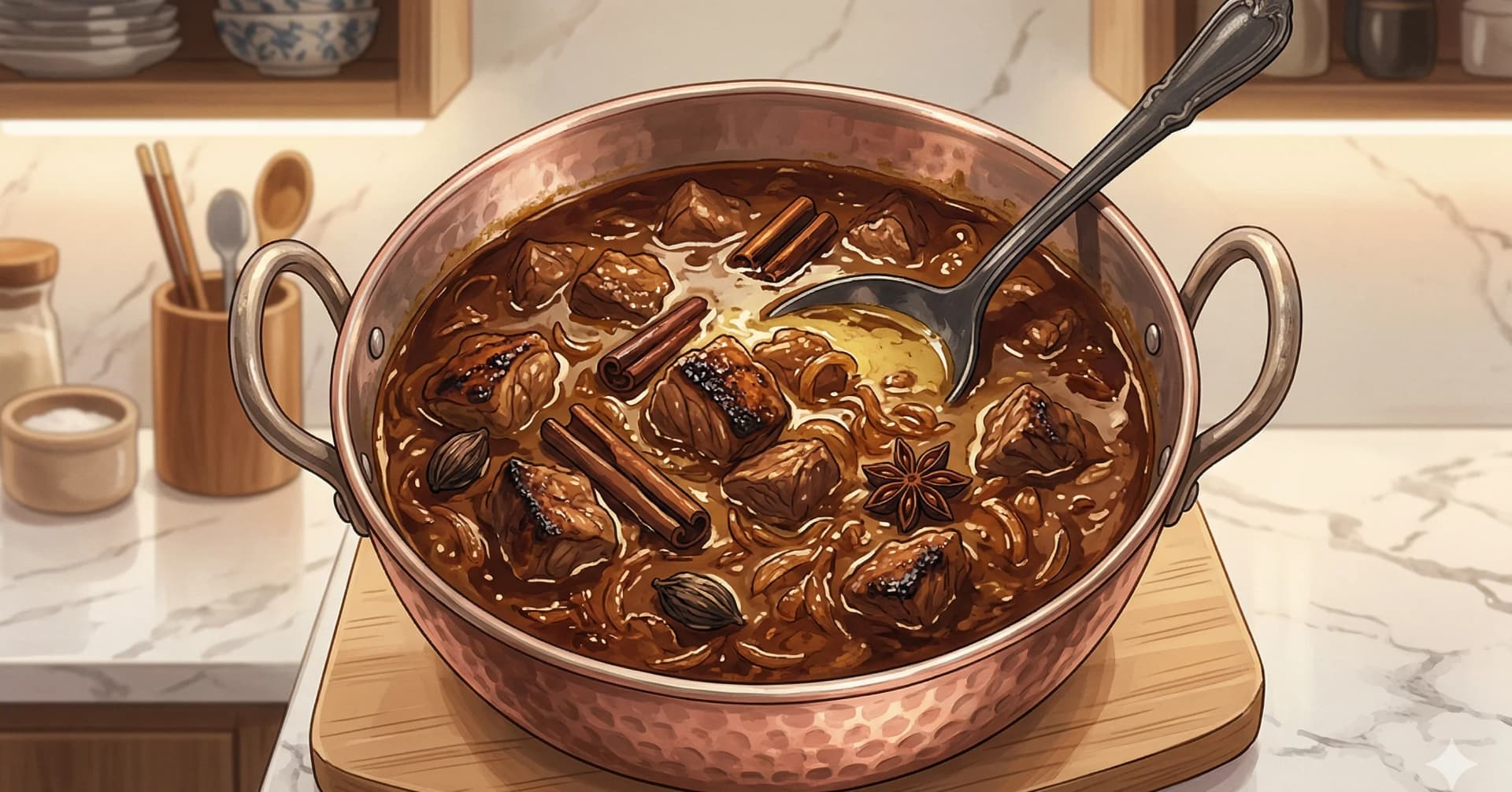
Semi-Dry Spiced Mutton (Rarha Gosht)
Lamb cooked three ways — boti, chops, and naali — in a deep spiced masala
The name rarha refers to a specific technique: the repeated bhunao, or reduction and drying of meat in its own moisture, done multiple times during cooking. This is not a hurried process. The lamb is added to the masala with its marinade, the mixture is brought to a boil, and then cooked until the moisture dries entirely. This cycle is repeated two or three times before liquid is added for the final braise. What emerges from this repeated reduction is a masala that has completely penetrated the meat, and a depth of flavour that a single addition of liquid could never achieve.
Rarha gosht is distinguished from a standard lamb curry by its three-cut composition: boti (boneless chunks, usually from the shoulder), chops (ribs, which render fat and flavour into the gravy), and naali (marrow bones, the long femur or shin bones that collapse over the heat and release marrow into the sauce, enriching it with an unctuous, mineral-sweet quality). This combination is deliberate and creates a dish with multiple textures and flavour contributions in the same pot.
The roasted and ground cumin and coriander, added towards the end, bring a different quality than the whole spices that went in at the beginning. Dry-roasting the seeds deepens and slightly nuttifies their flavour before grinding; these freshly ground spices carry more aromatic potency than a jar of pre-ground powder, and their addition near the finish keeps their fragrance intact in the final dish.
This is weekend cooking. The bhunao technique requires attention. Not constant, but frequent. The full process takes nearly two hours. The result is worth every minute.
At a Glance
Yield
Serves 6–8
Prep
30 minutes (plus 2 hours marinating)
Cook
1 hour 45 minutes
Total
4 hours 15 minutes
Difficulty
Involved
Ingredients
Marinade Ingredients
Curry Ingredients
- ¼ cupneutral oil
- ¼ ozgreen cardamom (about 4 pods)
- ¼ ozblack cardamom (about 2 pods)
- 1 tspwhole cloves (about 6 cloves)
- ⅞ tspcinnamon stick (about 3 cm)
- ¼ ozbay leaf (2 leaves)
- 4½ ozonion (about ½–1 onion), finely chopped
- 1¼ tbspginger paste (remainder)
- 2⅔ tspgarlic paste (remainder)
- 2½ tspKashmiri red chilli powder
- 3 oztomato (about ½–1 tomato), finely chopped
- ⅔ tspsalt
- 1¼ tbspfresh ginger, finely julienned
- 2 tspgreen chillies (about 2), slit lengthways
- ½ cupfresh coriander, roughly chopped
- 1¾ ozplain yoghurt, whisked (additional, for cooking)
- 1 tbspcumin seeds, dry-roasted and ground
- 2¾ tspcoriander seeds, dry-roasted and ground
Method
- 1
Marinate the lamb. Whisk the yoghurt (50 g) well. Combine all the lamb pieces in a large bowl. Add half the ginger (7 g) paste (20 g), half the garlic paste (13 g), the whisked yoghurt, and a pinch of salt (¾ teaspoon). Mix thoroughly so every piece is coated. Cover and refrigerate for at least 2 hours, or overnight.
- 2
Dry-roast the spices. In a dry frying pan over low-medium heat, roast the cumin seeds (7 g), stirring constantly, until they darken slightly and smell nutty, about 3 minutes. Tip onto a plate to cool. Repeat with the coriander (10 g) seeds (5 g). Once cooled, grind both separately or together to a coarse powder using a spice grinder or mortar. Set aside.
- 3
Bloom the whole spices. Heat the oil in a large, wide heavy-based pot over medium-high heat. Add the green cardamom (4 pods), black cardamom (2 pods), cloves (6 cloves), cinnamon, and bay leaves. Stir for 30–45 seconds until fragrant.
- 4
Fry the onions. Add the finely chopped onions and fry over medium-high heat, stirring regularly, for 12–15 minutes until deep golden brown. Add the remaining ginger and garlic pastes and stir for 2 minutes.
- 5
Add the Kashmiri chilli. Add the Kashmiri chilli powder (1 teaspoon) and stir for 30 seconds. The oil should turn a deep brick red.
- 6
First bhunao. Add all the marinated lamb with its marinade to the pot. Stir well to coat everything in the masala. Bring to a boil over high heat, then cook over medium-high heat, stirring every few minutes, until all the liquid from the marinade has completely evaporated and the mixture has reduced to a thick, dry masala clinging to the meat, about 15–18 minutes. This is the first *bhunao*.
- 7
Second bhunao. Add 100 ml of water to the pot. Stir well, scraping up any stuck bits. Bring back to a boil and again cook, stirring regularly, until the liquid has completely dried, another 12–15 minutes. The meat should look deep, almost charred at the edges where it rests against the pan.
- 8
Third bhunao. Repeat once more: add another 100 ml of water, bring to a boil, and cook until dry. At this stage the masala should be deeply fragrant, the lamb well coloured, and the oil beginning to separate and pool around the pieces.
- 9
Add tomatoes and yoghurt (50 g). Add the chopped tomatoes and stir well. Cook for 5 minutes until the tomatoes break down. Add the whisked yoghurt a little at a time, stirring constantly. Once incorporated, stir and cook for 3–4 minutes.
- 10
Final braise. Add 300–400 ml of hot water to bring the pot to a loose curry consistency. Add the salt. Bring to a boil, then reduce to a slow simmer. Cover and cook for 30–35 minutes until all the lamb pieces are completely tender. The boti should be soft and yielding, and the marrow should have melted from the naali bones into the gravy.
- 11
Finish. Add the roasted ground cumin and coriander powder. Stir through. Taste and adjust salt. Scatter the ginger julienne, green chillies (2), and fresh coriander over the top. Serve immediately.
Key Ingredient Benefits
Lamb marrow (naali) is one of the most nutrient-dense parts of the animal. Bone marrow is high in fat-soluble vitamins (particularly vitamin K2) and contains various fatty acids, iron, and collagen precursors. In Unani medicine, marrow preparations are considered among the most muqawwi (strength-giving) ingredients, used in preparations for recovery and vitality. The rich, unctuous quality it lends to a long-simmered curry is both flavour and function.
Black cardamom (Amomum subulatum) is distinct from green cardamom. Its dried, fire-smoked pods carry an earthy, camphor-like, slightly menthol note that is particularly suited to meat preparations. In Ayurvedic tradition it is considered warming and is used to support respiratory function. It is a key spice in Mughal-influenced North Indian cooking where its smoky depth rounds out rich meat gravies.
Yoghurt marinade tenderises the meat through its lactic acid content, which begins to break down muscle fibres during marinating. The proteins in the yoghurt also insulate the meat surface during the initial high-heat cooking, preventing it from hardening before the slow braise has a chance to fully tenderise the interior. This dual role as tenderiser and insulator is why yoghurt-based marinades appear throughout Mughal and Punjabi meat cookery.
Why This Works
The bhunao technique (the repeated dry-out cycles) achieves something that a straight braise cannot. Each time the moisture is driven off, the dry heat in the pan begins to toast the meat surface and the spices against the metal, developing Maillard compounds (browning flavours) that are very different from the flavours created by wet braising. By the third bhunao, the meat and masala have been cooked in both wet and dry conditions repeatedly, producing a multi-layered flavour profile that is the hallmark of serious North Indian meat cookery.
The three-cut composition serves more than aesthetics. Each cut contributes differently: the boti provides the tender, flavourful lean bulk of the dish; the chops render fat from their intramuscular marbling and their bones release collagen that gives the gravy body and a slight lip-coating richness; the naali marrow bones release marrow (pure fat and connective tissue) into the gravy as they cook, creating the unctuous, deeply savoury undertone that single-cut lamb curries lack.
Substitutions & Variations
Single-cut version: If naali or chops are not available, use 700 g of bone-in lamb shoulder pieces (with some bones for flavour). The dish will still be excellent, though with less of the multi-texture character.
Mutton for lamb: Older mutton produces even deeper flavour in this preparation, though cooking time in the final braise extends to 50–60 minutes.
Fewer bhunao cycles: Two bhunao cycles produce a very good result if time is short; three is ideal for the deepest flavour.
Lamb without marrow bones: If naali is unavailable, stir a tablespoon of ghee into the finished curry to approximate the richness the marrow bones provide.
Serving Suggestions
Rarha gosht is a centrepiece dish. It belongs at the centre of a serious meal, not as a supporting player. Serve with layered paratha or tandoori roti for a traditional Punjabi spread. Jeera pulao is also an excellent accompaniment, allowing the richly spiced gravy to be absorbed into fragrant rice. A simple raw kachumber salad (onion, tomato, cucumber, lemon, chilli) and a bowl of plain yoghurt are the only supporting dishes needed. This is the kind of meat dish that people remember for a long time.
Storage & Reheating
Refrigerate for up to 3 days. The flavours deepen significantly by the next day. The marrow from the bones will solidify into a layer of fat in the cold gravy; skim or stir back in depending on preference. Reheat gently over low heat, covered, adding a splash of water if the gravy has thickened. Freezes well for up to 1 month; the texture of the boti holds well through freezing and thawing.
Cultural Notes
Rarha gosht (रारा गोश्त, sometimes rara mutton) is the Punjabi-Awadhi double-textured lamb preparation in which whole pieces of bone-in lamb are cooked together with ground lamb (keema) in a single onion-tomato-ginger-garlic gravy, producing a dish that has the chew of the whole pieces and the rich texture of the keema blended into one preparation. The dish belongs to the Punjabi dhaba tradition (the roadside truck-stop and small-restaurant tradition of the Grand Trunk Road through Punjab and western Uttar Pradesh) and to the broader Mughlai meat-cooking lineage that influenced Punjabi cooking through centuries of cultural exchange.
The double-meat technique is the dish's defining feature. Most lamb curries use either whole pieces or ground keema, not both, and the rarha gosht's combination of the two textures in a single gravy gives the dish a richer mouthfeel than either single-texture preparation. The keema breaks down further as the dish cooks, adding body and savory depth to the gravy that ordinary whole-piece curries lack, while the whole lamb pieces provide the satisfying chew and bone marrow flavor of a slow-braised bone-in cut. The technique probably developed in the Punjab-Awadh corridor where Mughlai meat-cooking traditions met the heartier Punjabi dhaba style, producing a hybrid preparation that suits both refined court cooking and the assertive flavors of dhaba cooking.
The technique cooks the two meats together from the start. Bone-in lamb (shoulder or leg cut into curry-size pieces, with a few pieces of marrow bone for extra flavor) and ground lamb (medium-coarse mince, ideally with some fat content for richness) are combined in roughly equal proportions. Onions are sliced and sautéed in ghee until deep golden brown, then ginger-garlic paste, ground tomato, Kashmiri red chili powder, ground coriander, ground cumin, and turmeric are added. The two cuts of lamb are added together with salt and a small amount of water, and the pot is covered and cooked over medium heat for an hour. The keema breaks down into the gravy, the whole pieces tenderize, and the gravy thickens to a rich consistency. The dish is finished with a scatter of garam masala, fresh ginger juliennes, sliced green chilies, and chopped cilantro. The dish is served with naan, tandoori roti, or steamed basmati rice.
Nutrition Facts
Calories: 273kcal (14%)|Total Carbohydrates: 2.5g (1%)|Protein: 20.3g (41%)|Total Fat: 19.8g (25%)|Saturated Fat: 7.3g (37%)|Cholesterol: 68mg (23%)|Sodium: 560mg (24%)|Dietary Fiber: 0.4g (1%)|Total Sugars: 1.5g
You Might Also Like

Ratings & Comments
Ratings & Comments
Ratings
Share your thoughts on this recipe.
Sign in to rate and comment