Goan · Indian Cuisine
Goan Red Spice Paste (Reichado Masala)
The fiery Goan red paste of dried chillies, vinegar, garlic, and roasted spices
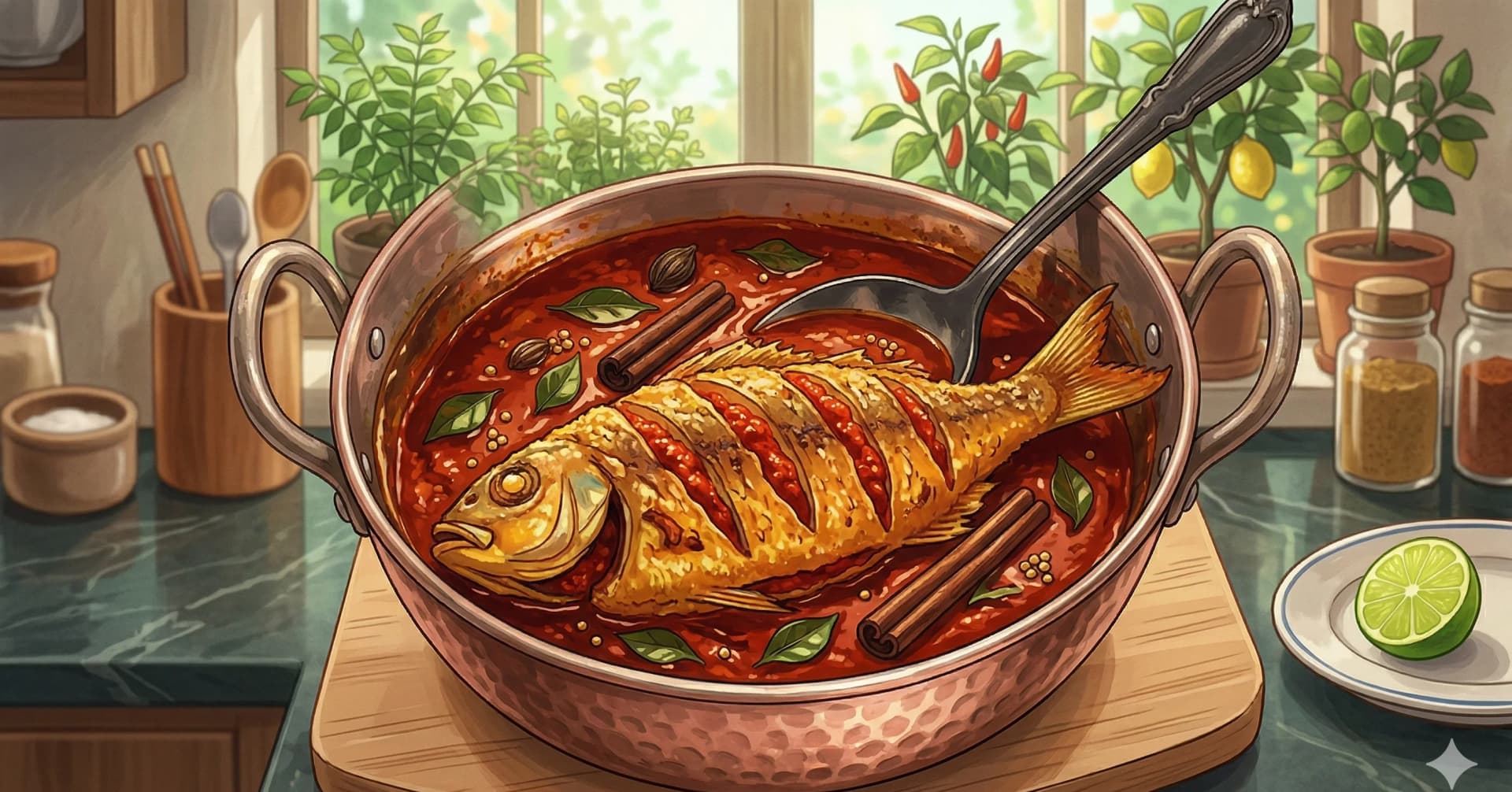
In Goan cooking, reichado masala is not a condiment that arrives at the table. It is the starting point that never shows itself directly. It is the paste stuffed into slitted mackerel before frying, the coating that gives stuffed prawns their fire, the base rubbed onto chicken before it meets the grill. To know this masala is to understand the engine behind much of what makes Goan coastal food distinct.
The combination is Goan through and through: dried red chillies ground with garlic (in quantities that would alarm most cooks), vinegar that carries the Portuguese influence still present in this cuisine three centuries after it arrived, tamarind for depth and sourness, and roasted whole spices — coriander, cumin, cloves, cinnamon — that are toasted carefully, at low heat, until fragrant but never dark. The instruction to keep the spices from darkening is specific and important: roasted-dark spices become bitter and overwhelming, overpowering the bright chilli and vinegar that are the soul of this paste.
The result, ground together with patience until completely smooth, is a paste the colour of dried brick: intensely aromatic, hot, sour, and complex. It keeps well in the refrigerator and is the kind of preparation that rewards making in a larger batch.
At a Glance
Yield
Makes about 200 g of paste
Prep
10 minutes
Cook
8 minutes (roasting the spices)
Total
20 minutes
Difficulty
Easy
Ingredients
- 3¼ tbspdried red chillies (about 10–15 chillies, depending on size and heat level)
- ⅓ tspwhole black peppercorns
- ⅓ cupgarlic flakes (about 10–12 cloves)
- ½ tspwhole cloves (about 4–5)
- ⅞ tspcinnamon (about 1 short stick)
- 1 tspcumin seeds
- 1¾ tbspcoriander seeds
- ¾ tspturmeric powder
- 1¼ tspsugar
- 1 oztamarind block, soaked in 60 ml warm water and strained to a pulp
- 2 tbspwhite wine vinegar or malt vinegar
Method
- 1
Soak the tamarind. Break the tamarind block (30 g) into the warm water and leave for 10 minutes, squeezing and working it into the water. Strain through a sieve, pressing well, to extract a smooth, dark pulp. Discard the fibres and seeds.
- 2
Roast the whole spices. In a dry frying pan over very low heat, add the coriander seeds (2 teaspoons), cumin (½ teaspoon), cloves (4–5), and cinnamon (1 short stick). Toast gently, stirring constantly, for 4–5 minutes until fragrant. The spices should be aromatic and a shade or two darker — but must not turn dark brown or black, which would make them bitter. Remove immediately from the pan onto a cool plate.
- 3
Combine and grind. Transfer the roasted spices to a blender or spice grinder. Add the dried red chillies (10–15 chillies, depending on size and heat level), peppercorns, garlic (10–12 cloves), turmeric (½ teaspoon), sugar (1 teaspoon), tamarind pulp, and vinegar. Blend to a completely smooth, fine paste. If the blender is struggling, add a tablespoon of water at a time to get it moving — but keep the paste thick.
- 4
Taste and adjust. The paste should be intensely hot, sour, aromatic, and slightly sweet. Adjust with a little more sugar if too sharp, or more vinegar if it needs brightness. Taste with caution — it is concentrated.
- 5
Store in a clean glass jar in the refrigerator for up to 4 weeks.
Key Ingredient Benefits
Dried red chillies retain most of their capsaicin content through drying and grinding. Capsaicin research has explored its potential role in metabolism, pain relief (topically), and cardiovascular function, though the dietary quantities in a paste like this are small enough that no specific effect should be expected.
Tamarind (Tamarindus indica) is a key souring agent across South and Southeast Asian cooking and also appears throughout West African cuisine. It is rich in tartaric acid and contains significant amounts of magnesium and iron. In Ayurvedic tradition, tamarind is used as a digestive and considered cooling despite its sour taste.
Garlic in the quantities used here (30 g is a lot) gives the paste a pungent, slightly raw depth that mellows when the paste is cooked into a dish but remains present. Garlic contains allicin, which has been studied extensively for its antimicrobial and potential cardiovascular properties.
Why This Works
Roasting the spices on very low heat (rather than the high heat typically used for tempering) is the crucial technique here. Low-heat roasting dries and develops the volatile aromatic compounds in each spice without driving them off or carbonising them. The difference in the finished paste is measurable: low-roasted spices produce a paste with floral, complex warmth; high-roasted spices produce bitterness.
Vinegar and tamarind together provide a double layer of sourness: vinegar's sharp acetic acid from the outside, tamarind's fruity tartaric and citric acids from within. The combination is more interesting than either alone and is a defining characteristic of Goan sour cooking, which layers acidic notes rather than relying on a single source.
Sugar is not a sweetener here. At this quantity it acts as a balancer, rounding the edges of the chilli heat and the vinegar sharpness without making the paste taste sweet.
Substitutions & Variations
Dried red chilies: Kashmiri chilies provide color without aggressive heat (most authentic Goan choice). Byadgi chilies are another mild, color-rich option. For more heat, use a mix of Kashmiri and Guntur chilies. Avoid bell-pepper-based chilies (too mild for proper reichado character).
Vinegar: Goan toddy vinegar (coconut vinegar) is the most authentic. Cane vinegar substitutes well. Apple cider vinegar works but is sweeter. White wine vinegar produces a sharper result. Avoid balsamic (too sweet, wrong character).
Garlic: Cannot really be reduced or omitted — garlic is one of the defining elements of reichado. Use fresh garlic, not powder.
Cumin and coriander seeds: Both should be whole and lightly toasted before grinding. Ground spices work but produce a less complex result.
Cinnamon and cloves: Use small quantities — these are accent spices, not dominant. Cassia bark substitutes for true cinnamon.
Tamarind: Tamarind paste (a small spoonful) adds depth to the vinegar's acidity. Optional but traditional. Lime juice can substitute.
Without a wet grinder or food processor: A mortar and pestle works (and is traditional) but requires significant time and effort. About 20 to 30 minutes of pounding produces a coarser but very flavorful paste. Modern Goan kitchens almost universally use electric grinders.
Spice level adjustment: The paste is meant to be moderately spicy but not aggressively hot. Reduce the chili quantity for milder versions; increase for fire-eaters.
Serving Suggestions
Reichado masala is a base preparation, designed to be used as a stuffing or marinade for other Goan preparations rather than eaten on its own. The most common applications:
Reichado fish: The classic preparation. The masala is stuffed into slits in whole fish (mackerel, pomfret, or sardines), which are then shallow-fried or grilled. The most iconic Goan use of reichado.
Reichado prawns: Large prawns butterflied and stuffed with reichado masala, then shallow-fried.
Reichado chicken: A modern variation. The masala is rubbed under the skin of chicken pieces before grilling or roasting.
Reichado stuffed vegetables: The masala stuffed into bell peppers, okra, or eggplant for vegetarian Goan preparations.
Sandwich spread: A modern Goan-Continental fusion application. Use as a spicy spread for grilled cheese, mackerel sandwiches, or paninis.
Marinade: Thin with a bit more vinegar and use as a marinade for fish or chicken before grilling.
Pairings: Reichado preparations are typically served with Goan rice and curry, sannas (steamed rice cakes), or Goan-style yellow rice. A simple solkadhi (coconut-kokum drink) is the traditional Goan accompaniment.
Beverage pairing: Cold Kingfisher beer or feni (Goan cashew/coconut liquor) for adult meals. Buttermilk or lassi for casual home meals.
Storage & Reheating
Keeps in a sealed jar in the refrigerator for up to 4 weeks. The vinegar and acid act as preservatives. Ensure no water or contaminating moisture enters the jar. The paste can also be frozen in small portions for up to 3 months.
Cultural Notes
Reichado masala (sometimes spelled recheado or recheio) is a defining preparation of Goan cuisine and one of the clearest examples of the Portuguese-Indian culinary fusion that characterizes the region. The name derives from the Portuguese recheado (literally "stuffed"), reflecting the preparation's primary use as a stuffing for fish.
The dish traces back to the Portuguese colonial period in Goa (1510-1961), one of the longest colonial relationships in Asian history. The Portuguese brought New World ingredients (chilies, tomatoes, potatoes, vinegar, garlic) to Goa and integrated them with local Konkan cooking traditions and Catholic dietary practices. The result is Goan-Catholic cuisine, which differs significantly from Hindu Goan cooking and from broader Indian regional traditions.
The use of vinegar as a primary souring agent (rather than tamarind, kokum, or yogurt) is one of the Portuguese influences that distinguishes Goan-Catholic cuisine from its neighbors. Reichado masala's vinegar base is central to its character — both as a preservative (allowing the paste to keep for weeks) and as a flavor element that produces the characteristic sharp, slightly acidic profile.
The dish belongs to a broader family of Goan masala pastes, including vindaloo masala (very hot, with more chilies and palm vinegar), cafreal masala (green herb-based, originally from Mozambique), and various seafood-specific pastes. Each represents a different aspect of Portuguese-Goan culinary fusion.
Reichado is particularly associated with fish preparation in Goan home cooking. Whole mackerel, pomfret, or sardines are slit along the sides, stuffed with reichado masala, and shallow-fried in coconut oil or vegetable oil. This preparation appears at virtually every Goan-Catholic family meal that includes fish, and is one of the most distinctive Goan home-cooking traditions.
The dish has become a marker of Goan cultural identity, particularly for the Goan-Catholic diaspora. Goan migrants to Mumbai, the Gulf states, the UK, Canada, and Australia have brought reichado preparations with them, and the cuisine has become one of the most recognizable Indian regional traditions globally. Restaurants serving authentic Goan food often feature multiple reichado preparations as signature items.
Nutrition Facts
Calories: 26kcal (1%)|Total Carbohydrates: 5.4g (2%)|Protein: 0.5g (1%)|Total Fat: 0.4g (1%)|Saturated Fat: 0.1g (1%)|Cholesterol: 0mg (0%)|Sodium: 1mg (0%)|Dietary Fiber: 0.9g (3%)|Total Sugars: 1.9g
You Might Also Like
Ratings & Comments
Ratings & Comments
Ratings
Share your thoughts on this recipe.
Sign in to rate and comment