Tamil Nadu · Indian Cuisine
Sambar
Tamarind and lentil vegetable stew from Tamil Nadu
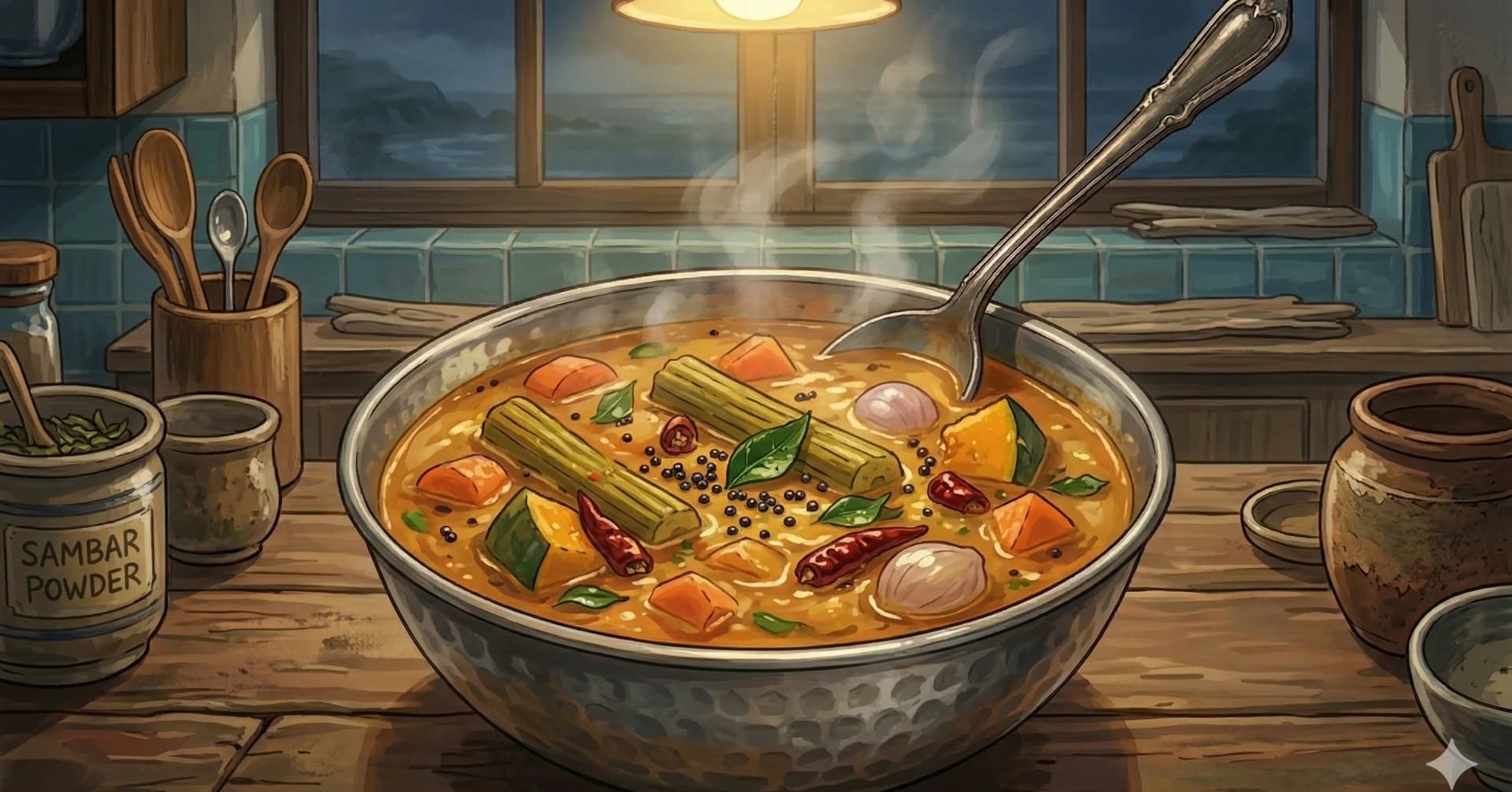
The smell of sambar is one of the most immediately recognisable in South Indian cooking — a complex, layered fragrance that arrives in waves: first the sour-deep note of tamarind as it begins to boil, then the warmth of sambar powder (dried chilli, coriander, curry leaves, and a dozen other spices, ground together), then the bright, crackling pop of mustard seeds hitting hot oil as the tempering is prepared. By the time it reaches the table, sambar carries the whole South Indian kitchen in its steam.
Sambar belongs to the daily repertoire of Tamil Nadu in a way that no other preparation does — it accompanies idly at breakfast, rice at lunch, and dosa in the evening. Every household and every cook has their version: some thicker, some sharper with tamarind, some sweeter with pumpkin, some built around drumstick alone, some containing a whole garden of vegetables. What they share is the structural logic: toor dal cooked to softness and mashed into the broth, tamarind providing the acidic backbone, the sambar powder rounding everything with its compound spice, and the tempering arriving at the very end as both flavour and theatre.
The vegetables matter. Drumstick (moringa) pods are the traditional centrepiece — their fibrous flesh extracts a particular sweet-earthy flavour into the sambar that nothing else replicates. Brinjal (eggplant) contributes a silky body; shallots add sweetness; tomato cuts through the tamarind with brightness. The combination should feel considered, not random. If drumstick is unavailable, the sambar will still be good — but different.
One practical note worth keeping: the tempering is the final act, not an afterthought. Heat the oil until it shimmers, add the mustard seeds and wait for every one of them to pop, then add the curry leaves (stand back — they spit), the dried chillies, and the asafoetida. Pour this hissing, crackling mixture over the sambar immediately and cover the pot for one minute to let the aromas bloom into the stew. That final minute makes the difference between sambar that tastes finished and sambar that does not.
At a Glance
Yield
Serves 4
Prep
20 minutes
Cook
40 minutes
Total
1 hour
Difficulty
Easy
Ingredients
- 7 oztoor dal (split pigeon peas), rinsed
- 7 ozmixed vegetables: drumstick (moringa pods), brinjal (eggplant), shallots, tomato (about 1½–2 tomatoes), and pumpkin — cut into medium pieces
- ¾ oztamarind block (about a walnut-sized piece), soaked in 200 ml warm water for 15 minutes
- ¾ ozsambar powder
- 1⅞ tspturmeric
- ⅞ tspfine salt, or to taste
- 1⅓ tbspneutral oil
- 1⅔ tspblack mustard seeds
- ⅓ cupfresh curry leaves (about 12–15 leaves, one sprig)
- 1½ tspdried red chillies (about 3 whole chillies)
- 1⅛ tspasafoetida / hing
- ¼ cupfresh coriander, roughly chopped
Method
- 1
Cook the dal. Place the rinsed toor dal (200 g) in a pressure cooker with 500 ml of water. Pressure cook for 4–5 whistles (about 15–20 minutes) until the dal is completely soft and beginning to break down. If cooking in an open pot, simmer for 35–40 minutes with a lid, checking and adding water as needed. The cooked dal should look thick and fully tender — no firm or white centres remaining. Using a whisk or the back of a ladle, mash the dal well until it is smooth and slightly creamy. Set aside.
- 2
Extract the tamarind juice. Work the soaked tamarind with your fingers in the soaking water, dissolving the pulp and loosening the fibres and seeds. Strain through a fine sieve, pressing firmly to extract all the pulp. Discard the fibres and seeds. You should have approximately 150–200 ml of tamarind extract — a deep amber, tart liquid.
- 3
Cook the vegetables. In a medium-to-large saucepan, combine the tamarind extract with an additional 300 ml of water. Bring to a boil. Add the chopped vegetables: if using drumstick, add it first (it takes longest). After 3 minutes add the brinjal, shallots, and pumpkin. After another 3 minutes add the tomato. Add the turmeric (1 teaspoon), sambar powder (4 teaspoons), and salt (1 teaspoon). Stir everything together and simmer on a medium flame, partially covered, for 10–12 minutes until all the vegetables are tender. The brinjal should have softened and lost its raw opacity; the drumstick should be fully cooked through and yielding.
- 4
Add the dal and simmer. Add the mashed toor dal to the simmering vegetables and tamarind broth. Stir to combine thoroughly — the sambar should look cohesive, not like dal floating in tamarind water. The consistency should be just thicker than a broth: pourable but with body. If it is too thick, add a splash of water and adjust. Simmer gently for 15–20 minutes, stirring occasionally, to allow the flavours to fully integrate. Taste and adjust salt, and if the tamarind sourness is too sharp, a small pinch of jaggery or sugar will round it. The finished sambar should taste rounded — sour and savoury and warm-spiced, with no single element dominating.
- 5
Prepare the tempering. In a small, heavy pan or tadka ladle, heat the oil over medium-high heat until it is visibly shimmering and very hot. Add the mustard seeds (1 teaspoon) and stand slightly back — within 30–45 seconds they will begin to pop with an enthusiastic, staccato sound. When every seed has popped, add the dried red chillies (3 whole chillies) whole and toss once, then add the curry (12–15 leaves, one sprig) leaves (they will spit loudly — this is normal and correct). Immediately add the asafoetida (½ teaspoon) and stir once, then remove from heat.
- 6
Finish and serve. Pour the entire contents of the tempering pan over the simmering sambar in one motion. Cover the pot immediately and leave for 1 minute to allow the aromatic oils to bloom into the stew. Uncover, add the chopped coriander (5 g), stir gently, and bring to the table.
Key Ingredient Benefits
Toor dal (split pigeon pea) is among the most commonly consumed legumes in South India, providing a significant source of plant protein and dietary fibre. Research suggests that regular legume consumption is associated with improved cardiovascular markers and sustained satiety. In Ayurvedic practice, toor dal is considered light and easy to digest compared to other dals.
Tamarind (Tamarindus indica) provides the sharp organic acidity that defines sambar's character. It contains tartaric acid, a natural preservative and the compound responsible for its distinctive sourness. Tamarind is traditionally used in South and Southeast Asian cooking as a digestive and appetite stimulant, and research suggests its tartaric acid content may be associated with antioxidant activity.
Curry leaves (Murraya koenigii) are far more than a garnish in Tamil Nadu cooking — they are a defining aromatic that releases a complex, resinous, slightly citrusy fragrance when they hit hot oil. Research suggests curry leaves contain alkaloids and carbazole compounds that may be associated with antioxidant and anti-inflammatory properties, though they are used here primarily for their irreplaceable flavour contribution.
Asafoetida (hing) is the dried resin of Ferula species and has been used in Indian cooking for millennia as both a flavour agent and a digestive aid. Traditionally used in Ayurveda to treat flatulence and bloating, it is a standard addition to any lentil-based preparation in Indian cooking. Research on its traditional carminative use is limited but supportive of its role in reducing digestive discomfort associated with legumes.
Why This Works
The pairing of toor dal with tamarind is one of the defining flavour combinations of South Indian cooking. Toor dal contributes a mild, slightly nutty sweetness and a starchy thickness that rounds and softens the tamarind's acidity. Without the dal, the tamarind broth would be too sharp and thin; without the tamarind, the dal would be too flat. The two together arrive at a balance that is the fundamental character of sambar — sour but not harsh, savoury but not heavy.
Sambar powder is a compound spice blend unique to this dish, typically containing dried red chilli, coriander seeds, cumin, black pepper, curry leaves, and other spices toasted and ground together. Using a good-quality sambar powder (or making your own) is more impactful on the final result than any other single ingredient choice. Store-bought sambar powders vary widely in quality and heat level; taste yours before adding and adjust accordingly.
Asafoetida (hing) in the tempering serves both flavour and digestive purposes. Its sharp, sulphurous raw smell (which can be alarming in the jar) transforms completely when it hits hot oil, becoming savoury and deeply onion-like. In Brahmin communities where onions and garlic are not used, hing provides the savoury depth that those aromatics would otherwise contribute. It is also traditionally used as a carminative, thought to ease the digestion of legumes.
Substitutions & Variations
Vegetables: The combination of vegetables is flexible. Drumstick (moringa pod) is the most authentic addition and worth seeking out; its flavour is irreplaceable. Other options include pearl onions, carrot, green beans, potato, raw banana, and yam. Avoid very delicate vegetables that will dissolve completely with the long simmer.
No pressure cooker: Toor dal can be simmered in an open pot with a lid — allow 35–40 minutes and check water levels. The result is identical, just slower.
Sambar powder: If sambar powder is unavailable, a rough substitute can be made from: 1 tsp ground coriander, ½ tsp red chilli powder, ¼ tsp cumin, ¼ tsp black pepper, and a pinch of ground fenugreek. This will not replicate the depth of a properly made sambar powder, but will approximate the flavour profile.
Tomato instead of tamarind: Some recipes reduce the tamarind and increase tomato for a fresher, less sour flavour. This is a valid variation, particularly good with more delicate vegetables.
Serving Suggestions
Sambar is the essential companion to idly (steamed fermented rice cakes) and is equally at home alongside dosa, uttapam, vada, or plain steamed rice. In Tamil Nadu households it typically appears at all three meals of the day. The traditional serving method is to ladle it generously into a separate bowl for dunking idlis and dosas, or to pour it directly over a mound of rice. A small amount of ghee stirred into a bowl of rice-and-sambar is a common and deeply comforting finish.
Storage & Reheating
Sambar keeps very well. Store in an airtight container in the refrigerator for up to 4 days — the flavour deepens noticeably after a day, as the spices and tamarind continue to integrate. Reheat gently on the stovetop over medium heat, adding a splash of water if it has thickened in the fridge. Sambar can also be frozen for up to 2 months; thaw overnight in the refrigerator and reheat as above.
Cultural Notes
Sambar (சாம்பார்) is the South Indian lentil-and-vegetable stew that anchors the broader South Indian meal alongside rice, dosa, idly, and vada. The dish is built around a base of cooked toor dal (split pigeon pea), to which tamarind water, vegetables (drumsticks, eggplant, okra, pumpkin, shallots, tomato, carrot), and the signature sambar masala spice blend are added, simmered together until everything is tender and the flavors meld. The dish has multiple regional variants across South India, with the most widely documented being the Tamil Brahmin (Iyer/Iyengar) version, the Karnataka (Udupi) version, the Andhra version, and the Kerala version, each with its own spice profile and ingredient preferences.
The sambar masala spice blend is the defining flavor element. The traditional Tamil version combines coriander seeds, chana dal, urad dal, fenugreek seeds, dried red chilies, asafoetida, and curry leaves, all dry-roasted and ground together to a coarse powder. Some regional variants add coconut, cumin, or black pepper. The blend is typically prepared in large batches and stored for several weeks, since the freshly ground masala is the single most important variable in the quality of the finished sambar. The dish is finished with a tadka (tempering) of mustard seeds, urad dal, dried red chili, curry leaves, and asafoetida bloomed in ghee or oil and poured over the simmered stew at the end.
The cultural foundation of sambar is the South Indian thali, the traditional plated meal in which sambar is one of two or three dal-based dishes (alongside rasam and sometimes a coconut-based curry) served over plain steamed rice. The thali appears at family meals, at the temple food (prasadam) tradition of South Indian Hindu temples, at the meals restaurants that serve the unlimited South Indian rice-and-curry meal for a fixed price, and at countless weddings and family events. The dish has spread through the global Indian diaspora and is now widely available at South Indian restaurants in the United States, the United Kingdom, Singapore, Malaysia, and the Gulf states. K.T. Achaya's Historical Dictionary of Indian Food documents the dish's history, noting that the word "sambar" itself may derive from Maratha sources during the seventeenth century, possibly named after the Maratha king Sambhaji.
Nutrition Facts
Calories: 225kcal (11%)|Total Carbohydrates: 37.1g (13%)|Protein: 11.6g (23%)|Total Fat: 3.9g (5%)|Saturated Fat: 0.5g (3%)|Cholesterol: 0mg (0%)|Sodium: 1265mg (55%)|Dietary Fiber: 8.8g (31%)|Total Sugars: 2.9g
You Might Also Like
Ratings & Comments
Ratings & Comments
Ratings
Share your thoughts on this recipe.
Sign in to rate and comment