Chinese Cuisine
Jian Dui (Sesame Balls)
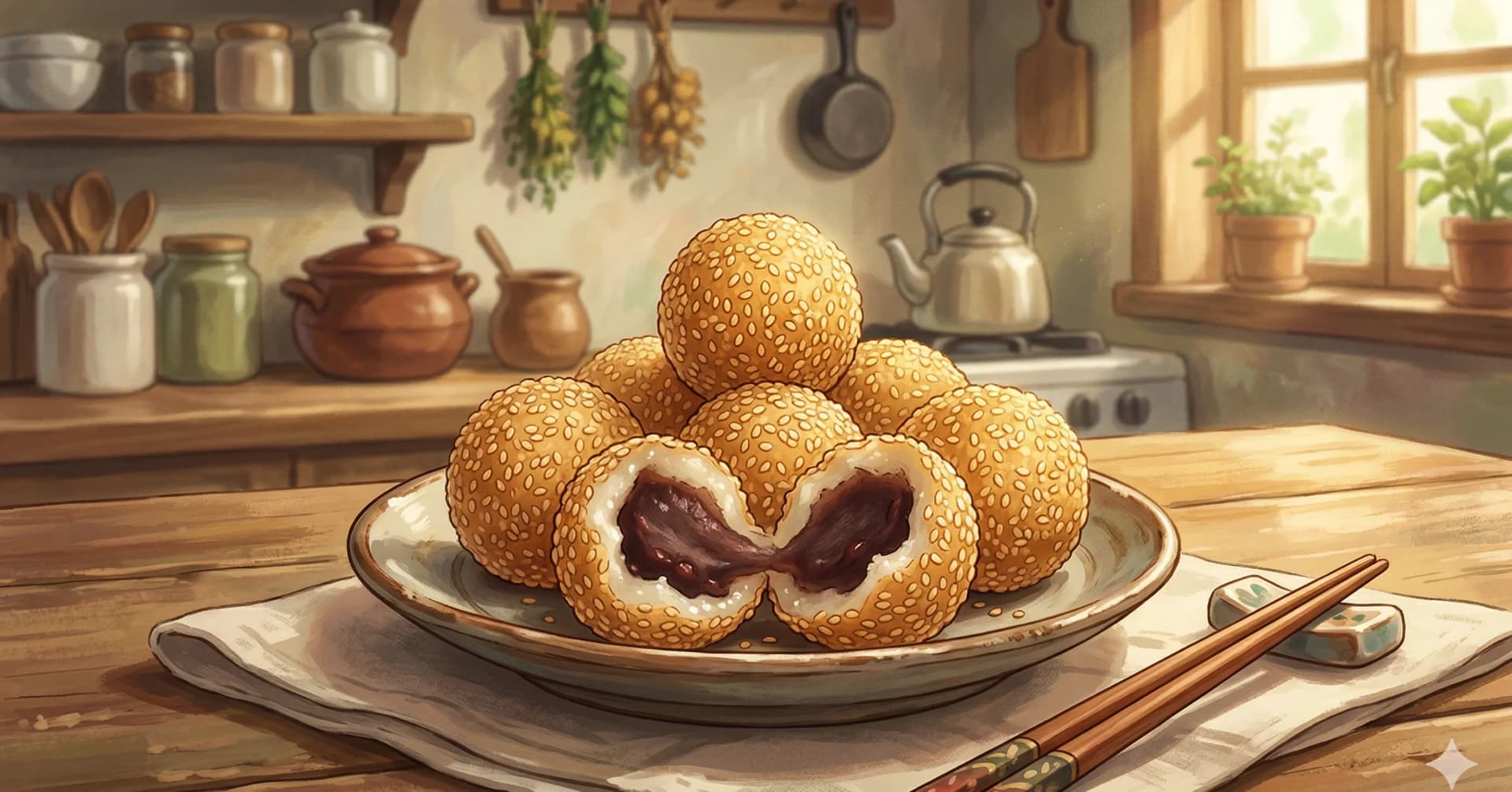
Crispy, golden fried glutinous rice balls coated in sesame seeds with a sweet red bean paste filling
There is a satisfying crunch when you bite through the sesame-crusted shell of a jian dui, followed by the soft, chewy give of the glutinous rice dough, and then the sweet, smooth rush of red bean paste at the center. The contrast is extraordinary: crispy, chewy, and creamy in a single bite. These golden spheres, perfectly round and covered in a uniform coat of toasted sesame seeds, are one of the most visually striking items in the dim sum repertoire, and one of the most technically fascinating to make.
Jian dui have a history that stretches back to the Tang Dynasty, when they were a court food known as "broken circles." Over centuries, they migrated from northern China to the south, becoming a fixture of Cantonese dim sum and bakery culture. In Cantonese tradition, they carry symbolic significance: their round shape represents wholeness and unity, and they are a traditional food during Lunar New Year celebrations.
The magic of jian dui is in the frying. The balls enter the oil as compact, dense spheres, but as the dough heats up, the water inside turns to steam and the glutinous rice starch puffs, inflating the ball to several times its original size. The inside becomes hollow, the shell becomes thin and crispy, and the sesame seeds on the outside toast to a golden finish. It is one of cooking's most dramatic transformations.
The practical key is oil temperature. The oil must start at a moderate temperature (around 150°C) and the balls must be fried slowly, with gentle pressing against the sides of the wok using a slotted spoon to encourage even expansion. Too hot, and the outside burns before the inside puffs. Too cool, and the balls absorb oil and become greasy.
At a Glance
Yield
12 balls
Prep
30 minutes
Cook
20 minutes
Total
50 minutes
Difficulty
Medium
Ingredients
Dough Ingredients
- 7 ozglutinous rice flour
- 3¼ tbspsugar
- ⅓ cupwarm water (adjust as needed)
- 1 tbspvegetable oil
Filling Ingredients
- 4 ozsweet red bean paste (store-bought or homemade)
Coating Ingredients
- ½ cupwhite sesame seeds
For Frying
- —Vegetable oil for deep-frying (about 800 ml)
Method
- 1
If using store-bought red bean paste, divide it into 12 equal portions (about 10 g each) and roll each into a small ball. If the paste is very soft, refrigerate the balls for 15 minutes to firm them up. This makes wrapping much easier.
- 2
In a large bowl, combine the glutinous rice flour and sugar. Add the warm water gradually while mixing with a spoon or your hands. The dough should come together into a soft, pliable ball that is not sticky. It should feel like playdough. Add more water by the teaspoon if too dry, or more flour if too wet.
- 3
Add the vegetable oil and knead it into the dough for 1 to 2 minutes. The oil prevents the dough from cracking during frying and contributes to a more tender texture.
- 4
Divide the dough into 12 equal portions (about 25 to 30 g each). Roll each into a ball.
- 5
Flatten one dough ball into a disc about 6 cm in diameter. Place a red bean paste ball in the center. Carefully wrap the dough around the filling, pinching the edges to seal. Roll between your palms to create a smooth, round ball with no visible seams. The dough should completely and evenly enclose the filling.
- 6
Place the sesame seeds in a shallow bowl. Lightly moisten each dough ball by rolling it quickly between damp palms (just barely moist, not wet). Roll the damp ball in the sesame seeds, pressing gently to ensure even coverage. The entire surface should be coated.
- 7
Repeat with all remaining balls. Set them on a plate, not touching each other.
- 8
Pour the vegetable oil into a wok or deep pot to a depth of at least 8 cm. Heat the oil to 150°C. This is lower than typical frying temperature, and it is intentional. A thermometer is very helpful here.
- 9
Gently lower 4 to 5 sesame balls into the oil. Do not crowd the pot, as the balls will expand significantly.
- 10
Fry at 150°C for about 3 to 4 minutes, gently pressing the balls against the side of the wok with a slotted spoon or wire skimmer. This encourages them to expand evenly and prevents one side from puffing more than the other. The balls will begin to float and slowly increase in size.
- 11
Gradually increase the oil temperature to 170°C over the next 3 to 4 minutes. Continue pressing and turning the balls. They should be expanding noticeably now, becoming lighter and more hollow.
- 12
When the sesame balls are golden brown all over and have roughly doubled in size, remove them with a slotted spoon. Drain on paper towels. The shells should feel crispy when tapped and the sesame seeds should be evenly toasted.
- 13
Allow the oil to return to 150°C before frying the next batch.
- 14
Let the sesame balls cool for 2 to 3 minutes before serving. They will deflate very slightly as they cool, which is normal. Serve warm.
Key Ingredient Benefits
Glutinous rice flour is made from ground sticky rice and is naturally gluten-free despite its name (the "glutinous" refers to its sticky, glue-like texture, not to gluten protein). It is primarily composed of amylopectin starch, which gives it its characteristic chewiness.
Red bean paste (dou sha) is made from azuki beans cooked with sugar. Azuki beans are a source of protein, fiber, iron, and B vitamins. In traditional Chinese medicine, red beans are considered beneficial for kidney function and are associated with reducing water retention.
Sesame seeds are rich in calcium, iron, magnesium, and lignans. Research suggests that regular consumption of sesame seeds may be associated with improved cholesterol profiles.
Why This Works
Glutinous rice flour, when mixed with water and heated, forms a starch gel that is extraordinarily elastic. This elasticity allows the dough to stretch as steam builds inside during frying, inflating the ball without cracking. Regular rice flour or wheat flour would not expand in the same way, as their starch structures are less elastic.
The slow, low-temperature start is critical. At 150°C, the dough heats gradually, allowing the interior moisture to convert to steam slowly and evenly. This gentle pressure inflates the ball uniformly. If the oil is too hot, the exterior sets and crisps before the interior has time to generate enough steam, resulting in a dense, underinflated ball with a thick shell.
Pressing the balls against the wok during frying serves two purposes. It redistributes the heat within the ball, promoting even expansion, and it prevents the ball from developing a thick side and a thin side, which would cause uneven puffing.
Substitutions & Variations
- Fillings: Black sesame paste, lotus seed paste, peanut butter mixed with sugar, or taro paste are all traditional alternatives. Custard and chocolate fillings are popular modern variations.
- Unfilled: Sesame balls can be made without filling for a simpler version. The inside will be hollow and the shell entirely chewy.
- Baked version: For a lower-fat option, brush the coated balls with oil and bake at 180°C for 20 to 25 minutes, turning once. They will not puff as dramatically but will still be tasty.
- Pumpkin dough: Adding 50 g of mashed cooked pumpkin to the dough (reducing the water accordingly) produces a golden-colored dough with a subtly sweet flavor.
- Mini sesame balls: Make them half the size for a more elegant presentation, reducing frying time by 2 to 3 minutes.
Serving Suggestions
Serve jian dui warm as a dessert at the end of a dim sum meal, as a snack with tea, or as part of a Lunar New Year spread. They pair well with a pot of oolong or jasmine tea, which cuts through the richness of the fried dough. In dim sum restaurants, they are typically served alongside other sweet items like egg tarts and mango pudding.
Storage & Reheating
Sesame balls are best eaten within a few hours of frying. The crispy shell softens as it sits and cannot be fully restored. If needed, store at room temperature (not refrigerated, as this accelerates staling) for up to 1 day. Reheat in a 180°C oven for 5 to 7 minutes to partially re-crisp the shell. Microwave reheating will make them soft and chewy throughout. Uncooked, formed balls (before frying) can be frozen on a sheet pan and stored in a freezer bag for up to 1 month. Fry directly from frozen at a slightly lower starting temperature (140°C), allowing extra time for the interior to heat through.
Cultural Notes
Jian dui (煎堆, called jin deui in Cantonese) is the deep-fried sesame ball that anchors the sweet dim sum lineup and appears at Lunar New Year celebrations across southern China. The ball is built from a glutinous rice flour dough wrapped around a sweet filling (most commonly lotus seed paste, red bean paste, or black sesame paste), coated heavily in raw white sesame seeds, then deep-fried at controlled heat. The frying causes the dough to puff into a hollow sphere with a thin crisp outer wall, the sesame seeds toast to a deep golden color, and the filling stays sweet and soft in the center. The finished ball is roughly the size of a large clementine, lightweight for its volume, and shatters into the mouth on the first bite.
The dish has been documented in Chinese cooking texts since the Tang dynasty (618-907 CE), when it appeared at the imperial court of Chang'an under the name li yu and was prepared by court bakers. The form migrated south during subsequent dynasties and was absorbed into the broader Cantonese sweet dim sum tradition, where it took its current name and standard form. The Tang origins are documented in Chinese culinary scholarship including the work of historian Hsiang Ju Lin, whose Slippery Noodles traces the development of many Chinese pastries from imperial court cookery to regional and home traditions.
The cultural meaning at Lunar New Year ties to the symbolism of the ball's form. Jian dui are sometimes called xiao tuan yuan (笑团圆, "smiling reunion") at New Year because the cracked-open ball with its hollow interior is said to look like a smiling face and because the round shape symbolizes family reunion (tuan yuan) and completeness. Cantonese families often prepare large batches during the New Year week, since the balls keep well for several days and can be reheated quickly. The dish appears year-round at dim sum restaurants in Hong Kong, Guangzhou, and the Cantonese diaspora, served at the end of the meal alongside other sweet items like custard buns and mango pudding.
Nutrition Facts
Calories: 473kcal (24%)|Total Carbohydrates: 70.2g (26%)|Protein: 8.4g (17%)|Total Fat: 18.2g (23%)|Saturated Fat: 1.5g (8%)|Cholesterol: 0mg (0%)|Sodium: 5mg (0%)|Dietary Fiber: 4.1g (15%)|Total Sugars: 20.6g
You Might Also Like
Ratings & Comments
Ratings & Comments
Ratings
Share your thoughts on this recipe.
Sign in to rate and comment