Awadhi · Indian Cuisine
Shammi Kebab
Silky, spiced mince discs from the Awadhi court kitchen
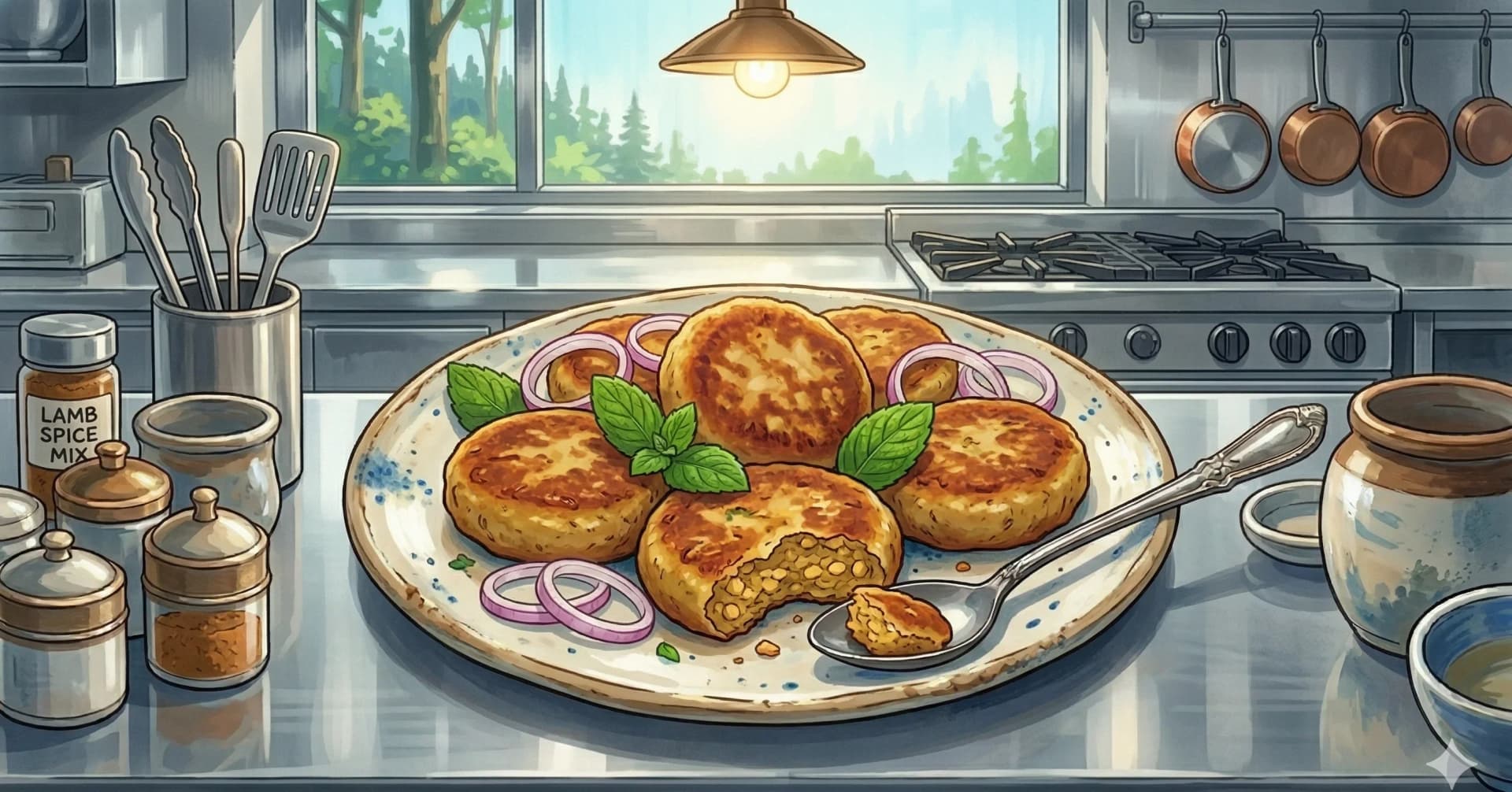
The test of a great shammi kebab, it is said, is that it should be soft enough to eat without teeth. This is not a joke — it is a historical record. The dish was developed in the kitchens of the Nawabs of Awadh specifically for a patron whose dental situation required soft food without any sacrifice of flavour or courtly refinement. The resulting technique — cooking mutton mince to complete tenderness with chana dal and whole spices, then grinding the entire mixture to a smooth paste — produces something that defies its description as a simple patty.
Where a regular seekh or boti kebab asserts itself through char and fire, the shammi works through restraint and texture. The exterior, golden from shallow-frying, gives way to an interior so smooth and fine it seems almost to dissolve on the tongue. The aromatics (ginger, garlic, cardamom, cinnamon, caraway) are present but integrated, not sharp. The chana dal is the structural secret: cooked alongside the mince until completely soft, it gives the paste its binding body and a slight nuttiness that rounds the mutton's richness.
The stuffing — a small pocket of raw onion, green chilli, coriander, and mint pressed into the centre of each patty before it is shaped — is where the shammi earns its contrast. A bite of the cool, raw herb stuffing against the warm, smooth outer shell is what separates this from anything else in the kebab repertoire.
Awadhi cooking is characterised by this kind of considered layering — the outside finished one way, the inside working differently, the whole arriving at the palate as a sequence rather than a simultaneous statement. Lucknow still produces some of the finest shammi kebabs in India, served at old eateries where the recipe has not changed in generations. At home, the technique is entirely achievable: the most important step is grinding the cooked mixture long enough to achieve genuine smoothness.
At a Glance
Yield
Makes 16–18 kebabs (serves 4–6)
Prep
25 minutes
Cook
45 minutes
Total
1 hour 10 minutes
Difficulty
Medium
Ingredients
Kebab Ingredients
- 1 lbmutton mince (*keema*)
- 1¾ ozchana dal (split chickpea lentil)
- ⅓ cupfresh ginger, roughly chopped
- ¼ cupgarlic cloves, peeled
- 3¾ tbspred chilli powder
- 1 tspgaram masala
- 1¼ tspcinnamon (about 1 short stick)
- 1 tspwhole cloves (about 6–8 cloves)
- ¼ ozgreen cardamom (about 4–5 pods)
- ¼ ozcaraway seeds / shahi jeera
- ⅞ tspfine salt
- —Water to cover
Filling Ingredients
- 1¾ ozonion, very finely chopped
- 1¼ cupfresh mint leaves, finely chopped
- 1⅔ cupfresh coriander leaves, finely chopped
- 3¼ tbspgreen chillies (about 4 chillies), finely chopped
For Frying
- 3½ ozeggs (about 2), beaten
- 3⅓ tbspneutral oil, for shallow-frying
Method
- 1
Cook the mince and dal. Place the mutton mince (500 g), chana dal (50 g), ginger (30 g), garlic, red chilli powder (4 teaspoons), garam masala (¾ teaspoon), cinnamon (1 short stick) stick, cloves (6–8 cloves), cardamom (4–5 pods) pods, caraway seeds (¾ teaspoon), and salt (1 teaspoon) in a heavy pot. Add just enough water to barely cover (about 200–250 ml). Bring to a boil, then reduce to a steady simmer. Cook uncovered, stirring occasionally, for 30–40 minutes until the mutton is completely cooked through, the chana dal is completely soft and beginning to break apart, and virtually all the liquid has evaporated. The mixture should be quite dry — if moisture remains, increase heat and cook off the excess, stirring constantly to prevent sticking. Allow to cool to room temperature.
- 2
Grind to a paste. Transfer the cooled mixture to a food processor. Process continuously for 3–4 minutes, stopping to scrape down the sides, until you have a completely smooth, fine paste. There should be no visible pieces of chana dal or mince — the texture should feel almost silky when a small amount is pressed between your fingers. If the paste seems too loose, refrigerate for 20 minutes to firm up.
- 3
Make the stuffing. Combine the finely chopped onion (50 g), mint (20 g), coriander (30 g), and green chillies (4 chillies) in a small bowl. Mix well and set aside.
- 4
Shape the kebabs. Divide the kebab paste into 16–18 equal portions. Take one portion, flatten it into a small disc in your palm, and place a small amount of stuffing (about ¾ teaspoon) in the centre. Fold the edges of the disc up around the stuffing and press together to seal, then gently flatten into a smooth, even patty about 1.5 cm thick and 6 cm across. Repeat with remaining portions. If the paste is sticking to your hands, dampen them lightly with water.
- 5
Coat and fry. Heat the oil in a wide flat pan over medium heat. Dip each shaped kebab into the beaten egg on both sides. Place in the hot oil without crowding — work in batches if necessary. Fry for 3–4 minutes on the first side until a deep golden crust forms, then carefully flip and fry for 2–3 minutes on the second side. The kebab should be uniformly golden-brown and heated through. Drain on kitchen paper.
- 6
Serve immediately — shammi kebabs lose their delicacy quickly. They are at their best in the first few minutes out of the pan.
Key Ingredient Benefits
Chana dal (split chickpea) is one of the most protein-dense legumes in the South Asian pantry, with a relatively low glycaemic index compared to many other dals. In Ayurveda it is considered strengthening and is used in preparations for sustained energy. Here its primary role is culinary — it is the binding agent and textural modifier that makes the shammi uniquely smooth.
Caraway seeds / shahi jeera (Bunium persicum) carry a warm, earthy depth that regular cumin lacks. They are traditional to Mughal-era cooking — appearing in biryanis, kormas, and Awadhi kebabs — and in Unani medicine are traditionally used as a carminative and digestive aid, thought to ease the digestion of rich meat preparations.
Fresh mint and coriander in the stuffing provide more than flavour contrast. Both herbs contain volatile aromatic compounds that break down quickly with heat — which is precisely why they are added raw to the stuffing rather than cooked into the paste. The brief heat of the fried kebab warms but does not fully cook the stuffing, keeping these volatile compounds intact.
Green chillies (Capsicum annuum) contain capsaicin, the compound responsible for their heat, which research suggests may be associated with improved metabolism and circulatory function in regular dietary use. In cooking, they bring a brighter, more immediate heat than dried red chilli, and the raw chilli in the stuffing delivers a sharper, fresher note than any dried spice could.
Why This Works
The chana dal serves a dual purpose that makes it indispensable. First, it acts as a binder — once cooked to softness and ground, it provides the starch and protein matrix that holds the kebab paste together without egg or breadcrumb mixed into the paste itself. Second, it moderates the mince's texture: pure ground mutton mince would become dense and slightly granular when fried; the dal smooths this out and creates a more supple final texture.
Cooking the whole spices directly with the mince (rather than adding ground spice powders) produces a more integrated, rounded flavour. The whole spices release their oils slowly into the mince as it cooks, rather than sitting on the surface. By the time the mixture is ground, the spice flavour has permeated every particle of mince and dal rather than remaining a separate layer of seasoning.
The egg coating serves both an aesthetic and structural function. It creates the golden, slightly lacquered exterior — a surface with more crispness and colour than the paste itself would achieve — while simultaneously providing a protective casing that keeps the soft interior from fragmenting in the hot oil. A double-coat of egg (dipping, draining, then dipping again) produces an even better result.
Substitutions & Variations
Mutton to chicken: Replace mutton mince with an equal weight of chicken thigh mince. The texture will be slightly leaner; add 1 tablespoon of ghee to the cooking mixture to compensate. Reduce cooking time to 20 minutes.
No food processor: A traditional stone grinder (sil batta) or mortar and pestle produces an even finer paste, though it requires more effort. A stick blender with a chopping bowl will work at a pinch, though achieving complete smoothness is harder.
Stuffing variations: Dried fruit (a few raisins or barberries) in the stuffing is a traditional Awadhi variation that adds a sweet counterpoint to the spiced outer shell.
Richer version: Mix 1 tablespoon of ghee into the kebab paste before shaping — the fried exterior becomes more flaky and rich.
Serving Suggestions
Serve on a flat plate with rings of raw onion, thin cucumber slices, lemon wedges, and a bright green coriander-mint chutney on the side. Shammi kebabs pair naturally with warm roomali roti or paratha for wrapping. As a starter before a larger Awadhi or Mughal meal, two per person is ample; as a snack, three to four. They are traditional at Eid feasts and family celebrations across North India, where they are often made in large quantities the day before and refried briefly to order.
Storage & Reheating
Shaped, uncooked kebab patties can be refrigerated on a parchment-lined tray, covered, for up to 24 hours before frying. Cooked shammi kebabs are best eaten fresh but can be stored in the refrigerator for up to 2 days. To reheat, pan-fry briefly in a little oil over medium heat for 2 minutes each side — do not microwave, as this destroys the crust and makes the interior rubbery. Raw shaped patties can be frozen between sheets of parchment for up to 1 month; fry directly from frozen, adding 2–3 minutes to the cooking time.
Cultural Notes
Shammi kebab (शामी कबाब) is the Awadhi (Lucknow) minced-meat kebab in which lamb is first cooked with split chickpeas (chana dal), onion, ginger-garlic, and whole spices until the meat is tender and the dal absorbs the cooking liquid, then ground to a smooth paste with fresh herbs and shaped into small flat patties that are shallow-fried in ghee until the exterior crisps and the interior stays moist. The dish belongs to the Lucknowi kebab tradition that flourished at the court of the Nawabs of Awadh and remains one of the signature Lucknowi street and home preparations.
The Lucknowi kebab tradition produced several distinct families of kebab, of which shammi is among the most enduring. The Awadhi court at its height (under Wajid Ali Shah, the last Nawab of Awadh, who ruled from 1847 to 1856) patronized kebab specialists who developed dedicated techniques for different cuts, textures, and presentations. The shammi family is defined by the chickpea-binding technique that gives the kebab its smooth texture without needing egg or breadcrumbs, while related Lucknowi kebabs like galouti (the famously soft melt-in-the-mouth kebab) and kakori (the long skewered kebab) explore other textural approaches. An apocryphal but widely told story attributes the development of the softer kebab styles to Wajid Ali Shah's later years when poor teeth allegedly required kebabs soft enough to eat without chewing; the historical accuracy is disputed but the story captures the Lucknowi kebab tradition's interest in textural refinement.
The technique cooks the meat and dal together before grinding. Boneless lamb (shoulder or leg, cut into small cubes) is combined with split chickpea dal (washed and soaked for an hour), sliced onion, ginger-garlic paste, whole spices (cinnamon, cardamom, cloves, peppercorns, bay leaf), red chili powder, and salt in a heavy pot with a small amount of water. The pot is covered and cooked over low heat for about an hour until the lamb is tender and the dal has absorbed all the cooking liquid. The mixture is cooled, the whole spices picked out, and the meat-dal is ground to a smooth paste in a food processor or with a stone sil-batta. Fresh mint, cilantro, green chilies, and a beaten egg are mixed into the paste, which is shaped into small round flat patties (about two inches across and a half-inch thick). The patties are shallow-fried in ghee until both sides develop a golden crisp crust. The dish is served hot with mint chutney and sliced raw onion.
Nutrition Facts
Calories: 331kcal (17%)|Total Carbohydrates: 6g (2%)|Protein: 17.6g (35%)|Total Fat: 25.9g (33%)|Saturated Fat: 9.7g (49%)|Cholesterol: 123mg (41%)|Sodium: 904mg (39%)|Dietary Fiber: 1.5g (5%)|Total Sugars: 1.4g
You Might Also Like
Ratings & Comments
Ratings & Comments
Ratings
Share your thoughts on this recipe.
Sign in to rate and comment