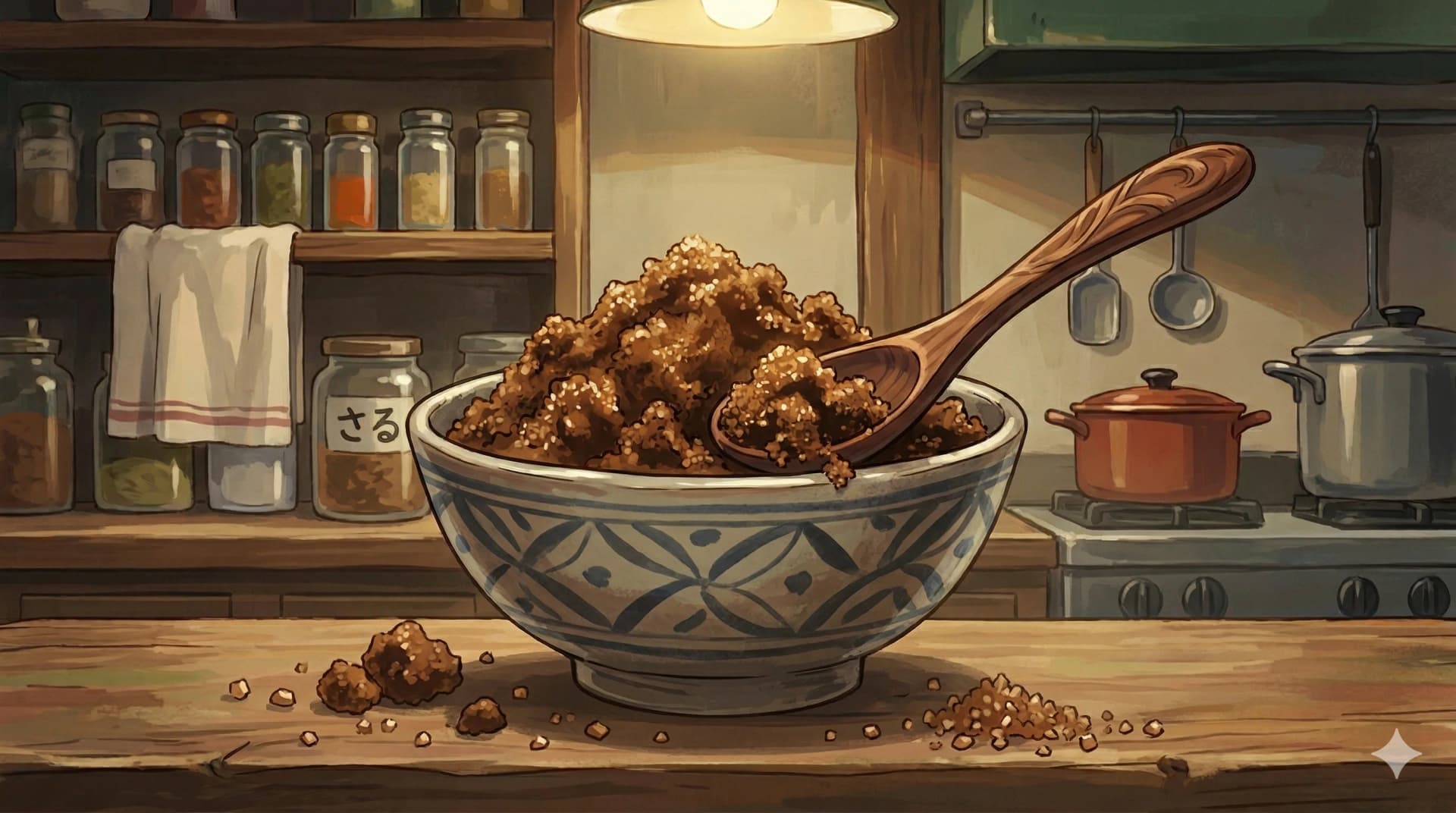
Brown Sugar
Also known as: Raw Cane Sugar, Demerara, Muscovado, Turbinado, Light/Dark Brown Sugar
Brown sugar is a broad category of sweeteners that shares a common characteristic: the presence of molasses alongside sucrose crystals. Most commercially produced brown sugar is white refined sugar with a controlled amount of molasses reintroduced after refining: light brown sugar contains roughly 3.5 percent molasses by weight, dark brown sugar approximately 6.
5 percent. Higher-quality varieties, including muscovado, demerara, and turbinado, retain their molasses more naturally through less intensive refining rather than having it added back, producing a more complex and less uniform flavor.
The flavor distinction between light and dark brown sugar is real and matters in cooking. Light brown sugar has a subtle, almost butterscotch-like warmth. Dark brown sugar is noticeably more intense, with a pronounced molasses character that can read as slightly bitter and deeply caramelized.
Muscovado is the most extreme: its molasses content is high enough to make it almost sticky and clumped, with a flavor that approaches blackstrap molasses. Demerara and turbinado are similar to each other, both featuring larger, amber crystals that are particularly valued as finishing sugars for their crunch and visual appeal when sprinkled on top of baked goods or cocktails.
In Indian cooking, brown sugar occupies a limited role. Jaggery performs the same function of providing a molasses-forward sweetness with far greater authenticity and complexity, and its use in traditional recipes is not casually interchangeable. When jaggery is unavailable, dark brown sugar is the closest functional substitute for most purposes, though the flavor will always differ in character: jaggery has an earthier, more complex profile that commercial brown sugar, even at its best, does not fully replicate.
Key facts at a glance:
- Brown sugar — Is a broad category of sweeteners that shares a common characteristic: the presence of molasses alongside sucrose crystals.
- The flavor — Distinction between light and dark brown sugar is real and matters in cooking.
- 5 percent molasses — By weight, dark brown sugar approximately 6.
- Light brown — Sugar has a subtle, almost butterscotch-like warmth.
- Dark brown — Sugar is noticeably more intense, with a pronounced molasses character that can read as slightly bitter and deeply caramelized.
- In Indian cooking — Brown sugar occupies a limited role.
Flavor Profile
Origin
Americas, Caribbean, Global
Traditional Medicine Perspectives
Ayurveda:
Brown sugar is not a traditional Ayurvedic ingredient and does not appear in classical texts. In modern Ayurvedic practice, it is sometimes discussed as preferable to white sugar on the grounds that it retains some molasses and thus some trace minerals, but it is not classified within the traditional framework that governs jaggery, date palm sugar, or raw sugarcane. For purposes of Ayurvedic cooking and medicine, jaggery is strongly preferred as the appropriate whole, unrefined sweetener.
Modern Scientific Research
Brown sugar and white sugar are nutritionally near-identical for practical purposes. The small amount of molasses in brown sugar contributes trace quantities of iron, potassium, and calcium, but at the amounts typically consumed in a serving of baked goods, these quantities are nutritionally insignificant. The glycemic index of brown sugar is effectively the same as white sugar.
Claims that brown sugar is meaningfully healthier than white sugar are not supported by evidence for typical consumption patterns.
Where brown sugar differs meaningfully from white is in its flavor chemistry. The molasses fraction contains a range of organic compounds, including organic acids, carbonyl compounds, and Maillard reaction products from the original cane juice reduction, that contribute to its characteristic taste. In baking, brown sugar is also hygroscopic (it attracts and retains moisture from the environment) to a greater degree than white sugar, which contributes to the chewier texture of brown sugar cookies versus white sugar cookies.
This moisture retention also affects shelf life and texture stability in baked goods over time.
Cultural History
The history of brown sugar is inseparable from the history of the transatlantic sugar trade and the plantation systems that produced it. Sugarcane, native to Southeast Asia and the Indian subcontinent, was introduced to the Caribbean and the Americas by European colonizers beginning in the 15th century. By the 17th century, the Caribbean colonies of Britain, France, Spain, and Portugal had become the world's dominant sugar producers, fueling European demand for sweetness at the cost of an enormous and catastrophically brutal trade in enslaved African labor.
The sugar refining process of the colonial era was not as efficient as modern methods, and the sugar that arrived in European ports and households was often partially refined, retaining more molasses than today's commercial brown sugar: closer to what we might now call demerara or turbinado. Truly white, fully refined sugar was the luxury product. The brown, molasses-retaining sugar was what most people actually consumed and cooked with.
The flavors embedded in 18th and 19th-century British baking, sticky toffee pudding, gingerbread, parkin, and treacle tart, reflect the molasses character of the sugar available at the time.
Demerara sugar takes its name from a region of what is now Guyana (formerly British Guiana) on the northern coast of South America, where a particularly large-crystalled, amber cane sugar was produced and exported. Muscovado, similarly, carries a name derived from the Portuguese "mascavado," meaning unrefined, and was historically produced in the Portuguese sugar colonies of Brazil and Madeira. The names of these sugars are, in this sense, cartographic artifacts: they map the geography of colonial sugar production.
Culinary Uses
In Western baking, brown sugar is used wherever a warm, molasses-inflected sweetness is wanted: chocolate chip cookies, gingerbread, banana bread, pecan pie, and sticky toffee pudding all rely on it for their characteristic flavor and texture. The hygroscopic properties of brown sugar are particularly important in cookie baking: recipes that use more brown sugar relative to white produce chewier, more pliable cookies that stay soft for longer after baking.
In savory cooking, brown sugar appears in barbecue rubs and sauces, where it contributes sweetness that caramelizes over high heat to create a lacquered crust on grilled and smoked meats. The same principle applies to glazed hams and lacquered pork ribs, where a brown sugar and mustard or brown sugar and soy sauce glaze produces the characteristic sweet-salty, slightly charred exterior. In Southeast Asian and fusion cooking, brown sugar is sometimes used as an accessible substitute for palm sugar or jaggery in dishes that call for either, with the understanding that the flavor will be somewhat flatter.
Preparation Methods
Brown sugar tends to harden and clump when exposed to air as moisture evaporates from the molasses. To soften hardened brown sugar: place it in a sealed container with a slice of fresh bread or a damp paper towel for several hours. The sugar will absorb moisture and return to its soft, pliable state.
Alternatively, microwave it in a covered bowl with a small cup of water placed alongside for 20 to 30 seconds.
For a dark caramel with molasses depth, dark brown sugar can be melted directly in a dry pan over medium heat, stirring constantly. It will caramelize quickly due to its moisture content and should be watched carefully to prevent burning. This caramel can be used to glaze meats, flavor sauces, or form the base of toffee and fudge.
To substitute for jaggery in a recipe: use dark brown sugar at a 1:1 ratio by weight. The flavor will be somewhat lighter and less complex, but the sweetness level and color will be reasonably comparable. For the most accurate substitution, add a small amount of blackstrap molasses (1 teaspoon per 100 grams of dark brown sugar) to bring the flavor closer to the earthiness of jaggery.
Traditional Dishes
- Chocolate Chip Cookies
- Sticky Toffee Pudding
- Gingerbread
- Pecan Pie
- Banana Bread
- Barbecue Pork Ribs
- Glazed Ham
- Rum Punch
- Parkin
- Treacle Tart
- Brown Sugar Bourbon Glaze
- Pulled Pork
- Carrot Cake
- Coffee Cake
Comments
Share your thoughts on this ingredient.
Sign in to comment0 Comments