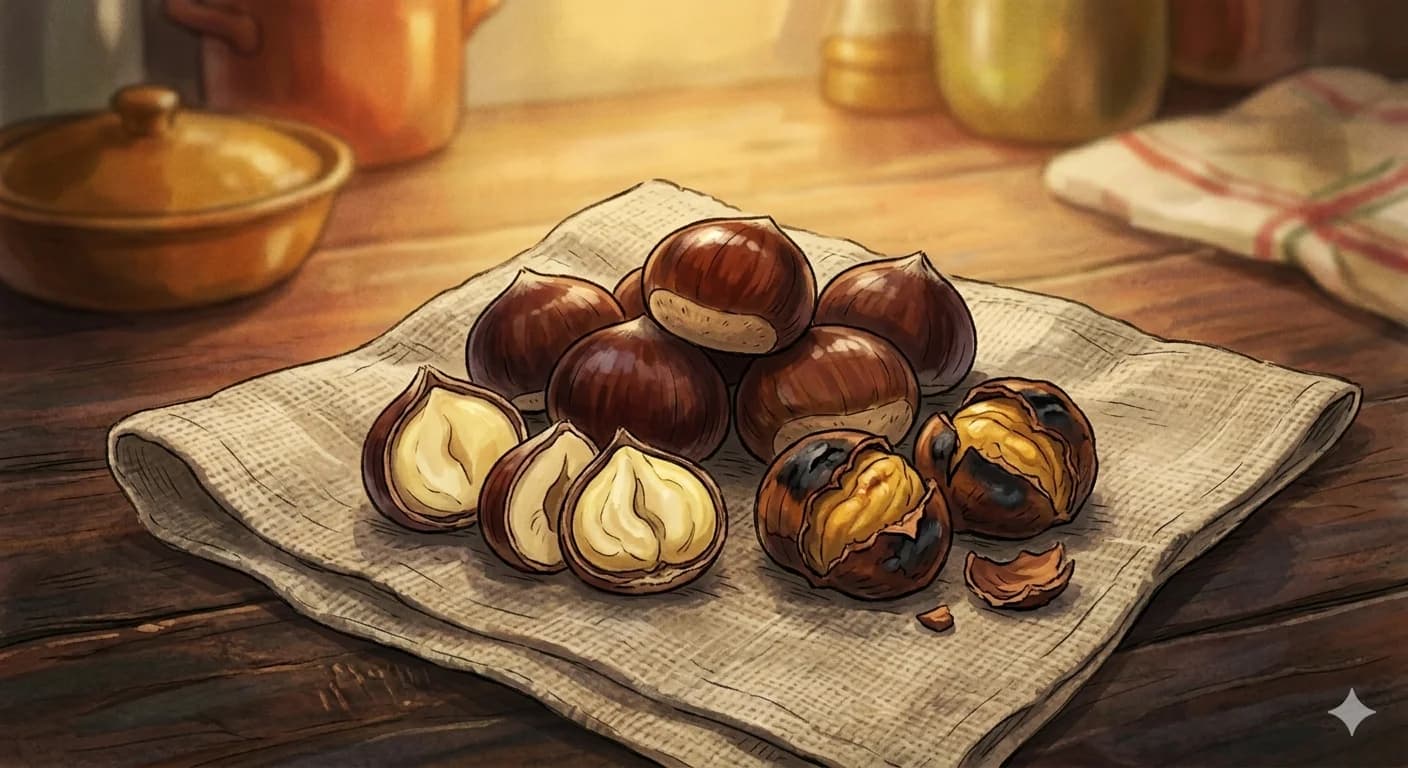
Chestnuts
Also known as: Chinese Chestnuts, Li Zi, Bam, 밤, Kuri
Chestnuts stand apart from every other nut — they are starchy rather than oily, sweet rather than rich, and they have been a staple food rather than a snack across much of Asia and Europe for millennia.
Roasted over charcoal on cold winter streets, braised with chicken in aromatic soy sauce, or ground into flour for cakes and noodles, chestnuts occupy a unique place in the culinary world. Their flavor is warm, subtly sweet, and earthy, with a floury texture that makes them behave more like a root vegetable or grain than a typical nut.
Chinese chestnuts tend to be smaller and sweeter than their European counterparts, with a firmer texture that holds up well in braises and stir-fries. Korean chestnuts (bam) are prized for their sweetness and appear in festive rice dishes, stuffings, and desserts.
Key facts at a glance:
- Starchy, not oily — more like a root vegetable than a typical nut
- Low in fat — roughly 2–3% fat compared to 50–70% for most tree nuts
- Staple food for millennia — chestnuts sustained populations before widespread grain cultivation
- Versatile across savory and sweet — braises, roasting, flour, confections
- Distinct varieties — Chinese (smaller, sweeter, firmer), Korean, Japanese, European
Flavor Profile
Origin
Northern China, Korea, Japan, Southern Europe, Anatolia
Traditional Medicine Perspectives
Traditional Chinese Medicine
Chestnut (Li Zi) is classified as sweet and warm, entering the Spleen, Stomach, and Kidney meridians. It is used to nourish the Kidney, strengthen the sinews and bones, and invigorate the Spleen and Stomach. It is traditionally recommended for weak knees and lower back, frequent urination, and poor digestion in elderly patients.
Modern Scientific Research
Chestnuts are unusually low in fat and high in complex carbohydrates compared to other tree nuts — roughly 45% starch and only 2–3% fat. They contain significant amounts of vitamin C (unusual among nuts), B vitamins, potassium, and magnesium.
Chestnuts are roughly 45% starch and only 2–3% fat — more nutritionally similar to a grain or root vegetable than to other tree nuts.
Chestnut starch has been studied for its prebiotic potential — its resistant starch content may support beneficial gut bacteria. The nuts also contain gallic acid and ellagic acid, phenolic compounds with demonstrated antioxidant properties in laboratory studies.
For those with tree nut allergies, chestnuts are sometimes tolerated because their protein profile differs significantly from oily nuts, though individual assessment is always necessary.
Cultural History
Chestnuts have been a fundamental food source in China for over three thousand years. Before rice cultivation spread to northern China, chestnuts — along with millet — were a primary source of calories. The Chinese character for chestnut (栗) appears in some of the earliest written records.
In Korea, chestnuts (bam, 밤) are essential to festive cooking. They appear in yakbap (medicinal sweet rice), samgyetang (ginseng chicken soup), and songpyeon (harvest moon rice cakes). A Korean proverb says a feast without chestnuts is like a painting without a frame.
In Japan, chestnuts (kuri) mark the arrival of autumn. Kuri gohan (chestnut rice), kuri kinton (sweet chestnut paste), and candied chestnuts are seasonal traditions that the Japanese anticipate all year.
Culinary Uses
Score an X on the flat side and roast at 425°F (220°C) for 20–25 minutes — the classic preparation that fills winter streets across Asia and Europe with their warm, sweet aroma. Peel while still warm; the inner skin clings stubbornly once cool.
Braise with chicken, soy sauce, ginger, and star anise for li zi shao ji (chestnut braised chicken), one of the great autumn comfort dishes of Chinese home cooking. The chestnuts absorb the braising liquid and become silky and rich.
Score an X on the flat side before roasting — this prevents the chestnuts from exploding in the oven and makes peeling dramatically easier.
Grind dried chestnuts into chestnut flour for gluten-free cakes, crepes, and noodles. In Korean cuisine, mash cooked chestnuts into a smooth paste for yulgwa (chestnut confection) or use whole in rice preparations.
Preparation Methods
The biggest challenge with chestnuts is peeling them. Score each nut with an X on the flat side, then either roast or boil. Roasting develops more flavor; boiling is faster and easier for peeling.
To boil-peel: score, boil for 3 minutes, remove a few at a time, and peel while hot. The inner pellicle (fuzzy skin) is bitter and must be removed.
Peel chestnuts while still warm — the inner skin clings stubbornly once they cool. Work in small batches, keeping the rest in hot water.
Vacuum-packed pre-peeled chestnuts (common in Asian grocery stores) are a legitimate shortcut and work well in braises and desserts.
Traditional Dishes
- Li zi shao ji (chestnut braised chicken)
- Yakbap
- Kuri gohan
- Samgyetang
- Songpyeon
- Marrons glacés
- Kuri kinton
Comments
Share your thoughts on this ingredient.
Sign in to comment0 Comments