Cross-Cultural · Korea
Braised Short Ribs (Galbi-jjim / 갈비찜)
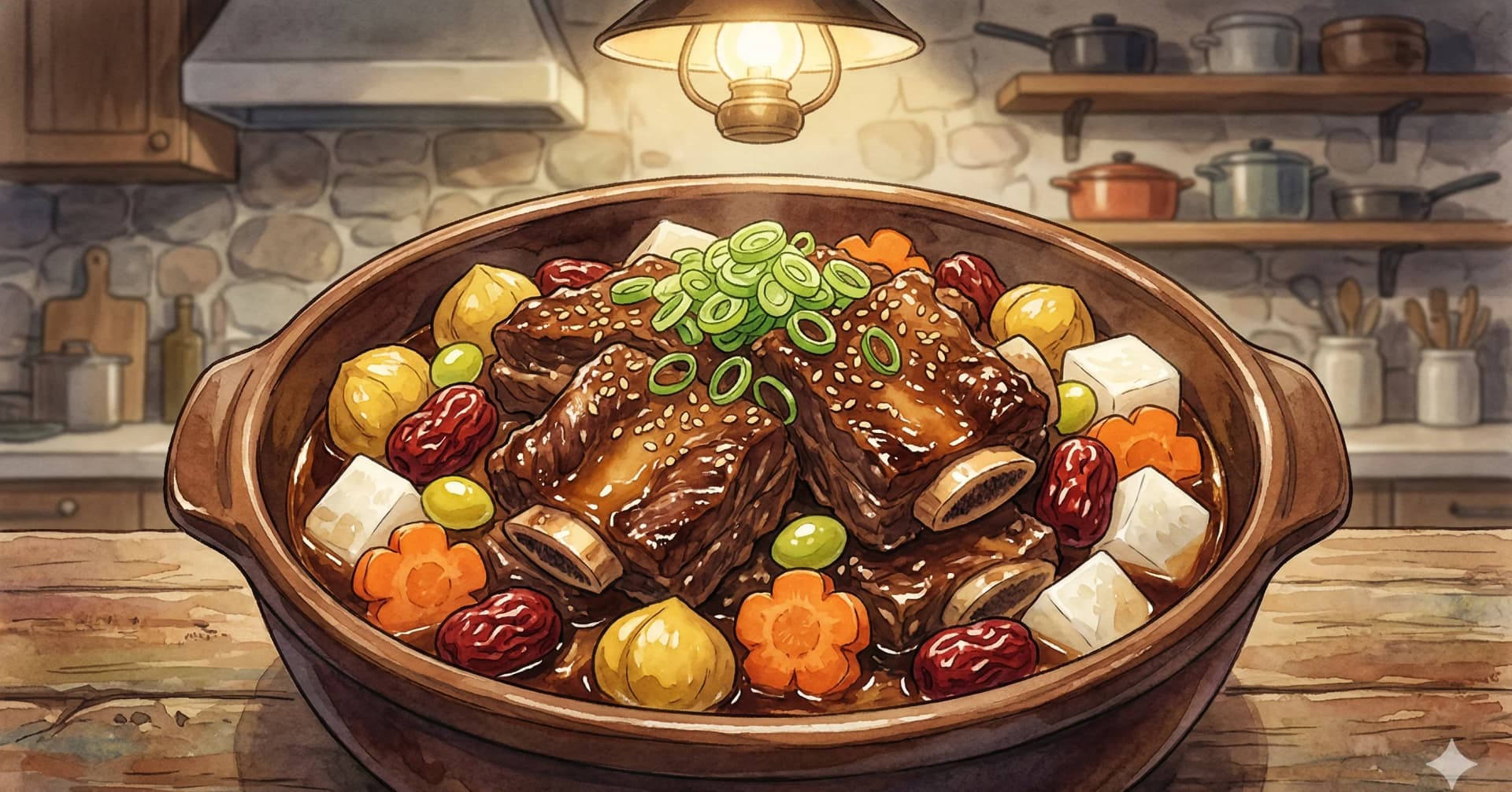
Beef short ribs braised with carrots, radish, chestnuts, and jujubes in a sweet soy-garlic sauce until fall-off-the-bone tender
Galbi-jjim is the dish that appears at every Korean celebration: Lunar New Year, Chuseok, birthdays, and family gatherings. Beef short ribs braise for over an hour in a sauce built on shiitake mushroom soaking water, soy sauce, mirin, sugar, garlic, and ginger until the meat is so tender it nearly falls off the bone. Carrots and radish, traditionally cut into cubes and rounded into ball shapes for the occasion, braise alongside the ribs and absorb the rich, sweet-savory sauce.
The preparation starts the night before, or at least several hours ahead. Dried shiitake mushrooms soak in cold water for three to four hours, producing a deeply flavored soaking liquid that becomes the base of the braising sauce. The short ribs soak in cold water for at least thirty minutes to draw out blood, then get a quick five-minute blanch to remove scum. This double cleaning is what produces a clean, clear braising liquid.
Chestnuts and jujubes go in near the end, adding sweetness and a textural contrast to the tender meat and soft vegetables. Rice syrup in the last ten minutes gives the sauce a glossy sheen. The final step is increasing the heat and spooning the reduced sauce over the ribs and vegetables repeatedly until everything is glazed and glistening. Pine nuts and ginkgo nuts as a garnish are traditional for the presentation, though the dish is complete without them. This is food for celebrating.
At a Glance
Yield
4 servings
Prep
4 hours
Cook
1 hour 35 minutes
Total
6 hours
Difficulty
Medium
Ingredients
- 8beef short ribs, soaked in cold water 30-60 min
- 4dried shiitake mushrooms, soaked in 2.5 cups cold water 3-4 hours
- 1/3 cupsoy sauce
- 1/2 cupmirin or water
- 1/4 cupsugar
- 1/2 tspground black pepper
- 8garlic cloves, minced
- 1 tspfresh ginger, minced
- 1medium Korean radish or daikon, peeled, cut into 1.5-inch cubes, rounded
- 2large thick carrots, peeled, cut into 1.5-inch cubes, rounded
- 12chestnuts, peeled (optional)
- 8large dried jujubes, pitted (optional)
- 2 tbsprice syrup or corn syrup
- 12pine nuts, for garnish (optional)
Method
- 1
Soak shiitake mushrooms in 2.5 cups cold water for 3-4 hours. Drain, reserve 2 cups soaking liquid. Quarter the caps.
- 2
Mix reserved mushroom water with soy sauce, mirin, sugar, pepper, garlic, and ginger for the braising sauce.
- 3
Soak ribs in cold water 30-60 min, changing water several times. Blanch in boiling water 5 min. Drain, rinse. Clean the pot.
- 4
Return ribs to clean pot with the braising sauce. Cover, cook on medium-high 20 min.
- 5
Add mushrooms, chestnuts, radish balls, and carrot balls. Cover, reduce to low, cook 1 hour, stirring occasionally.
- 6
Add jujubes and rice syrup. Simmer 10 more minutes.
- 7
Increase to high. Spoon broth over meat and vegetables repeatedly until sauce reduces and glazes everything.
- 8
Transfer to a platter. Garnish with pine nuts. Serve with rice.
Key Ingredient Benefits
Beef short ribs: A heavily marbled cut from the chuck region with a high ratio of connective tissue and intramuscular fat. The collagen breaks down into gelatin during the long braise, giving the dish its signature lip-coating, almost glossy quality. Short ribs are also one of the richest sources of dietary creatine and bioavailable iron of any beef cut.
Dried shiitake mushrooms: The drying process concentrates the guanylate compounds that give shiitake their intense umami flavor, making them significantly more savory than fresh. The mushroom soaking water becomes the braising liquid base — this is one of the most flavor-dense moves in the dish. Sun-dried shiitake are also one of the few plant sources of vitamin D.
Korean radish (mu): Sweeter and starchier than daikon, with a higher water content. As it braises, the radish releases its own subtle vegetable broth into the sauce while absorbing the surrounding flavors. Many Koreans consider the braised radish the highlight of the dish.
Chestnuts and jujubes: Traditional festival ingredients. Chestnuts add a starchy, mild sweetness that absorbs the braising sauce. Jujubes contribute a date-like caramel sweetness and a chewy texture. In Korean tradition, both ingredients symbolize prosperity and longevity, which is why they appear in galbi-jjim served at celebrations.
Mirin and rice syrup: Korean braised dishes often use a dual-sweetener strategy. Mirin contributes umami and gentle sweetness from rice fermentation. Rice syrup adds glossy depth and helps the sauce reduce to a glaze. Together they produce a more layered sweetness than sugar alone.
Why This Works
Soaking the dried shiitake before cooking does two things: it rehydrates the mushrooms and produces a deeply umami broth that becomes the braising liquid. Using this liquid instead of plain water or beef stock means the sauce starts with concentrated savoriness without any additional work. The same principle drives braised chicken with lily buds.
Pre-boiling the short ribs in water is a Korean braising technique that pulls out impurities and excess blood, then discards the cooking water. This produces a cleaner, clearer sauce. Western braising methods often skip this step, but Korean cooking is precise about visual clarity in dishes meant for celebration.
The braising sauce is built on a balance of salty (soy sauce), sweet (sugar, mirin, rice syrup), and aromatic (garlic, ginger). The sweetness is essential, not optional. Sugar and rice syrup do more than add flavor — they help break down the connective tissue in the short ribs through Maillard reactions during the long braise, and they help the sauce reduce into a glossy glaze that coats every piece of meat and vegetable.
Adding the radish, carrots, chestnuts, and jujubes in the second half of the braising process keeps them from breaking down. Vegetables added at the start would be mush by the time the meat is tender. By staging them, you get short ribs that fall off the bone and vegetables that hold their shape and absorb the braising sauce.
Substitutions & Variations
Beef short ribs: Bone-in beef shanks or oxtail are the closest substitutes and produce excellent results, though they take longer to cook (add 45 to 60 minutes). Boneless chuck roast can be used; cut into 2-inch chunks and reduce cooking time by about 20 minutes. The dish loses some richness without bones.
Dried shiitake mushrooms: Fresh shiitake will work but use beef stock instead of water for the braise to compensate for the lost umami. Dried porcini are an excellent flavor substitute, though the flavor is less Asian.
Korean radish (mu): Daikon is a one-to-one swap. Turnip works in a pinch but is sharper and less sweet.
Chestnuts: Pre-peeled vacuum-packed chestnuts (available at Asian and European specialty grocers) are the easiest option. Peeling fresh chestnuts is laborious. The chestnuts are optional and can be skipped without ruining the dish.
Jujubes: Pitted Medjool dates are an acceptable substitute, though sweeter and softer. Dried apricots can also work for a different fruit profile.
Mirin: Dry sake plus a teaspoon of sugar, or Chinese Shaoxing wine, both work. Avoid sweet "mirin-flavored" cooking liquid (aji-mirin), which is artificially sweetened and lacks the umami of true mirin.
Rice syrup: Honey or light corn syrup work for the glazing function. Brown sugar dissolved in a little water is acceptable.
Serving Suggestions
Galbi-jjim is a celebration dish, traditionally served at Lunar New Year (Seollal), Korean Thanksgiving (Chuseok), birthdays, and major family gatherings. Serve it as the centerpiece of a Korean feast with steamed short-grain rice, several banchan, and at least one cooling soup.
Recommended banchan: sigeumchi namul (seasoned spinach), kongnamul muchim (seasoned soybean sprouts), oi muchim (spicy cucumber salad), and japchae (glass noodles with vegetables). A bowl of miyeok guk (seaweed soup) is the traditional accompaniment, especially for birthdays.
For an everyday serving, simply ladle the short ribs and braising vegetables over a bowl of rice and finish with toasted sesame seeds and pine nuts. The braising sauce is rich enough that the dish needs no other accompaniment.
Pair with a chilled bottle of soju or makgeolli, or for non-alcoholic options, hot barley tea (boricha) or sujeonggwa (cinnamon-ginger punch).
Storage & Reheating
Refrigerator: Store in an airtight container for up to 4 days. This is one of those dishes that genuinely improves over the next day or two as the flavors continue to meld and the meat absorbs more sauce.
Reheating: Reheat gently in a covered pan over medium-low heat with a splash of water to loosen the sauce. The braising sauce will solidify in the fridge from the gelatin extracted during cooking; this is a sign of good braising and will re-melt with gentle heat.
Skim the fat: After refrigerating, the fat will solidify on top. You can leave it for richness or skim it off for a cleaner finish. Most Korean cooks skim about half.
Make-ahead: Galbi-jjim is an ideal make-ahead dish. Cook it a day or two in advance and store covered in the fridge. Reheat slowly over low heat or in a 150°C (300°F) oven for 30 minutes.
Freezing: Freezes well for up to 2 months. Thaw overnight in the fridge and reheat as above. The vegetables hold up surprisingly well, though chestnuts can become slightly mealy.
Cultural Notes
Galbi-jjim is one of the centerpieces of Korean celebration cooking. Galbi means "ribs" and jjim means "steamed" or "braised in a small amount of liquid" — together they describe the technique of slow, sealed braising that produces meltingly tender meat. The dish is one of the most labor-intensive in the Korean home cooking repertoire and is reserved for occasions worth the effort: Lunar New Year (Seollal), Chuseok (the Korean harvest festival), 60th birthdays (Hwangap), and weddings.
The use of chestnuts and jujubes in the braise is symbolic as well as flavorful. In traditional Korean culture, chestnuts (bam) represent fertility and the continuation of the family line because the nut grows from a single seed buried in the ground. Jujubes (daechu) symbolize prosperity and many descendants. These ingredients appear in many other Korean ceremonial dishes — yaksik (sweet rice cakes), samgyetang (ginseng chicken soup), and traditional tea services — for the same reasons.
The dish has roots in royal court cuisine (gungjung-eumsik), where it was served to the king and royal family during important ceremonies. The home cooking version that became standard in the 20th century is somewhat simpler than the court version, which often included rare ingredients like pine nuts, ginkgo nuts, and even golden gourd. Modern restaurant versions sometimes restore these elaborate touches for high-end versions of the dish.
Galbi-jjim is closely related to but distinct from galbi (grilled marinated short ribs) and galbitang (clear short rib soup). The same cut, three different techniques, three different occasions.
Nutrition Facts
Calories: 448kcal (22%)|Total Carbohydrates: 34.7g (13%)|Protein: 23.4g (47%)|Total Fat: 24.2g (31%)|Saturated Fat: 9.7g (49%)|Cholesterol: 101mg (34%)|Sodium: 663mg (29%)|Dietary Fiber: 3.8g (14%)|Total Sugars: 13.5g
You Might Also Like
 Medium
Cross-Cultural · Korea
Braised Black Cod (Eundaegu-jorim / 은대구조림)
45 minutes
 Medium
Cross-Cultural · Korea
Napa Cabbage Kimchi (통배추김치)
8 hours plus 1-2 days fermentation
 Easy
EasyCross-Cultural · China
Braised Pork with Potatoes (薯仔炆豬肉)
40 minutes
 Medium
Korean Cuisine
Bibimbap (Mixed Rice Bowl)
1 hour 10 minutes
Ratings & Comments
Ratings & Comments
Ratings
Share your thoughts on this recipe.
Sign in to rate and comment