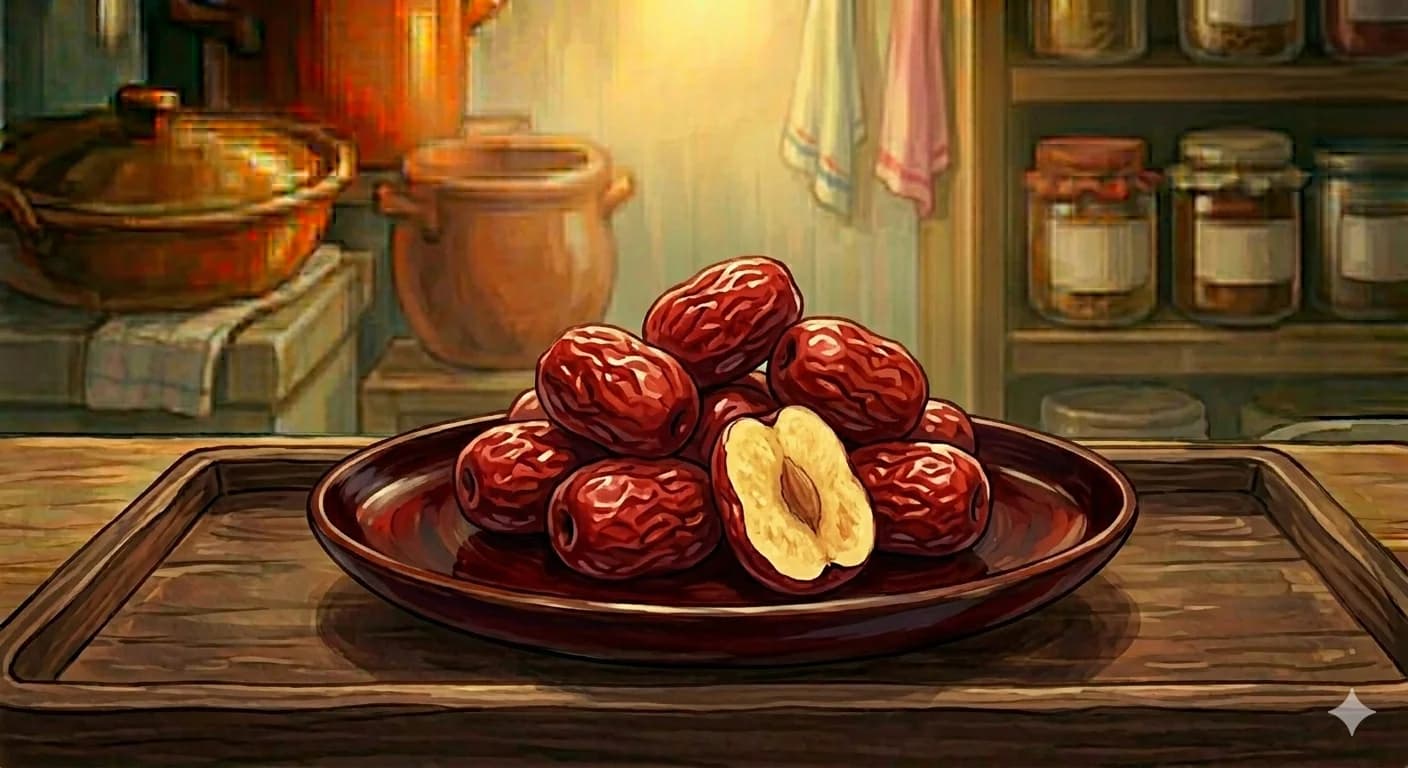
Jujube
Also known as: Red Date, Da Zao, Chinese Date, 大枣
Jujube, the small wrinkled red fruit also known as the Chinese red date, is one of the oldest cultivated fruits in the world and a cornerstone ingredient in Traditional Chinese Medicine and East Asian cooking.
Fresh jujubes have a crisp, apple-like sweetness, but it is the dried form that dominates kitchens and apothecaries across China and Korea. Dried jujubes develop a deep, concentrated sweetness somewhere between a date and a dried apple, with warm caramel undertones and a slightly chewy texture.
In Chinese cooking, jujubes appear in everything from slow-simmered soups and congees to sweet dessert soups and stuffed pastries. They are rarely the star of a dish, but their quiet, grounding sweetness is often the element that ties a complex preparation together.
Key facts at a glance:
- One of the oldest cultivated fruits — over 4,000 years of documented use in China
- Dried form dominates — concentrated sweetness with caramel and warm fruit notes
- TCM staple — classified as a qi and blood tonic
- Rich in vitamin C — fresh jujubes contain more vitamin C per gram than most citrus fruits
- Versatile across sweet and savory — soups, braises, teas, desserts, and medicinal preparations
Flavor Profile
Origin
Northern China, Korea, Central Asia, Middle East
Traditional Medicine Perspectives
Traditional Chinese Medicine
Jujube (Da Zao) is classified as sweet and warm, entering the Spleen, Stomach, and Heart meridians. It is one of the most commonly used herbs in TCM formulas, where it serves to tonify qi and blood, calm the spirit, and moderate the harsh properties of other herbs. It is a key ingredient in many classical formulas and is traditionally used for fatigue, poor appetite, and restlessness.
Modern Scientific Research
Jujubes are notably rich in vitamin C — fresh fruits contain 200–500 mg per 100g, rivaling rosehips. Dried jujubes retain significant amounts of cyclic AMP (cAMP), a nucleotide involved in cellular signaling.
Research has identified triterpenoid saponins (jujubosides) as compounds of interest for their potential sedative and anxiolytic effects in animal studies. Jujube extracts have shown antioxidant activity in vitro, attributed to their high polyphenol and flavonoid content.
Studies have also investigated jujube polysaccharides for potential immunomodulatory and hepatoprotective properties, though human clinical data remains limited.
Cultural History
Jujube cultivation in China stretches back over four thousand years, making it one of the five most important traditional fruits alongside peach, plum, apricot, and chestnut. The fruit is so deeply embedded in Chinese culture that it appears in wedding rituals — the word for jujube (枣, zǎo) is a homophone for "early," and jujubes are placed on the marriage bed to wish for the early arrival of children.
In Korean cuisine, jujubes (called daechu, 대추) hold a similarly honored position. They are essential in samgyetang (ginseng chicken soup), ssanghwa-tang (restorative herbal tea), and yakbap (sweet medicinal rice).
Across East Asia, the jujube has never been just food — it sits at the intersection of nourishment, medicine, and cultural symbolism in a way few other ingredients can claim.
Culinary Uses
Add whole dried jujubes to slow-simmered soups and broths — they contribute a gentle sweetness that balances the richness of pork bones, chicken, or herbal ingredients. No need to pit them; the seed softens during long cooking.
Use in sweet soups and desserts: jujubes pair beautifully with lotus seeds, snow fungus, longan, and goji berries in Cantonese tong sui (sweet soups). They also stuff well — split and fill with glutinous rice for the classic nian gao preparation.
Jujubes are rarely the star of a dish, but their quiet, grounding sweetness is often the element that ties a complex preparation together.
Steep dried jujubes in hot water with goji berries and a few slices of ginger for a simple, warming jujube tea that is a staple comfort drink across China and Korea. In Korean cooking, sliced jujubes are an essential garnish for festive dishes like japchae and tteokguk.
Preparation Methods
For soups and braises, rinse dried jujubes and add them whole — they need no soaking. For teas, slice in half or crush lightly to release more flavor into the liquid.
For desserts and stuffings, soak in warm water for 30 minutes to soften, then pit by slitting one side and removing the seed. The softened flesh can be chopped, mashed into paste, or stuffed.
Store dried jujubes in a cool, dark place in an airtight container — they keep for up to a year. Discard any that smell sour or show mold.
Traditional Dishes
- Samgyetang
- Jujube tea
- Eight treasure congee
- Yakbap
- Tong sui sweet soup
- Nian gao stuffed jujubes
Comments
Share your thoughts on this ingredient.
Sign in to comment0 Comments