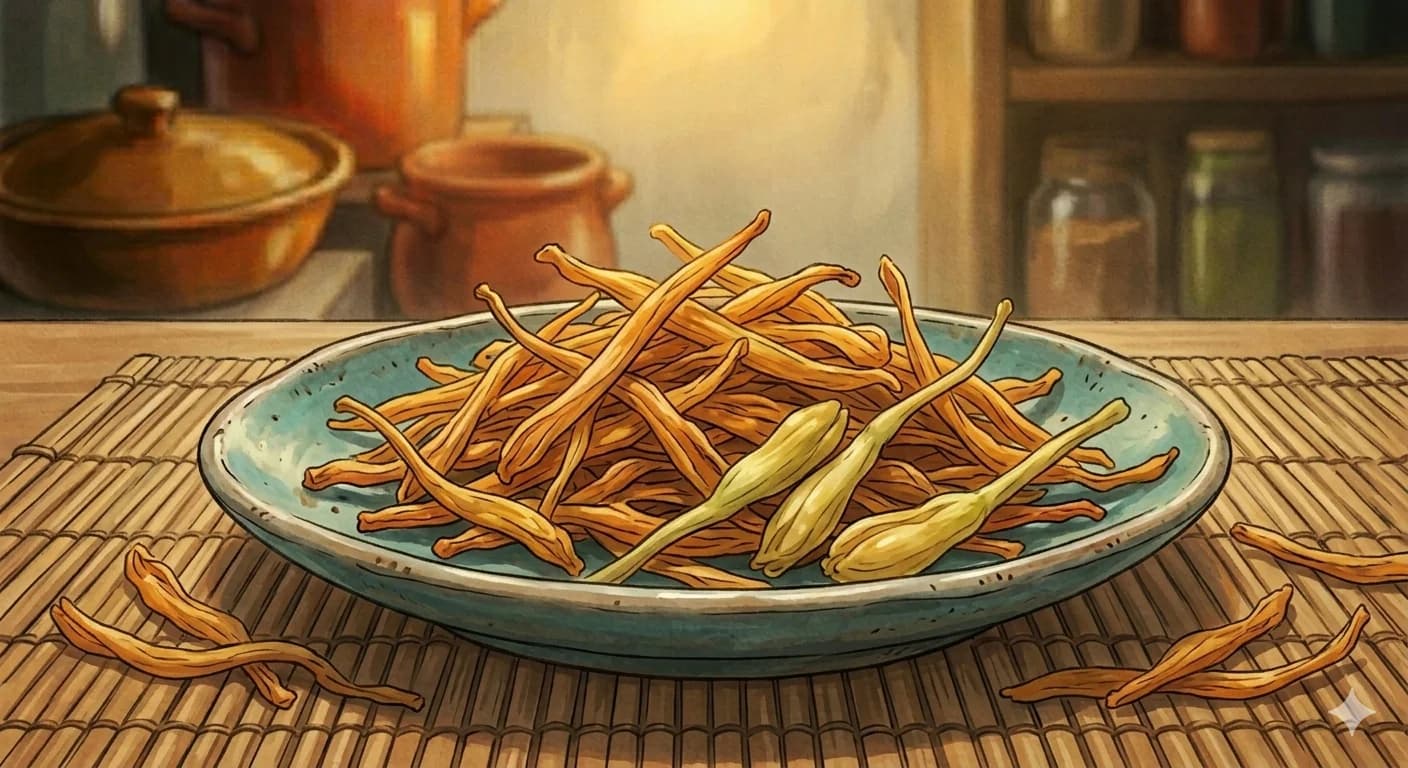
Daylily
Also known as: Golden Needles, Huang Hua Cai, Jin Zhen, 金针菜, Dried Lily Buds
Daylily buds — known poetically as "golden needles" (jin zhen, 金针) — are the dried, unopened flower buds of the Hemerocallis citrina plant, prized in Chinese cooking for their delicate, slightly musky sweetness and tender, chewy texture.
The dried buds are long, thin, and golden-orange, resembling slender needles. When rehydrated and cooked, they develop a flavor that is subtly sweet, floral, and lightly earthy, with a pleasant chewiness that adds textural contrast to soups, stir-fries, and braised dishes.
Golden needles are one of those quiet ingredients that define home-style Chinese cooking without ever drawing attention to themselves. They appear in hot and sour soup, mu shu pork, Buddhist vegetarian dishes, and countless regional preparations.
Key facts at a glance:
- Dried unopened flower buds of the Hemerocallis citrina daylily
- "Golden needles" (jin zhen) — the poetic Chinese name
- Subtly sweet, floral, and chewy — a textural and flavor accent
- Staple of home-style Chinese cooking — soups, stir-fries, braises
- Must be dried or thoroughly cooked — fresh buds contain colchicine and must be processed
Flavor Profile
Origin
China, East Asia
Traditional Medicine Perspectives
Traditional Chinese Medicine
Daylily (Xuan Cao/Huang Hua Cai) is classified as sweet and cooling in TCM, entering the Liver meridian. It is traditionally associated with calming the spirit, clearing heat, and promoting urination. Its Chinese name — the forgetting worry plant — reflects its traditional use for melancholy and insomnia. It is also used to support lactation in postpartum women.
Modern Scientific Research
Fresh daylily buds contain colchicine, an alkaloid that can cause nausea and digestive distress if consumed raw. Drying and thorough cooking effectively neutralize colchicine, which is why daylily buds are always used in dried form in Chinese cooking.
Dried daylily buds contain carotenoids (responsible for their golden color), vitamin A precursors, iron, and phosphorus. They are a good source of plant protein relative to other vegetables.
Some preliminary research has investigated daylily compounds for potential anxiolytic and sleep-promoting properties, which would align with the traditional name "forgetting worry plant," though clinical evidence remains very limited.
Cultural History
Daylily buds have been used in Chinese cooking and medicine for over two thousand years. The daylily (Hemerocallis) is known in Chinese as "xuan cao" (萱草), the "forgetting worry plant" — it was traditionally planted in gardens and given to women during pregnancy to help them forget their anxieties.
In Chinese Buddhist vegetarian cuisine, golden needles are one of the essential dried ingredients, often combined with wood ear mushrooms, dried tofu skin, and dried shiitake in meatless preparations that nonetheless deliver satisfying depth and complexity.
Golden needles are especially prominent in northern and central Chinese cooking, appearing in home-style dishes from Shandong, Henan, and Hunan provinces.
Culinary Uses
Soak dried golden needles in warm water for 20-30 minutes until soft and pliable. Tie each bud in a knot (a traditional technique that helps them hold together during cooking and makes a more elegant presentation).
Add to hot and sour soup with wood ear mushrooms, tofu, and vinegar — golden needles provide a sweet counterpoint to the sour and spicy elements. Use in mu shu pork alongside wood ear mushrooms and scrambled eggs.
Tie each soaked bud in a small knot before cooking — this traditional technique prevents them from falling apart and creates an elegant presentation.
Stir-fry with pork, eggs, or other vegetables. Add to braised dishes and noodle soups for textural variety. In vegetarian cooking, golden needles are invaluable for adding a meaty chewiness without any animal products.
Preparation Methods
Always use the dried form — never eat fresh daylily buds raw due to their colchicine content. Soak in warm water for 20-30 minutes, then squeeze out excess water.
Trim and discard the tough stem end if present. Tie individual buds in a loose knot for better texture retention during cooking.
Look for golden needles that are a bright, even golden-orange color. Very dark or brown buds may be old. Store in a cool, dry place in an airtight container — they keep for a year or more.
Traditional Dishes
- Hot and sour soup
- Mu shu pork
- Buddhist vegetarian stir-fry
- Golden needle pork rib soup
- Steamed pork with golden needles
Comments
Share your thoughts on this ingredient.
Sign in to comment0 Comments