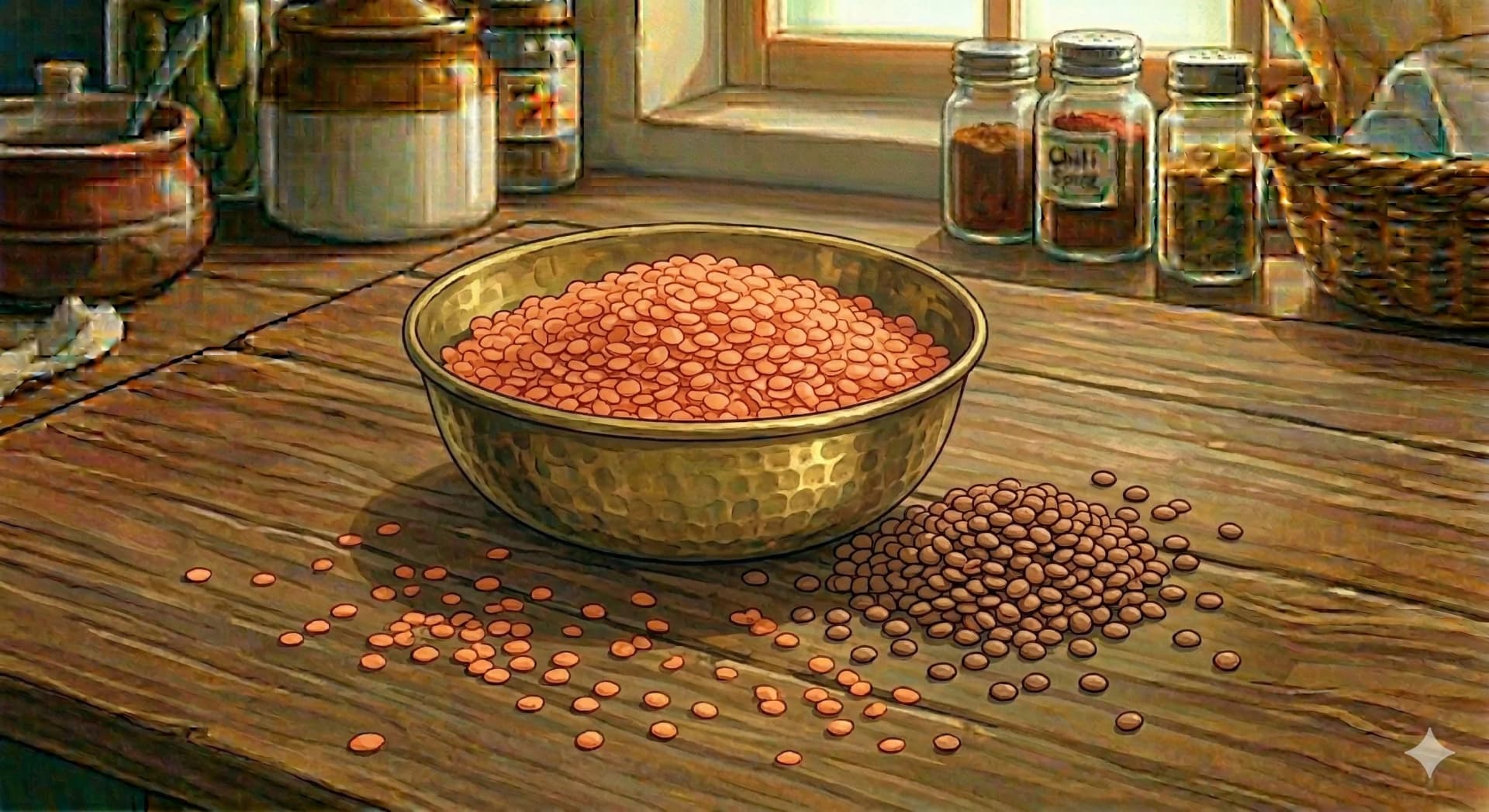
Masoor Dal
Also known as: Red Lentils, Split Red Lentils, Lens culinaris, Pink Lentils
Masoor dal is the fastest answer to the question of protein on a weeknight. Split red lentils require no soaking, cook in 15 to 20 minutes on the stovetop, and produce a thick, smooth, naturally comforting pot of food with minimal effort.
This alone would make them valuable, but masoor dal also happens to taste genuinely good: earthy and mildly sweet in a way that responds readily to both subtle and assertive seasoning, from a simple Bengali preparation with mustard oil and garlic to a complexly spiced Punjabi tadka.
The color transformation of masoor dal during cooking is one of the more striking phenomena in the everyday kitchen. Raw masoor dal is orange-red, almost salmon-colored. By the time it is fully cooked, it is a warm golden-yellow, with no trace of the original color. This is not a sign of overcooking or nutrient loss; it is a normal chemical transformation in which the red pigments (flavonoids) denature with heat.
An important distinction: masoor dal (split red lentils) and whole masoor (brown/green lentils) are the same plant, Lens culinaris, in different forms — the split form has had its hull removed and cooks very quickly, while the whole form retains its hull and holds its shape.
Key facts at a glance:
- No soaking needed — cooks in 15-20 minutes on the stovetop
- Color transformation — shifts from orange-red to golden-yellow during cooking
- Same plant, two forms — split masoor dissolves; whole masoor holds shape
- 18g protein per cup — with 16g fiber and high folate
- Universal comfort food — from Bengali mustard oil preparations to Turkish mercimek corbasi
Flavor Profile
Origin
Middle East, South Asia, Mediterranean
Traditional Medicine Perspectives
Ayurveda:
Masoor dal is considered slightly warming and moderately easy to digest, better than whole lentils but not as light as split moong. It is considered mildly Pitta-aggravating in large amounts due to its slightly warming nature, but balancing for Vata and Kapha. It is not recommended as the primary food during acute illness (moong is preferred for that purpose) but is suitable for everyday use by healthy adults. Cooking with turmeric and digestive spices is standard practice.
Traditional Chinese Medicine:
Lentils are classified as sweet and neutral in TCM, supporting Spleen and Stomach function and nourishing Qi and Blood. They are considered appropriate for general fatigue, deficient digestion, and recovery from illness in moderate amounts. Their neutral temperature makes them accessible to most constitutions.
Modern Scientific Research
Masoor dal's nutritional profile is strong across all major metrics: approximately 18 grams of protein and 16 grams of fiber per cooked cup, with high folate (90 percent of daily value), significant iron, and a range of B vitamins.
A meta-analysis published in the Canadian Medical Association Journal in 2014 found that daily legume consumption reduced LDL cholesterol by an average of 5 percent. The fiber ferments in the gut to produce short-chain fatty acids, particularly butyrate, which is a primary fuel for colonocytes (colon cells).
The traditional practice of adding tomatoes or tamarind — both acidic and vitamin C-rich — to lentil preparations is a natural bioavailability enhancer for non-heme iron absorption, a combination embedded in South Asian cooking long before anyone understood the biochemistry.
Cultural History
Lentils are among humanity's oldest cultivated crops. Charred lentil remains have been found at Franchthi Cave in Greece dating to 11,000 BCE. Lens culinaris was domesticated alongside wheat and barley in the agricultural revolution of the ancient Near East.
In Bengal, where mustard oil is the cooking fat, masoor dal is often made simply: cooked down with tomatoes, tempered with mustard seeds and dried red chilies in mustard oil, and eaten with plain rice. It is a daily food, not a special occasion dish.
Across the Middle East and Mediterranean, the split red lentil became the soup lentil. Turkish mercimek corbasi, the red lentil soup served at the start of almost every meal in Anatolia, is one of the most broadly consumed lentil preparations in the world.
In Egypt, red lentils appear in koshari, the layered street food of lentils, rice, pasta, and spiced tomato sauce that is the country's national dish by most reckonings.
Culinary Uses
The behavior of masoor dal when cooked is almost entirely dissolving. Unlike chana dal or toor dal, which retain some structural integrity, fully cooked masoor dal becomes a smooth, thick puree. This makes it ideal for soups and creamy dal preparations, but it cannot be used where intact dal pieces are needed.
For the classic North Indian masoor dal tadka, the dal is cooked with turmeric until completely soft, then combined with a masala of onion, tomato, ginger, and garlic that has been cooked down until the oil separates. The technique requires that the masala be properly bhunoed (cooked until the raw smell is gone) before the dal is added.
For Turkish red lentil soup, the approach is even more streamlined: onion, garlic, and tomato paste sweated in butter, red lentils and stock simmered 20 minutes, blended smooth, and finished with a butter-and-paprika drizzle.
Preparation Methods
No soaking required. Rinse masoor dal thoroughly (3 to 4 rinses) until the water runs relatively clear.
Stovetop: 1 cup rinsed dal to 3 cups water. Add a pinch of turmeric. Bring to a boil, skim any foam, then simmer on medium-low for 15 to 20 minutes until completely soft. Add salt after cooking.
Pressure cooker: 1 cup dal to 2.5 cups water with turmeric. 1 to 2 whistles or 5 minutes high pressure. Stir vigorously after opening to smooth the texture.
Dal tadka finish: Heat 2 tablespoons ghee in a small pan until very hot. Add 1 teaspoon cumin seeds, let sputter 30 seconds. Add 2 dried red chilies, a pinch of asafoetida, and optionally 2 sliced garlic cloves. Cook until garlic is golden. Pour immediately over the cooked dal.
Traditional Dishes
- Masoor dal tadka (North Indian)
- Bengali masoor dal (mustard oil and mustard seed tempered)
- Turkish red lentil soup (mercimek corbasi)
- Egyptian koshari
- Masoor dal khichdi
- Ethiopian misir alicha (turmeric-mild version)
- Ethiopian misir wot (berbere-spiced)
- Masoor soup with lemon and cumin (Lebanese-style)
- Masoor dal with spinach
Comments
Share your thoughts on this ingredient.
Sign in to comment0 Comments