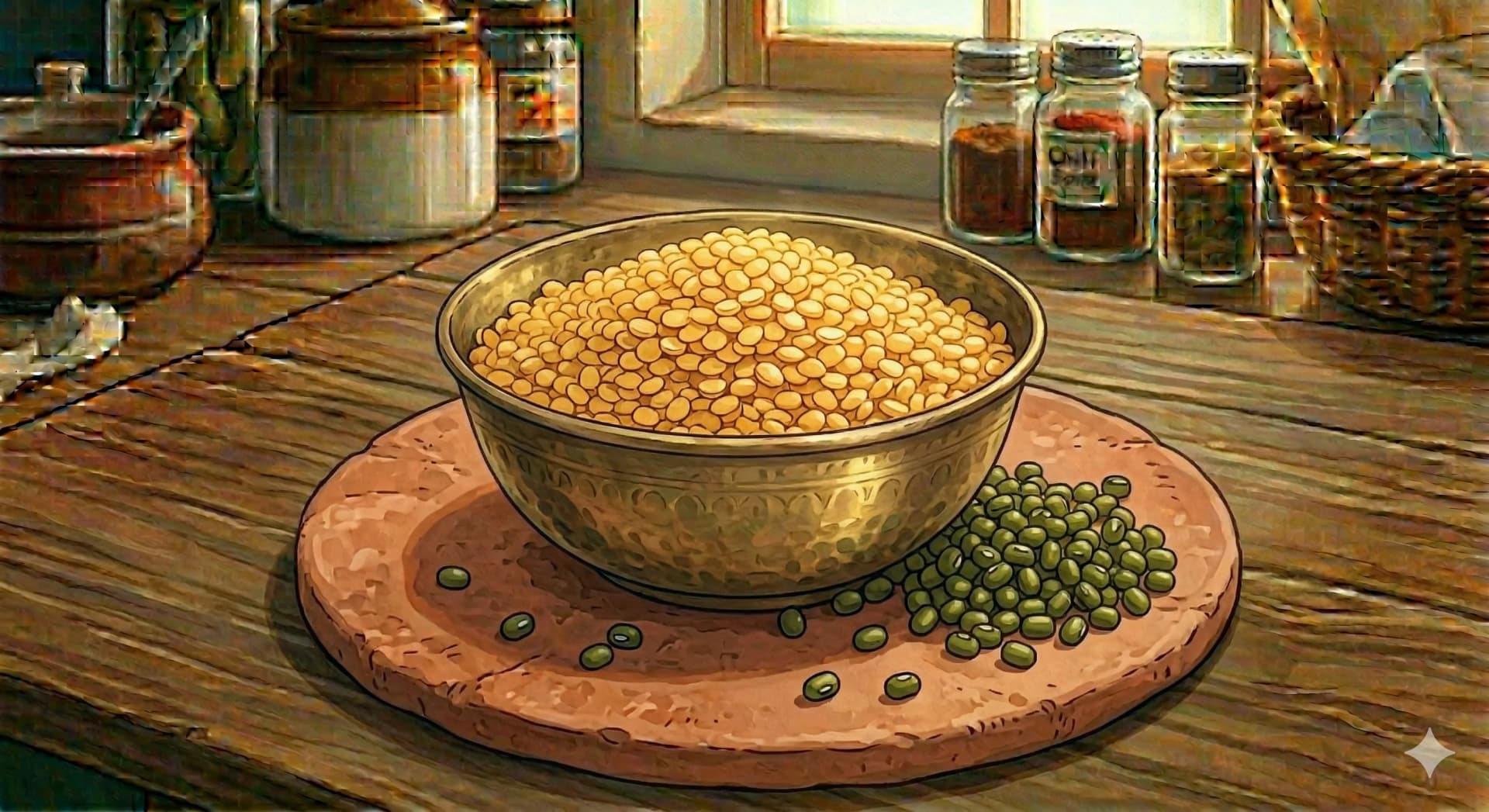
Moong Dal
Also known as: Mung Dal, Split Mung Beans, Vigna radiata (split), Green Gram
In the vast family of Indian dals, moong dal occupies a singular position. It is the dal Ayurvedic medicine endorses without qualification — the only legume considered appropriate for infants, the elderly, the ill, and those recovering from surgery or fever.
This is not simply traditional wisdom: moong dal is genuinely easier to digest than other legumes, containing lower amounts of the oligosaccharides that produce gas and digestive discomfort, and higher amounts of easily absorbed protein.
Like urad dal, moong functions as three distinct ingredients depending on processing. Whole green mung beans (sabut moong), with their green skins intact, take 30 to 40 minutes to cook. Split with skin on (chilka moong) cooks in 20 to 25 minutes. Split and skinned yellow moong (dhuli moong) is the most familiar form: pale yellow, quick-cooking (15 to 20 minutes), and mildest in flavor.
Split yellow moong is also the sprout-capable form when used whole: whole green mung beans, soaked overnight and kept moist, produce white sprouts in 24 to 48 hours that are among the most nutritious and widely eaten sprouts globally.
Key facts at a glance:
- Ayurvedic gold standard — the only legume universally recommended for all constitutions
- Easiest to digest — lowest oligosaccharide content among common legumes
- Three forms — whole green (sabut), split with skin (chilka), split skinned (dhuli)
- 15-20 minutes — no soaking needed for split yellow moong
- Sprout source — whole green mung beans produce nutritious sprouts in 24-48 hours
- Khichdi base — the foundational ingredient in India's most healing one-pot dish
Flavor Profile
Origin
Indian subcontinent, Southeast Asia
Traditional Medicine Perspectives
Ayurveda:
Moong dal is the most highly regarded dal in the Ayurvedic system. It is classified as tridoshic (balancing for all three doshas, Vata, Pitta, and Kapha) and is considered sattvic, supporting mental clarity and calm energy. It is specifically recommended for those with weak digestive fire (mandagni), children, the elderly, pregnant women, and anyone recovering from illness. Khichdi (moong + rice) is the canonical Ayurvedic healing food, used in the panchakarma cleansing protocols where it is eaten exclusively for several days. The dal's light, easily digestible quality is attributed to its low fiber skin content (in the split form) and its favorable starch composition.
Traditional Chinese Medicine:
Mung beans are classified as sweet and cold, making them one of the few legumes considered cooling in TCM. They are used to clear heat and toxins, reduce summer fever, and address conditions attributed to excess heat in the system. Mung bean soup is a traditional summer cooling remedy across China and Southeast Asia.
Modern Scientific Research
The exceptional digestibility of moong dal has a biochemical basis. Compared to chickpeas and kidney beans, mung beans contain significantly lower levels of the flatulence-causing oligosaccharides raffinose and stachyose. A 2014 review by Tang and colleagues in Chemistry Central Journal covers this and the rest of the mung bean phytochemistry in detail, and the low-oligosaccharide profile is the biochemical correlate of the Ayurvedic observation that moong is the gentlest of the dals.
Germination (sprouting) further reduces these oligosaccharides while increasing vitamin C content dramatically (from near zero in the dry bean to roughly 13 mg per 100 g in sprouted form) and roughly doubling folate content.
Mung bean starch has particularly high amylose content (about 44 percent of total starch), contributing to its lower glycemic index — the transparent glass noodles common in Asian cooking are made from this starch precisely because of its clarity and gel-forming properties.
Mung-bean protein has also been studied for peptides with ACE-inhibitory (blood-pressure-modulating) activity in laboratory work, though the dietary relevance of these findings is not yet established.
Cultural History
Moong has been cultivated in India for at least 4,000 years, with archaeological remains found in Harappan sites. From its origins on the subcontinent, it spread eastward into Southeast Asia, where the whole mung bean became a pantry staple independent of Indian dal preparations.
In Thailand, mung beans appear in sweet preparations: a classic dessert of whole mung beans cooked in coconut milk. In Vietnam, mung bean paste appears in mooncakes and banh.
Khichdi, the preparation of split yellow moong and rice cooked together into a soft, porridge-like one-pot dish, is described in multiple Ayurvedic texts as the ideal food for healing. It was the meal served to Mughal Emperor Akbar when he fasted, and the dish given to new mothers recovering from childbirth.
Moong dal halwa, a Rajasthani dessert made by roasting split moong dal in ghee until golden, then cooking with sugar syrup and cardamom, demonstrates the dal's remarkable versatility — transforming from a plain, savory dal into a rich, nutty dessert.
Culinary Uses
Split yellow moong's greatest culinary virtue is speed. It requires no soaking and cooks completely in 15 to 20 minutes on the stovetop. Its mild flavor makes it a clean canvas for any tadka, and it dissolves smoothly without becoming gluey.
For khichdi, combine with rice in a 1:1 ratio and cook with additional water until thick and unified, then season simply with ghee, salt, and cumin.
For pesarattu, the savory crepe of Andhra Pradesh, whole green mung beans are soaked overnight and ground with ginger, green chili, and salt to a thin batter. It is one of the more elegant uses of the whole mung bean: protein-rich, naturally gluten-free, and ready in minutes.
For sprouting, whole green mung beans are soaked for 8 hours, then drained and left in a covered container, rinsed twice daily — at the 1 to 2 centimeter length, they are crisp and sweet.
Preparation Methods
Split yellow moong (no soaking needed): Rinse until water runs clear. Add to 3 cups water per 1 cup dal. Bring to boil, skim foam, simmer 15 to 20 minutes until soft. Season with salt. Finish with tadka.
For khichdi: Rinse 1 part split moong and 1 part rice together. Add to 4 parts water with salt and turmeric. Cook in a pressure cooker (2 whistles) or heavy pot until very soft and unified. Stir in ghee and season.
Pressure cooker (split moong): 1 cup dal to 2.5 cups water, with turmeric and salt. 2 to 3 minutes high pressure, natural release. Stir vigorously to smooth.
Sprouting: Soak whole green mung in ample water, 8 to 12 hours. Drain completely. Transfer to a colander or sprouting jar. Cover with a damp cloth. Rinse and drain twice daily. Sprouts ready in 24 to 48 hours at room temperature.
Traditional Dishes
- Moong dal khichdi (Ayurvedic healing khichdi)
- Moong dal tadka
- Pesarattu (Andhra mung crepe)
- Moong dal halwa (Rajasthani)
- Sprouted moong chaat
- Moong dal chilla (savory crepe)
- Gujarati moong dal with sugar (sweet dal)
- Panchmel dal (as one of five dals)
- Mung bean glass noodle soup
Comments
Share your thoughts on this ingredient.
Sign in to comment0 Comments