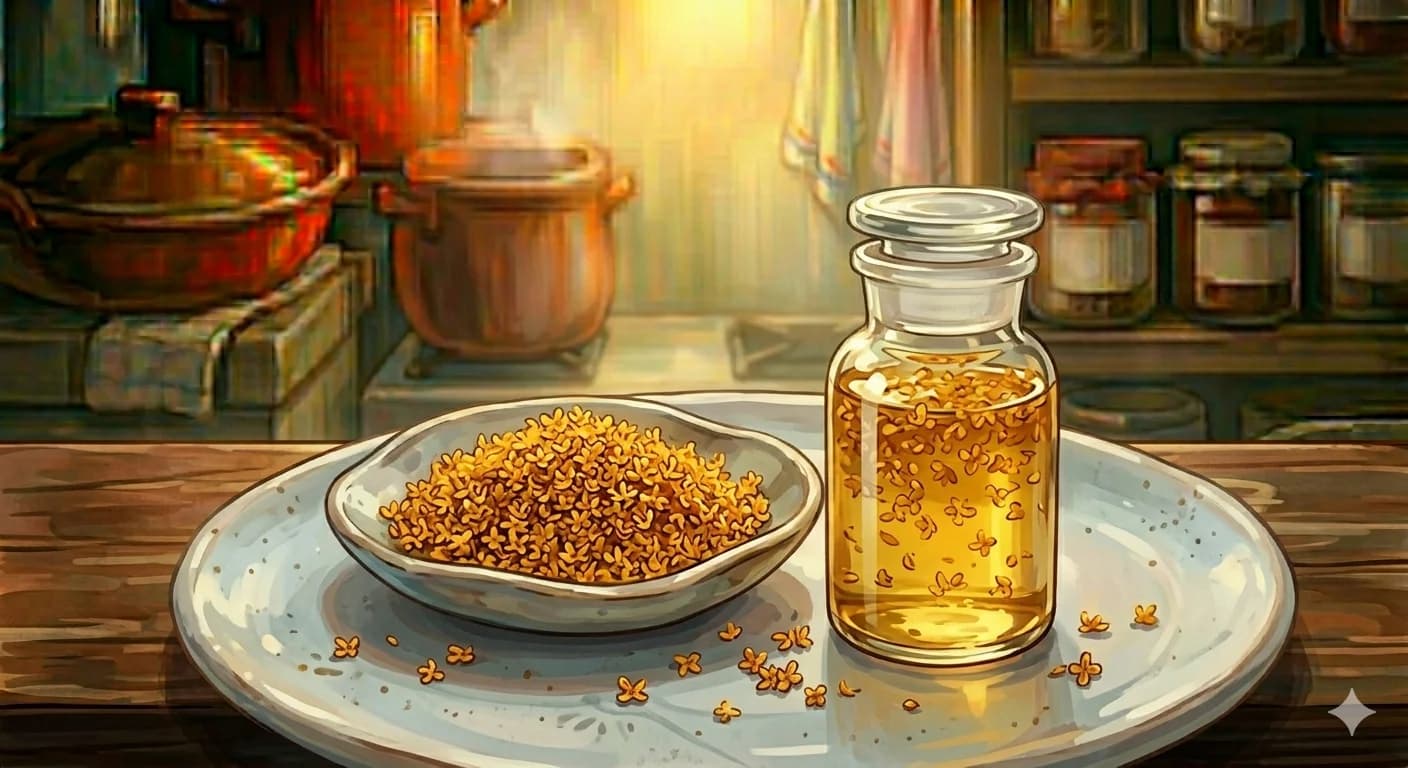
Osmanthus Flowers
Also known as: Gui Hua, 桂花, Sweet Olive Blossoms, Osmanthus fragrans
Osmanthus flowers — tiny, golden blossoms with an intoxicating fragrance of ripe apricots, peaches, and honey — are one of the most romantically beautiful ingredients in Chinese cooking, used to perfume desserts, teas, wines, and sauces.
The flavor of osmanthus is delicately sweet, fruity, and floral, with an aroma that is far more powerful than the taste. A small amount transforms a simple dessert into something enchanting — the fragrance lingers in the nose and memory long after the last bite.
Osmanthus flowers are used in two main forms: dried flowers (for teas and garnishes) and osmanthus syrup/jam (gui hua jiang), which is the preserved form made by steeping the flowers in sugar or honey. The syrup is the more versatile and commonly used form in cooking.
Key facts at a glance:
- Tiny golden blossoms of Osmanthus fragrans — intensely aromatic
- Fragrance of apricots, peaches, and honey — one of the most beloved scents in Chinese culture
- Preserved as syrup (gui hua jiang) — the most common culinary form
- Desserts, teas, and wines — used primarily in sweet applications
- Autumn flower — associated with the Mid-Autumn Festival and harvest moon
Flavor Profile
Origin
Southern China, East Asia, Himalayas
Traditional Medicine Perspectives
Traditional Chinese Medicine
Osmanthus flower (Gui Hua) is classified as warm and pungent in TCM, entering the Lung and Stomach meridians. It is traditionally used to warm the Lung, dispel cold, and resolve phlegm. It is also associated with improving complexion and freshening breath. In folk medicine, osmanthus tea is drunk for stomach discomfort, coughs, and to harmonize the digestive system.
Modern Scientific Research
Osmanthus flowers contain volatile compounds including linalool, ionone, and various terpenoids that are responsible for their distinctive fragrance. These compounds are of interest in aromatherapy and fragrance science.
The complex fragrance of osmanthus flowers comes from a blend of linalool, ionone, and other volatile terpenoids — the same compounds found in roses, violets, and ripe stone fruits.
The flowers contain flavonoids and phenolic compounds with demonstrated antioxidant activity in laboratory studies. Some research has investigated osmanthus extracts for potential anti-inflammatory and neuroprotective properties, though these are early-stage findings.
In food science, osmanthus flower extracts are studied as natural flavoring agents and potential food preservatives due to their antimicrobial properties against certain food pathogens.
Cultural History
The osmanthus tree has been cultivated in China for over 2,500 years and holds deep cultural significance. The Chinese name "gui hua" (桂花) — osmanthus flower — is associated with the Moon Palace in Chinese mythology, where a giant osmanthus tree is said to grow.
Osmanthus blooms in autumn, coinciding with the Mid-Autumn Festival (Moon Festival), and its fragrance is inseparable from the season's celebrations, harvest moon poetry, and mooncake traditions. The city of Guilin (桂林, "osmanthus forest") is named after the trees that once filled its landscape.
Osmanthus wine (gui hua jiu) and osmanthus-scented rice wine have been produced for centuries and are traditionally consumed during the Mid-Autumn Festival. The flower also appears in classical Chinese poetry as a symbol of beauty, nobility, and the bittersweet passage of time.
Culinary Uses
Drizzle osmanthus syrup (gui hua jiang) over glutinous rice balls (tang yuan), sweet tofu pudding (douhua), or chestnut cake for an instant fragrant flourish. A teaspoon or two is sufficient — the fragrance is potent.
Brew dried osmanthus flowers alone or blended with green tea or oolong for osmanthus tea — one of the most beloved floral teas in China. The flowers can also be steeped in warm rice wine for osmanthus wine (gui hua jiu).
A small amount of osmanthus transforms a simple dessert into something enchanting — the fragrance lingers in the nose and memory long after the last bite.
Use osmanthus syrup in mooncake fillings, sweet rice cakes, and as a flavoring for almond tofu (xing ren doufu). Scatter dried flowers as a garnish over dessert soups and puddings for visual beauty and aroma.
Preparation Methods
Osmanthus syrup (gui hua jiang) is ready to use — drizzle directly over desserts or stir into teas and warm drinks. Store in the refrigerator after opening.
Dried osmanthus flowers should be used sparingly — a pinch goes a long way. For tea, steep 1-2 teaspoons in hot water for 3-5 minutes. Do not over-steep or the tea becomes bitter.
Look for osmanthus syrup in the condiment aisle of Chinese grocery stores — it comes in small jars and lasts a long time since you use very little at once. For dried flowers, select those that are golden and fragrant, not brown or musty.
Traditional Dishes
- Osmanthus tang yuan
- Osmanthus jelly
- Osmanthus sweet rice cake
- Gui hua jiu (osmanthus wine)
- Osmanthus tea
- Almond tofu with osmanthus
Comments
Share your thoughts on this ingredient.
Sign in to comment0 Comments