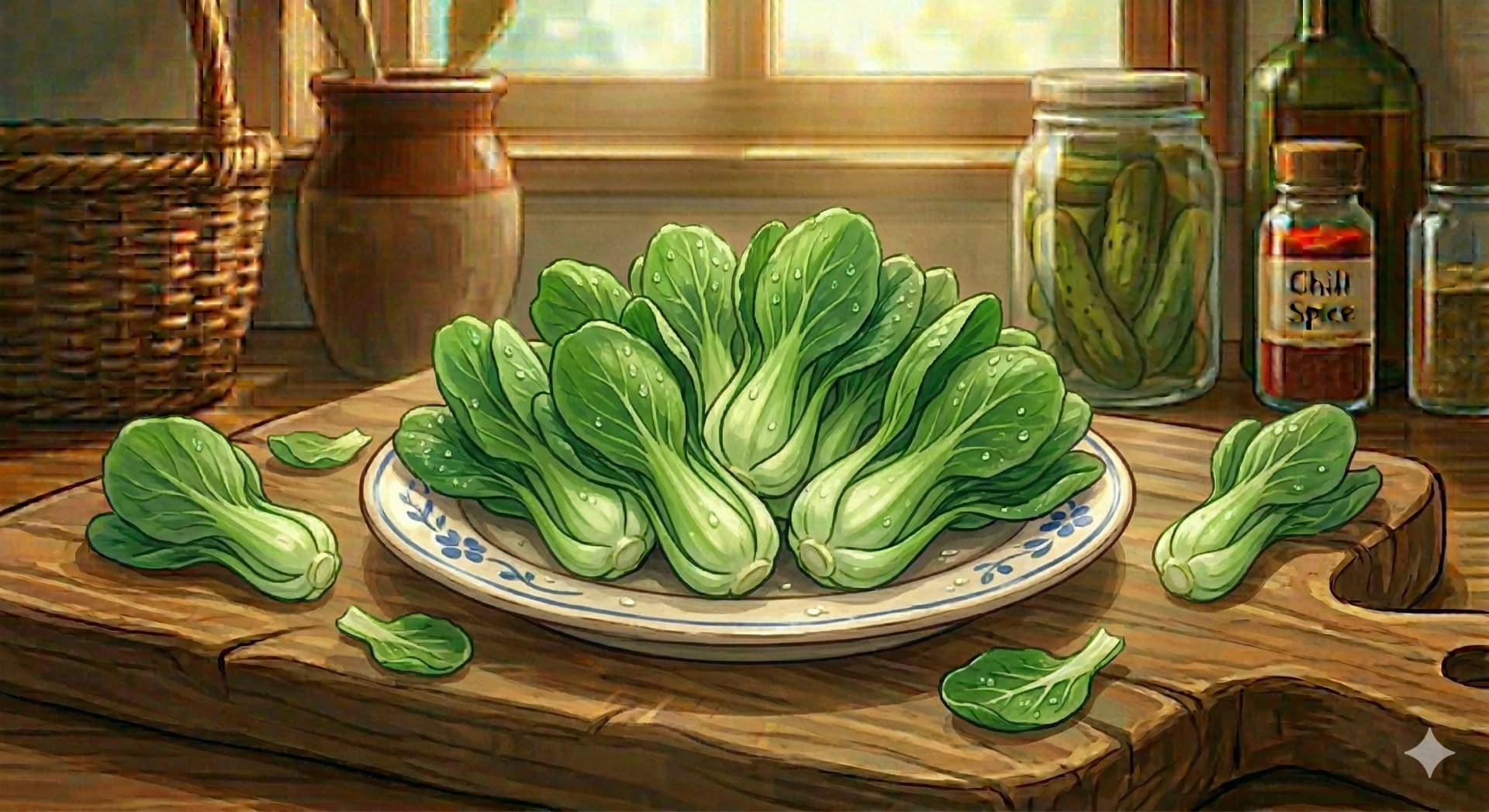
Shanghai Baby Bok Choy
Also known as: Shanghai Bok Choy, Xiao Bai Cai, Spoon Cabbage, Small White Cabbage
Shanghai baby bok choy is a smaller, more delicate variety of bok choy with pale green stalks (rather than the stark white of regular bok choy) and a spoon-shaped leaf base that gives it a neat, self-contained appearance when halved or quartered.
It is milder and more tender than regular bok choy with a subtly sweet, clean flavor. Its visual appeal — compact, bright green, and uniform — makes it a preferred choice for presentation-conscious cooking.
Key facts at a glance:
- Pale green stalks — distinguishes it from the stark white of regular bok choy
- Milder and more tender — subtly sweet, clean flavor compared to standard varieties
- Developed in the Yangtze Delta — associated with refined Shanghainese home cooking
- Higher leaf-to-stalk ratio — provides proportionally more leafy nutrients
- Rich in vitamins A, C, and K — plus calcium and cancer-preventive glucosinolates
Flavor Profile
Origin
Shanghai, Yangtze Delta, China
Traditional Medicine Perspectives
Traditional Chinese Medicine
Shanghai baby bok choy shares the TCM properties of bok choy generally: cool and sweet, clearing heat, moistening dryness, and supporting the Large Intestine. Its smaller, more tender form is considered gentler and more appropriate for people with delicate constitutions or those recovering from illness.
Modern Scientific Research
Shanghai baby bok choy has the same nutritional profile as standard bok choy — rich in vitamins A, C, and K, calcium, and glucosinolates.
The smaller size means a higher leaf-to-stalk ratio, providing proportionally more of the leafy nutrients.
Research on brassica glucosinolates and their metabolites shows consistent cancer-preventive associations in epidemiological studies.
Cultural History
Shanghai baby bok choy developed as a distinct type in the Yangtze Delta region around Shanghai, where the mild climate and fertile soil produced a smaller, more tender brassica.
It became associated with Shanghainese home cooking and restaurant cuisine, where its neat form made it appropriate for more refined presentations.
As Chinese cuisine spread globally, Shanghai bok choy became widely available and is now among the most commonly found Chinese vegetables in Western supermarkets.
Culinary Uses
Halve or quarter and blanch for simple preparations dressed with sauce. Steam whole over boiling water.
Stir-fry at high heat briefly. Add to clear soups and hot pots.
The compact size makes it ideal for individual servings or as an elegant side dish. Use in clay pot preparations and noodle soups.
Preparation Methods
Halve or quarter through the base to keep leaves attached. Wash carefully between leaves.
Blanch in boiling salted water for 60–90 seconds.
For stir-fries, the small size means it cooks quickly — 2–3 minutes total over high heat.
Comments
Share your thoughts on this ingredient.
Sign in to comment0 Comments