Snake Gourd
Also known as: Padwal, Chichinda, Trichosanthes cucumerina, Potlakaaya, Pudalangai
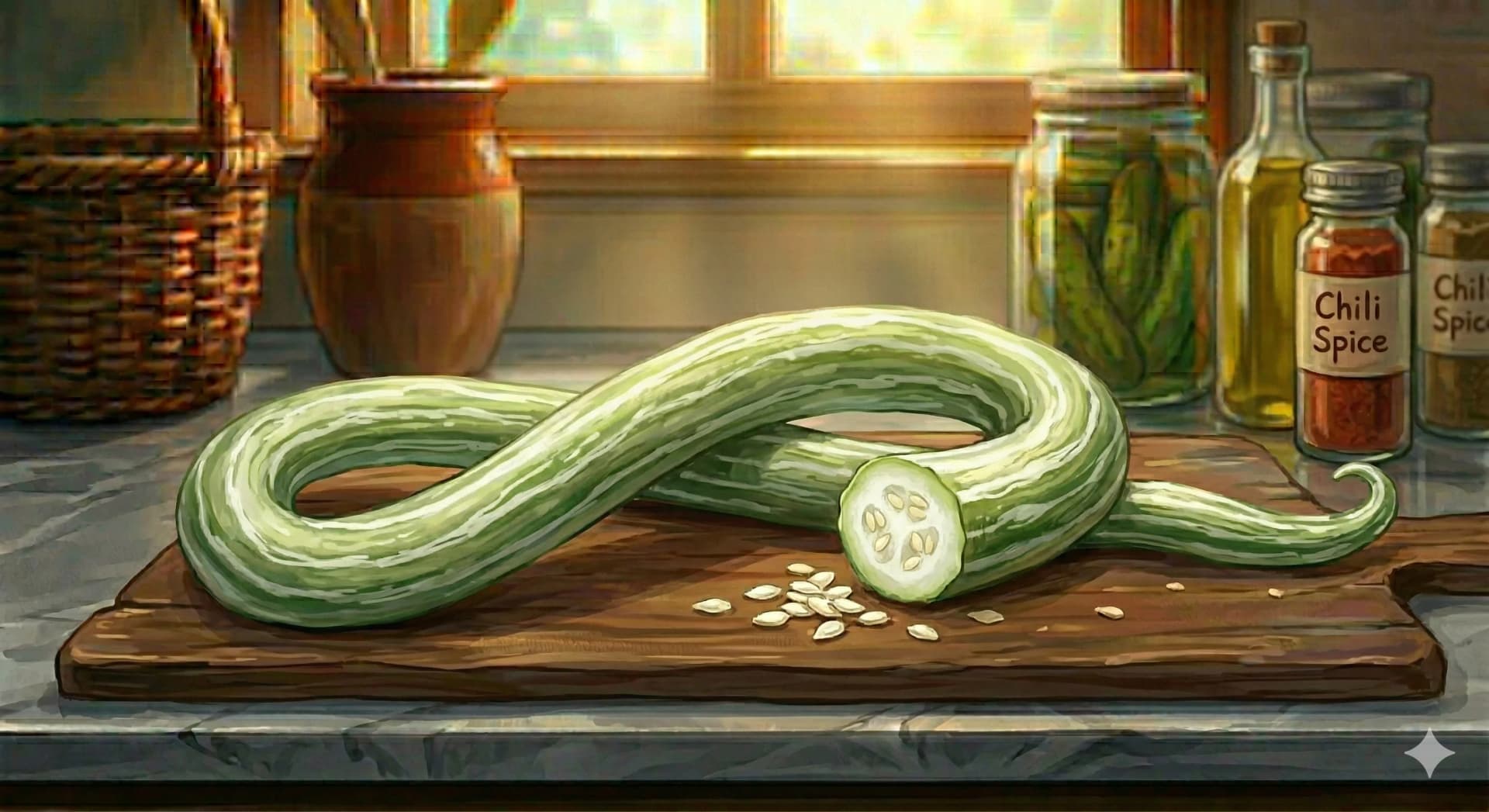
Snake gourd is a tropical vegetable of unusual physical character. The pods grow from hanging vines in elongated, often coiling forms, twisting as they extend until they can reach 100 to 150 cm in length in some varieties. The shape that gives the plant its English name is not incidental: young snake gourds grow straight, but as they lengthen they curve and spiral naturally, and some cultivars produce pods with a distinctly serpentine coil. In traditional markets across South India and Southeast Asia, they are often displayed hanging straight, weighted with a small stone at the tip to counteract the natural curl during growth.
The exterior is smooth and pale green, sometimes with faint white stripes or mottling. The flesh is white to pale, watery, and soft when cooked. The seeds in young gourds are small and undeveloped; in mature specimens they become large, hard, and red-orange colored, at which point the gourd is past its edible stage.
The flavor is mild, with a faint, pleasant bitterness that is characteristic without being dominant. This gentle bitterness distinguishes snake gourd from the more neutral bottle gourd and requires good seasoning to balance, but it is not the aggressive bitterness of bitter gourd. It is a background note rather than the defining character.
In South Indian cooking, snake gourd functions as a reliable everyday vegetable whose mild nature makes it adaptable across a range of preparations. It appears in dry fries, lentil-based dishes, coconut-enriched curries, and in a variety of regional preparations specific to Andhra Pradesh, Tamil Nadu, and Kerala.
Key facts at a glance:
- Can reach 100–150 cm in length — among the longest cultivated vegetables
- Mild, pleasant bitterness — a background note distinguishing it from bottle gourd
- Staple of South Indian cooking — appears in dry fries, lentil dishes, and coconut curries
- Most abundant during monsoon season — available year-round at South Asian grocers
- Over 90% water content — very low caloric density
- Documented in classical Sanskrit literature — referenced in Ayurvedic medical texts
Flavor Profile
Origin
South Asia, Southeast Asia, Tropical Australia
Traditional Medicine Perspectives
Ayurveda:
Snake gourd is classified in Ayurvedic texts as a cooling, diuretic, and purgative food when consumed in quantity. It is recommended for reducing pitta imbalances, managing fever, and supporting kidney and urinary tract health. The cooling quality makes it a summer vegetable in Ayurvedic dietary frameworks. The leaves and seeds also have traditional medicinal applications: the seeds are used in treatments for respiratory conditions, and leaf preparations appear in remedies for skin conditions and fever. The vegetable is considered beneficial for liver health and is prescribed as part of dietary management for liver-related conditions in traditional practice.
Traditional Chinese Medicine:
Snake gourd (gua lou or tian hua fen, though these terms refer specifically to Trichosanthes kirilowii, a related species) has an important place in Chinese medicine. The Chinese snake gourd species is used primarily for its root, seeds, and outer rind as medicinal materials. The plant family's cooling, heat-clearing, and phlegm-resolving properties are well-established in the Chinese materia medica. While Trichosanthes cucumerina is not the primary medicinal species in Chinese tradition, the broader family's framework of clearing heat and moisture from the lungs and stomach applies by analogy to its culinary cousins.
Modern Scientific Research
Snake gourd contains vitamin C, B vitamins, calcium, phosphorus, and iron in moderate amounts. Its high water content (above 90 percent by weight) keeps caloric density low.
Phytochemical studies have identified alkaloids, saponins, flavonoids, and phenolic acids in different parts of the plant, consistent with the range of biological activities documented in traditional medicine.
Research on Trichosanthes cucumerina extracts has demonstrated anti-inflammatory, anti-diabetic, hepatoprotective, and antimicrobial activity in laboratory and animal studies. The seeds contain cucurbitacins (as in related Cucurbitaceae plants), and seed protein fractions have been studied for cytotoxic activity against cancer cell lines.
Anti-parasitic properties have been documented in extracts from the plant's roots and leaves. While clinical evidence in humans remains limited, the phytochemical profile supports the traditional classifications of the plant as a cooling, diuretic, and therapeutically active food plant.
Cultural History
Trichosanthes cucumerina is native to tropical Asia and is documented in cultivation across South and Southeast Asia, northern Australia, and parts of tropical Africa. Evidence of its use in South Asian cooking extends back to classical Sanskrit literature, where it appears in lists of cultivated gourds and is referenced in Ayurvedic medical texts.
The plant is well adapted to the hot, humid conditions of South India and South Asia more broadly, growing vigorously in monsoon conditions and producing abundantly over an extended season.
In the Telugu-speaking regions of Andhra Pradesh and Telangana, potlakaaya (the Telugu name) is a vegetable of particular domestic importance, appearing regularly in the daily cooking of households. The Andhra preparation tradition around snake gourd includes several distinct dishes, from simple stir-fries seasoned with mustard seeds and curry leaves to more complex preparations with lentil pastes and tamarind.
Tamil cooking calls the vegetable pudalangai, and it appears frequently in kootu (vegetable and lentil dishes with coconut) and in sambar. In Kerala, it is incorporated into coconut milk curries and thoran (dry vegetable preparations with grated coconut).
The plant's natural growth habit made it a practical choice for traditional home gardens across the region: the vines climb trellises and fences efficiently, produce abundantly in tropical conditions, and require relatively minimal cultivation effort once established. Like the moringa tree and the curry leaf plant, snake gourd vines were a common feature of domestic agricultural spaces in South India.
Culinary Uses
Snake gourd's mild and slightly bitter character requires decisive seasoning. Preparations that rely primarily on the vegetable's own flavor tend to fall flat.
The most effective approach is a confident tempering: mustard seeds, dried red chilies, curry leaves, and often asafoetida, all bloomed in hot oil before the vegetable is added. This aromatic foundation gives the dish a flavor structure that the snake gourd absorbs and extends. Lemon juice or tamarind provides the acid balance that counters the faint bitterness and brightens the overall profile.
For dry preparations like potlakaaya fry, the snake gourd is sliced into thin rounds or half-rounds after peeling and seed removal. High heat and an open pan allow moisture to evaporate quickly, developing slightly caramelized edges on the rounds. Peanuts added to Andhra-style preparations provide texture and richness that complement the watery vegetable particularly well.
In dal-based dishes, snake gourd pieces are cooked together with lentils until both are soft, producing a unified dish where the gentle bitterness of the gourd is absorbed into the broader spiced lentil context. Kerala preparations with coconut milk are gentler: the coconut's richness softens the bitterness and the result is a mild, slightly sweet curry well suited to plain rice.
For stuffed snake gourd, shorter segments are hollowed out and filled with a seasoned mixture of cooked lentils or crumbled paneer, then cooked in a shallow pan or baked. This technique, more elaborate than everyday preparations, treats the snake gourd as a vessel rather than a primary ingredient.
Preparation Methods
Selecting: Choose snake gourds that are uniformly pale green, firm throughout their length, and without soft spots or yellowing at the tips. Smaller diameter gourds (3 to 5 cm across) tend to be more tender with smaller seeds. Very large or overly mature gourds have hard, prominent seeds and tougher flesh.
Preparing: Wash well. Peel the thin skin with a vegetable peeler: it comes away easily. Cut into rounds or half-rounds of about 0.5 to 1 cm. Scoop out and discard seeds from larger specimens using a spoon or the tip of a knife. Young, small gourds with undeveloped seeds do not require seed removal.
Cutting for stuffing: Cut the gourd into cylinders of 8 to 10 cm. Use a long, narrow knife or apple corer to hollow out the center, leaving walls of about 1 cm. Fill with prepared stuffing and secure the ends with toothpicks.
Cooking: Snake gourd cooks faster than many gourds. Thin rounds become tender in 5 to 7 minutes in an active pan. Avoid cooking until completely mushy: the rounds should be tender but still hold their circular shape. In liquid-based preparations, add the snake gourd toward the end of cooking to prevent it from overcooking and disintegrating.
Traditional Dishes
- Potlakaaya fry (Andhra Pradesh
- with mustard seeds and dried chili)
- Kerala snake gourd curry with coconut milk
- Pudalangai kootu (Tamil Nadu
- with dal and coconut)
- Chichinda sabzi (North Indian)
- Stuffed snake gourd (festive preparation)
- Snake gourd thoran (Kerala
- dry preparation with grated coconut)
- Chichinda dal (Rajasthan and UP)
- Snake gourd chutney (Andhra
- with lentils and tamarind)
Comments
Share your thoughts on this ingredient.
Sign in to comment0 Comments