Taro
Also known as: Yu Tou, Yam Taro, Colocasia esculenta, Arbi, Kalo, Dasheen
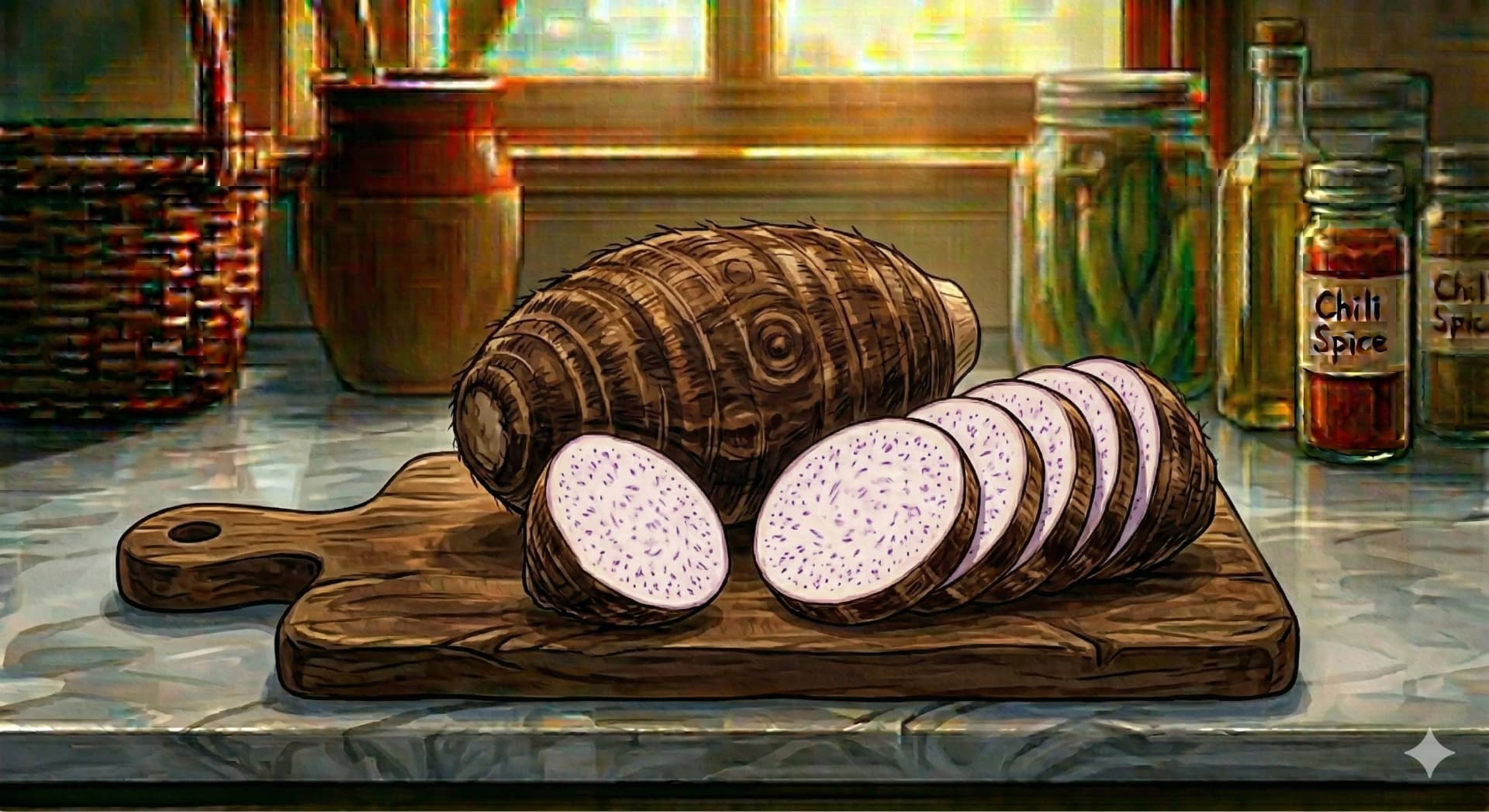
Taro is one of the oldest cultivated root vegetables in the world — a large, shaggy-skinned corm with purple-specked white flesh that turns creamy and richly starchy when cooked.
Its flavor is mild and subtly sweet with a distinctive nuttiness, and its texture when fully cooked is smooth and almost fluffy. Raw taro contains calcium oxalate crystals that cause irritation — it must always be cooked.
In Chinese cooking, taro appears in both savory and sweet preparations, often paired with rich fatty meats or coconut milk.
Key facts at a glance:
- One of the oldest cultivated root vegetables — at least ten thousand years of cultivation
- Must always be cooked — raw taro contains calcium oxalate crystals that cause irritation
- Purple-specked white flesh — turns creamy, rich, and starchy when cooked
- Central to Cantonese and Hakka cooking — appears in dim sum, braises, and desserts
- Contains resistant starch — acts as a prebiotic supporting gut microbiome health
- Wu gok (taro dumpling) — one of the most technically demanding dim sum items
Flavor Profile
Origin
Southeast Asia (origin), China, South Asia, Pacific Islands, West Africa
Traditional Medicine Perspectives
Traditional Chinese Medicine
Taro (Yu Tou) is classified as neutral and sweet in TCM, associated with the Spleen, Stomach, and Large Intestine meridians. It is used to tonify the Spleen and Stomach, resolve accumulation, reduce nodules and swellings, and support digestion. It is considered a tonifying, grounding food appropriate for people with Spleen deficiency.
Modern Scientific Research
Taro contains resistant starch — a type of dietary fiber that acts as a prebiotic in the colon, supporting gut microbiome health.
Research shows resistant starch consumption lowers postprandial blood glucose and insulin responses.
Taro is a good source of potassium, magnesium, vitamin E, and B vitamins. The purple pigmentation in some varieties comes from anthocyanins with antioxidant properties.
Cultural History
Taro has been cultivated for at least ten thousand years, originating in Southeast Asia and spreading globally with human migration. It is the primary starchy staple of many Pacific Island cultures (poi in Hawaii) and has been central to South and Southeast Asian cooking for millennia.
In Chinese cuisine, taro (yu tou) is associated with Cantonese and Hakka cooking — the dim sum classic wu gok (taro dumpling with honeycomb crust) is one of the most technically demanding dim sum items.
Braised pork belly with taro is a Cantonese and Hakka celebration dish, the taro absorbing the rich braising liquid to become more flavorful than the meat itself.
Culinary Uses
Braise with pork belly and oyster sauce for the classic Cantonese preparation. Use as a base for Taiwanese taro balls in sweet soup.
Use in dim sum dumpling dough (wu gok). Add to coconut milk with palm sugar for a simple dessert soup.
Wu gok — taro dumpling with honeycomb crust — is one of the most technically demanding dim sum items.
Fry thin slices for taro chips.
Preparation Methods
Always handle raw taro with gloves or oiled hands — the calcium oxalate crystals in raw taro cause skin irritation.
Peel thickly with a knife. Cut into chunks for braising.
For mashing and dumplings, steam or boil until completely tender, then mash with butter or lard while hot. Always cook thoroughly — raw taro is inedible.
Traditional Dishes
- Braised pork belly with taro
- Wu gok (taro dumpling)
- Taro balls in sweet ginger soup
- Cantonese steamed taro cake
- Taro in coconut milk
Comments
Share your thoughts on this ingredient.
Sign in to comment0 Comments