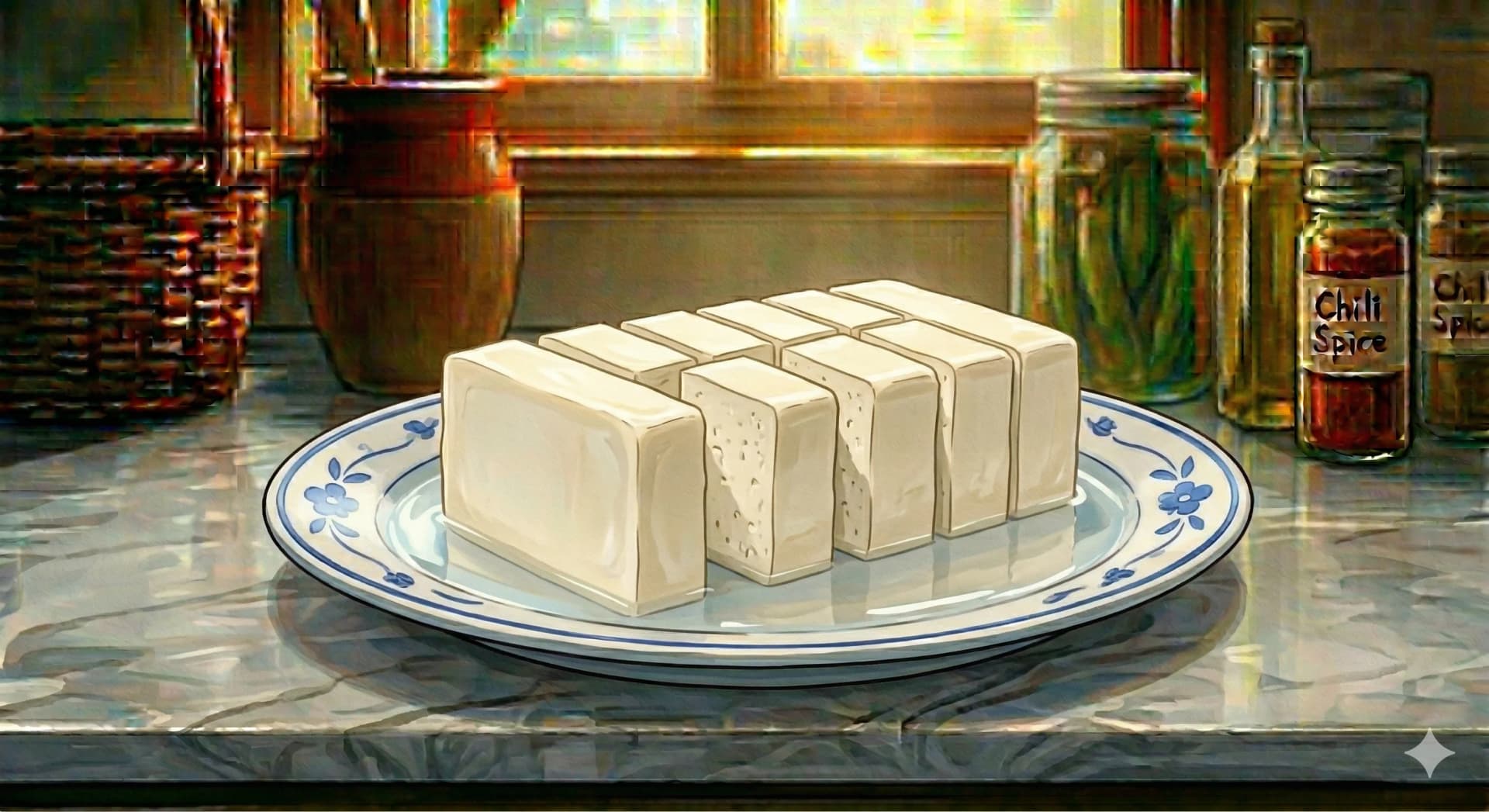
Tofu
Also known as: Doufu, Bean Curd, Dou Fu, Toufu
Tofu is one of the great achievements of East Asian food culture — a transformed product made by coagulating soy milk and pressing the resulting curds into blocks of varying firmness.
Its flavor is mild and neutral; its value lies in its texture, its nutritional density, and its extraordinary ability to absorb the flavors of everything around it.
Tofu is not a substitute for anything — it is its own ingredient, with its own textures and properties, capable of being silky or crispy, delicate or robust, mild or richly sauced.
Key facts at a glance:
- Made by coagulating soy milk — curds pressed into blocks of varying firmness
- Extraordinary flavor absorption — absorbs the flavors of everything around it
- Complete protein source — contains all essential amino acids
- Credited to Prince Liu An — Han dynasty, around 164 BCE
- Soy isoflavones — associated with reduced cardiovascular disease risk and improved bone density
- Not a substitute — its own ingredient with unique textures and properties
Flavor Profile
Origin
China, East Asia, Japan, Korea
Traditional Medicine Perspectives
Ayurveda
Tofu is considered a moderately sattvic food in Ayurveda — nourishing and grounding. Its white color and mild flavor associate it with purity. For Vata and Kapha constitutions it is best eaten cooked and warm; for Pitta, plain or lightly spiced tofu is cooling and nourishing. Tofu is not traditional to Ayurvedic food culture but is widely integrated into modern Ayurvedic practice.
Traditional Chinese Medicine
Tofu (Doufu) is classified as cool and sweet in TCM, associated with the Spleen, Stomach, and Large Intestine meridians. It is used to tonify Qi, clear heat, moisten dryness, and generate fluids. Considered one of the most balanced and universally appropriate protein sources in TCM dietary medicine — neither too warm nor too cold, making it appropriate for most constitutions. The cooling nature means it should be eaten with warming spices for people with cold-type constitutions.
Modern Scientific Research
Tofu is a complete protein source, containing all essential amino acids.
Soy isoflavones (genistein, daidzein) have been extensively studied — meta-analyses show associations with reduced cardiovascular disease risk, improved bone density in postmenopausal women, and potential cancer-preventive effects.
Tofu is an excellent source of calcium (particularly when coagulated with calcium sulfate), iron, magnesium, and manganese.
Cultural History
Tofu was invented in China, traditionally credited to Prince Liu An of the Han dynasty (around 164 BCE). From China, tofu spread to Japan, Korea, Vietnam, and throughout Southeast Asia, becoming central to the food culture of each country.
In Japan, the tofu tradition developed extraordinary refinement — the silken tofu of Kyoto, eaten simply with ginger and soy sauce, represents austere perfection.
In China, mapo tofu in a fiery, numbing sauce is one of the most famous dishes in the Chinese canon. Buddhism spread tofu culture throughout Asia as a protein source compatible with vegetarian dietary requirements.
Culinary Uses
The right tofu for each application: firm or extra-firm for stir-frying and pressing; medium-firm for braising and mapo tofu; soft for scrambles and fillings; silken for dressings, desserts, and agedashi.
Pan-fry firm tofu until golden before adding to any braised preparation.
Press firm tofu between kitchen towels before frying to remove excess water.
Preparation Methods
Press firm tofu by wrapping in kitchen towels and placing under a weighted cutting board for 30–60 minutes.
For pan-frying: dry the surface, use a well-oiled pan, and don't move it until a golden crust forms.
For braising: press and pan-fry first. For mapo tofu: cut into cubes and simmer gently in sauce for 2–3 minutes only.
Traditional Dishes
- Mapo tofu (Sichuan)
- Agedashi tofu (Japanese)
- Dubu jjigae (Korean)
- Cantonese braised home-style tofu
- Stir-fried tofu with vegetables
Comments
Share your thoughts on this ingredient.
Sign in to comment0 Comments