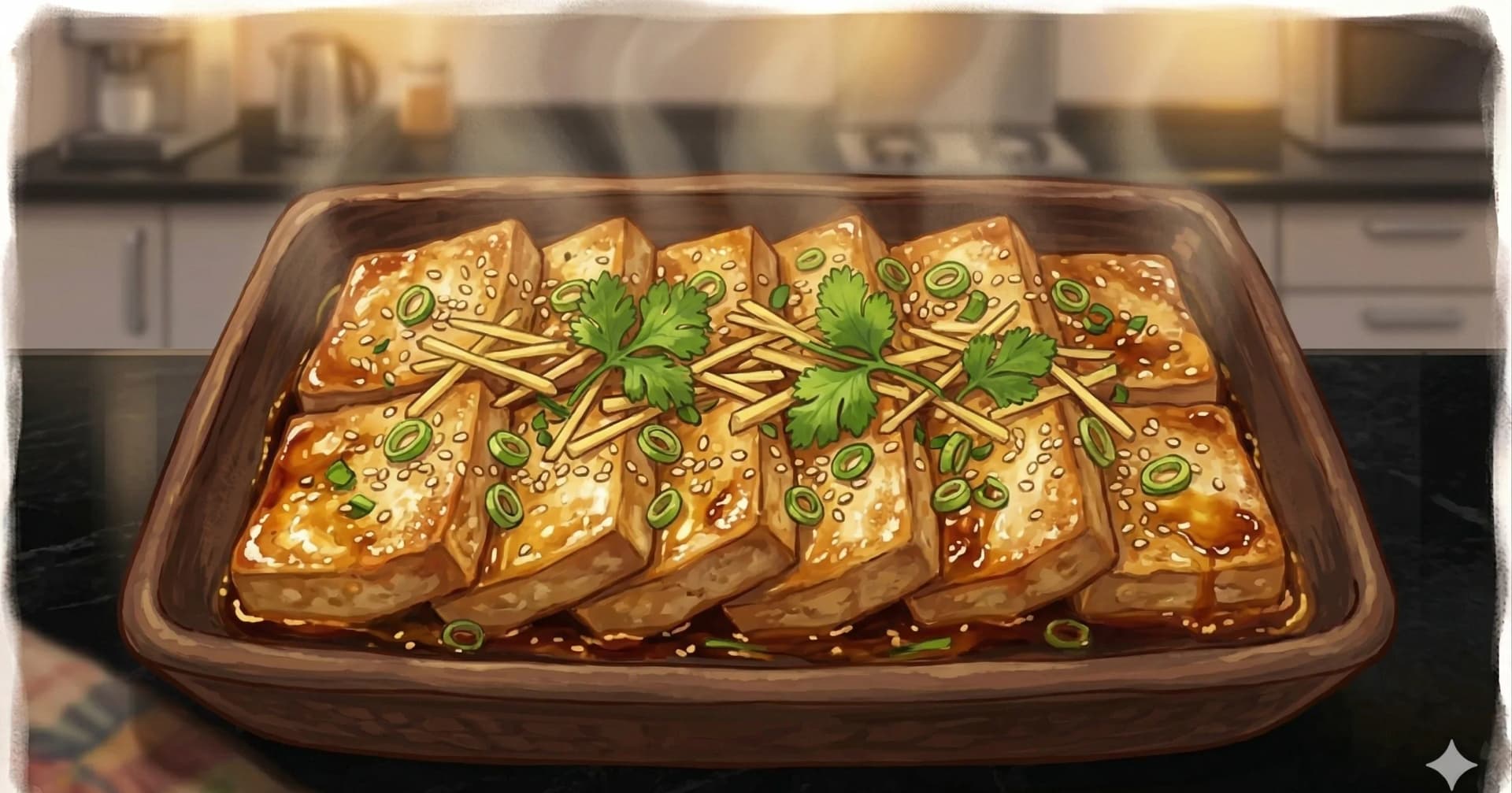
Cross-Cultural · Korea
Braised Spicy Tofu (Dubu-jorim / 두부조림)
Firm tofu pan-fried golden then braised in a spicy soy-gochugaru sauce with garlic and scallions
Dubu-jorim is proof that tofu does not need to be boring. Firm tofu, sliced into thick slabs and seared until golden and slightly crispy on the outside, gets braised in a sauce of soy sauce, gochugaru, garlic, sesame oil, and scallions. The result is tofu that tastes meaty and substantial, with a crispy exterior that gives way to a soft, creamy interior saturated with the spicy-savory sauce.
The technique is simple enough for a weeknight but produces a banchan that tastes like it took more effort than it did. The tofu must be patted very dry before searing. Wet tofu steams instead of browning, and the golden crust is what makes this dish satisfying. Three to four minutes per side in a non-stick pan with a little oil is enough. The sauce goes directly over the seared tofu in the pan. Lifting the edges of the tofu lets the sauce flow underneath, which seasons both sides.
This is one of the most popular banchan in Korean cooking, appearing on home tables and in restaurant banchan spreads alike. It is good hot, warm, or cold, which makes it perfect for making ahead. The leftovers keep for three to four days in the fridge. For a vegan version, use vegetable broth instead of anchovy stock in the sauce.
At a Glance
Yield
4 servings
Prep
10 minutes
Cook
15 minutes
Total
25 minutes
Difficulty
Easy
Ingredients
Tofu Ingredients
- 14-18 ozfirm tofu, 1 package
- 1 tbspvegetable oil
Sauce Ingredients
- 3 tbspsoy sauce
- 3 tbspwater or anchovy stock
- 1 tbspsesame oil
- 1 tspsugar
- 1 tspgochugaru
- 1 tspsesame seeds
- 2garlic cloves, minced
- 2scallions, finely chopped
Method
- 1
Cut tofu into 1/2-inch thick slabs. Pat very dry with paper towels.
- 2
Mix sauce: soy sauce, water, sesame oil, sugar, gochugaru, sesame seeds, garlic, scallions.
- 3
Sear tofu in oil over medium-high heat, 3-4 min per side until golden brown.
- 4
Pour sauce evenly over tofu. Lift edges to let sauce flow underneath. Simmer 3-4 min on medium-low.
- 5
Flip, simmer 1-2 min more, spooning sauce over. Serve warm or cold with rice.
Key Ingredient Benefits
Firm tofu: The protein backbone of the dish. Firm tofu has enough structural integrity to be sliced into thick slabs, pan-seared until crispy on both sides, and braised in sauce without falling apart. Tofu is a complete protein source containing all essential amino acids, with about 8 grams of protein per 100g serving. The high calcium and iron content make it nutritionally significant for plant-forward diets.
Soy sauce: The flavor foundation. Korean jin-ganjang provides salinity, deep umami, and the characteristic mahogany color of jorim dishes.
Gochugaru: Provides gentle, building heat and the slight reddish hue that distinguishes dubu jorim from other tofu preparations. The coarse Korean grind also gives the sauce a subtle textural quality.
Garlic and scallions: The aromatic backbone. Minced garlic adds pungency to the braising sauce; sliced scallions add fresh allium fragrance and visual color. Both are essential.
Sesame oil and sesame seeds: Added at the end for nutty fragrance and visual finish. The oil softens the spicy edge of the gochugaru and adds the unmistakable Korean aromatic signature.
Anchovy stock (optional): Using anchovy stock instead of water for the braising liquid is the technique that transforms dubu jorim from a simple tofu dish into something with restaurant-level depth. The anchovy umami plays beautifully with the soy sauce and gives the dish a complexity that water-based versions lack.
Why This Works
Pre-searing the tofu before braising is the technique that separates a great dubu jorim from a mediocre one. Pan-searing creates a slightly crispy, browned exterior on each tofu slab, which acts as both a textural contrast and a sauce-grabbing surface. Tofu added directly to the braising liquid without searing remains slightly flabby and never develops the satisfying bite that makes this dish addictive.
Patting the tofu dry with paper towels before searing is critical. Wet tofu will not brown — the moisture has to evaporate before Maillard browning can occur, and surface moisture creates dangerous oil splatter. Dry tofu sears cleanly and quickly.
The braising liquid is intentionally minimal — just enough to half-submerge the tofu slabs. As the sauce reduces, it concentrates and clings to the tofu rather than diluting into a soup. Tilting the pan and spooning sauce over the exposed top of the tofu helps distribute flavor evenly.
The dish is meant to have a slightly sticky, glossy sauce coating each slab. If the sauce stays watery, increase the heat for the final minute to drive off liquid and concentrate the seasoning.
Adding fresh scallions and sesame seeds at the end rather than during cooking preserves their freshness and visual appeal.
Substitutions & Variations
Firm tofu: Extra-firm tofu is the best choice — even sturdier than firm and easier to sear. Silken or soft tofu is not appropriate; it will not hold its shape during searing or braising. Pressed tofu (pre-pressed and packaged) is excellent and saves the step of pressing yourself.
Gochugaru: A blend of sweet paprika and cayenne (3 to 1 ratio) approximates the color and heat. The flavor will be flatter without the smoky-fruity depth of Korean chili.
Soy sauce: Korean jin-ganjang is ideal. Japanese soy sauce works perfectly. Avoid sweet or low-sodium varieties.
Anchovy stock: Plain water works but lacks depth. Vegetable stock, dashi, or even a teaspoon of dissolved miso in water can substitute and add some umami. For a vegan version, use vegetable stock plus a teaspoon of soy sauce.
Garlic and scallions: Cannot be skipped without significantly altering the dish.
Sesame oil: Cannot be skipped or substituted. The dish depends on the toasted sesame fragrance.
Serving Suggestions
Dubu jorim is one of the most versatile Korean banchan, working equally well as a side dish, a main protein for a vegetarian meal, or even a anju (drinking food). Serve with steamed short-grain rice and at least one fresh banchan to balance the rich, spicy tofu.
Recommended pairings: sigeumchi namul (seasoned spinach), kongnamul muchim (seasoned soybean sprouts), oi muchim (spicy cucumber salad). A bowl of kimchi provides the acidic counterpoint.
For a vegetarian or vegan main course (using vegetable stock instead of anchovy stock), serve over a generous bed of rice with steamed Korean perilla or sesame leaves on the side. The tofu becomes the protein centerpiece of a meal that satisfies without meat.
As an anju, dubu jorim pairs beautifully with chilled soju or makgeolli. The salty-spicy-savory flavor profile is famously good with cold alcohol.
Storage & Reheating
Refrigerator: Keeps in an airtight container for up to 5 days. The flavor deepens over the first 24 hours as the tofu absorbs more of the sauce.
Serving temperature: Equally good cold from the fridge or briefly warmed. Many Koreans serve it at room temperature, straight from the container.
Reheating: Warm in a covered pan over low heat with a splash of water or stock to loosen the sauce. Avoid microwave reheating if possible — the tofu can become rubbery from uneven heating.
Make-ahead: This is a make-ahead dish by design. The flavor actually improves over 1 to 2 days. Many Korean families prepare a large batch on Sunday and have it as a default banchan throughout the week.
Freezing: Possible but not ideal. Frozen-and-thawed tofu has a noticeably spongier, more porous texture, which some Koreans actually prefer (called "dongtae" texture). If you do not mind the texture change, dubu jorim freezes for up to 2 months.
Cultural Notes
Dubu jorim is one of the foundational vegetarian-friendly banchan in Korean cooking. Tofu has been part of Korean cuisine for over 1,500 years, introduced from China during the Goryeo dynasty, and Korean tofu preparations have developed distinctively over the centuries. Today, Korea is one of the world's largest per-capita consumers of tofu.
The jorim technique applied to tofu reflects a broader Korean culinary principle: humble ingredients elevated through bold seasoning. The combination of soy sauce, gochugaru, garlic, sesame, and scallion is the same one used for many Korean braised dishes, and applying it to tofu turns an inexpensive everyday protein into something with serious flavor and presence on the table.
Dubu jorim has particular significance in Korean Buddhist temple cuisine, where the dish exists in modified forms without garlic, scallions, or other pungent allium vegetables (banned in Korean temple cooking under the o-shin-chae principle). The temple version relies on the natural flavor of high-quality tofu and the depth of vegetable stock, producing a more delicate result.
In Korean home kitchens, dubu jorim is one of the most common banchan to find in the refrigerator at any given time. It is inexpensive to make, keeps for days, and provides a complete protein alongside the rice that anchors every Korean meal. Many older Koreans remember dubu jorim from their childhood as a constant presence on the family table, particularly during economically lean periods.
Nutrition Facts
Calories: 79kcal (4%)|Total Carbohydrates: 3.8g (1%)|Protein: 1.5g (3%)|Total Fat: 6.8g (9%)|Saturated Fat: 0.8g (4%)|Cholesterol: 0mg (0%)|Sodium: 640mg (28%)|Dietary Fiber: 0.8g (3%)|Total Sugars: 1.6g
You Might Also Like
 Medium
Cross-Cultural · Korea
Braised Black Cod (Eundaegu-jorim / 은대구조림)
45 minutes
 Medium
Cross-Cultural · Korea
Napa Cabbage Kimchi (통배추김치)
8 hours plus 1-2 days fermentation
 Easy
EasyCross-Cultural · China
Braised Pork with Potatoes (薯仔炆豬肉)
40 minutes
 Medium
Korean Cuisine
Baek Kimchi (White Kimchi)
3 hours (plus 1 to 3 days fermentation)
Ratings & Comments
Ratings & Comments
Ratings
Share your thoughts on this recipe.
Sign in to rate and comment