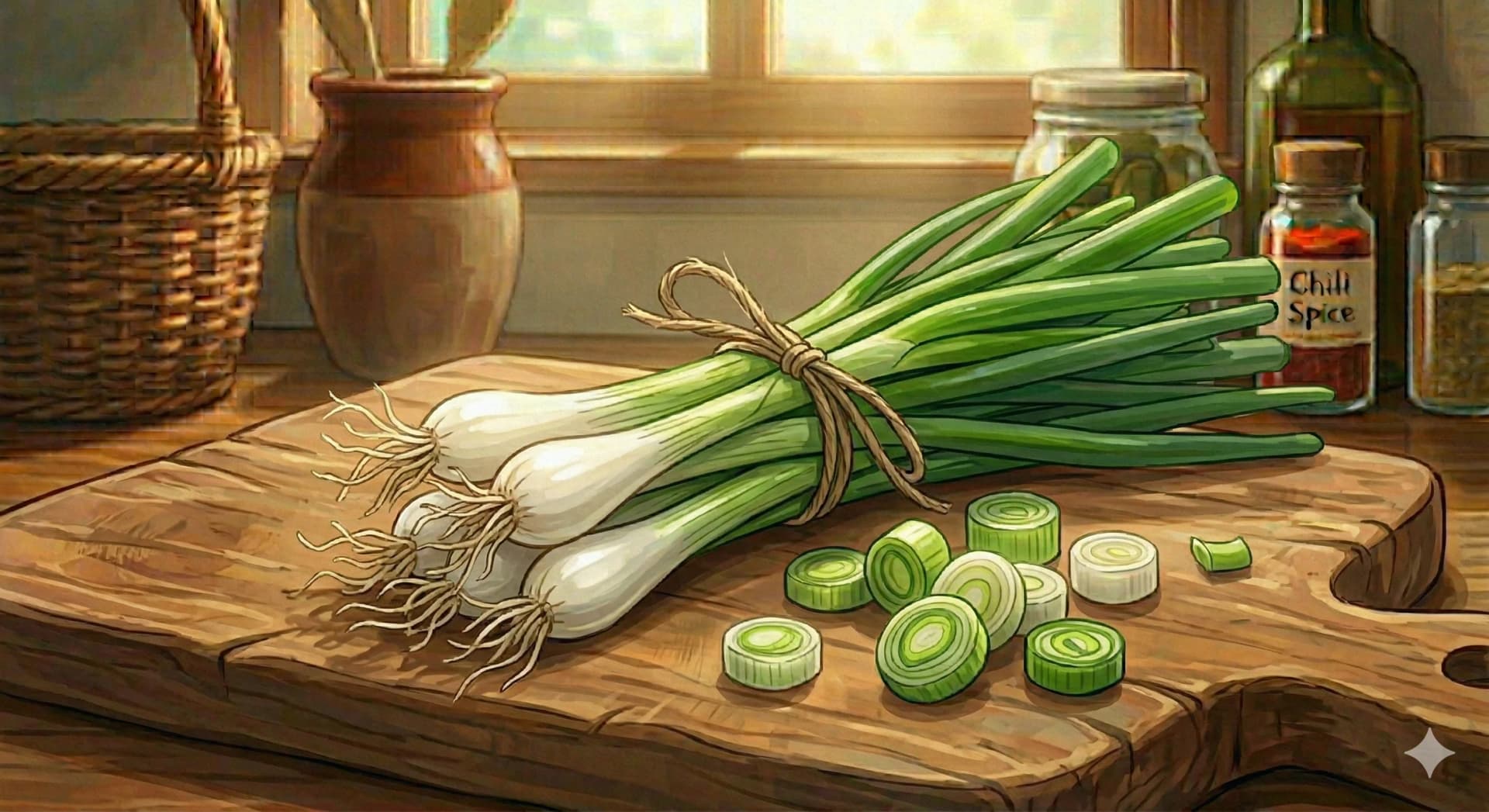
Scallions
Also known as: Green Onions, Cong, Spring Onions, Allium fistulosum, Welsh Onion
Scallions — also called green onions or spring onions — are the most universally used aromatic in Chinese cooking. The white base delivers sharp, onion-like pungency; the green tops contribute mild, grassy freshness. They appear raw as a garnish, cooked as an aromatic base, and deep-fried as a crispy condiment.
No Chinese kitchen is without them. In Chinese culinary tradition, scallion, garlic, and ginger form the essential aromatic trinity on which the flavor of most dishes is built.
Key facts at a glance:
- Most universal Chinese aromatic — appearing in virtually every style of Chinese cooking
- Dual-purpose structure — white base for pungency, green tops for freshness
- Part of the aromatic trinity — with garlic and ginger, the foundation of Chinese flavor
- Cultivated over 3,000 years — Allium fistulosum, the Welsh onion
- Rich in quercetin and kaempferol — flavonoids with anti-inflammatory properties
Flavor Profile
Origin
China, East Asia, Shandong
Traditional Medicine Perspectives
Traditional Chinese Medicine
Scallion (Cong Bai — specifically the white base) is classified as warm and acrid in TCM, associated with the Lung and Stomach meridians. It is used to release the exterior, dispel wind-cold, and unblock Yang Qi. It is a common home remedy for early-stage colds — simmered with ginger in a warming broth. The green tops (Cong Ye) are considered more cooling and are used differently in some formulas.
Modern Scientific Research
Scallions contain flavonoids, vitamin K, vitamin C, and organosulfur compounds. Research suggests the quercetin and kaempferol content may have anti-inflammatory and antioxidant effects.
Like other alliums, scallions contain fructooligosaccharides that function as prebiotics, supporting gut microbiome health. The green tops are particularly rich in chlorophyll and carotenoids.
Cultural History
Scallions have been cultivated in China for over three thousand years and are deeply embedded in Chinese food culture at every level from home cooking to banquet cuisine. The Welsh onion (Allium fistulosum), the variety most commonly used in Chinese cooking, was cultivated in East Asia long before its name acquired any connection to Wales.
In northern Chinese cuisine, scallions are used raw in substantial quantities — rolled into pancakes, layered into flatbreads, and eaten alongside rich meats as a palate cleanser. In Shandong province, the large, thick scallions known as da cong are a defining regional ingredient.
Culinary Uses
Use white parts as an aromatic base in stir-fries, soups, and braises. Add green tops as a raw garnish at the end of cooking.
Use both parts in dumpling fillings. Make scallion oil (cong you) by frying scallions in oil until golden — a foundational flavoring in Shanghainese and Cantonese cooking. Roll into pancakes and flatbreads in northern Chinese cooking.
Preparation Methods
Separate white and green parts — they are used differently. Slice on the diagonal for garnishes. Mince finely for fillings and sauces.
Bruise the white part before adding to stocks and braises to release flavor. Keep the green tops for finishing.
Traditional Dishes
- Scallion pancakes (cong you bing)
- Red-braised pork garnish
- Wonton soup garnish
- Peking duck (as a condiment)
- Shanghainese scallion oil noodles
Recipes Using Scallions
- Cháo Gà (Vietnamese Chicken Rice Porridge)
- Bai Qie Ji (White Cut Chicken)
- Dong Gua Tang (Winter Melon Soup)
- Bulgogi (Korean BBQ Beef)
- Agedashi Tofu (Fried Tofu in Dashi Broth)
- Napa Cabbage Kimchi (통배추김치)
- Zaru Soba (Cold Soba Noodles)
- Bubur Ayam (Indonesian Chicken Rice Porridge)
- Bun Rieu (Vietnamese Crab and Tomato Noodle Soup)
- Cháo Lòng (Vietnamese Pork Organ Rice Porridge)
- Nasu Dengaku (Miso-Glazed Eggplant)
- Canh Khổ Qua (Vietnamese Stuffed Bitter Melon Soup)
- Gochujang Chicken (Spicy Korean Glazed Chicken)
- Lian Ou Pai Gu Tang (Lotus Root Pork Rib Soup)
- Dak Gomtang (Clear Chicken Soup)
- Dak Kalguksu (Chicken Knife-Cut Noodle Soup)
- Curry Udon (Udon Noodles in Curry Broth)
- Korean Miso Stew (Doenjang-jjigae / 된장찌개)
- Eomuk Soup (Fish Cake Soup)
- Cashew Chicken Stir-Fry (Gai Pad Med Mamuang / ไก่ผัดเม็ดมะม่วงหิมพานต์)
- Budae Jjigae (Army Stew)
- Guo Tie (Potstickers)
- Jiao Hua Ji (Beggar's Chicken)
- Jianbing (Chinese Breakfast Crepe)
- Jok (Thai Rice Congee with Pork Meatballs)
- Cong You Bing (Scallion Pancakes)
- Kimchijeon (Kimchi Pancake)
- Egg Drop Soup (蛋花汤)
- Caramelized Fish in Clay Pot (Cá Kho Tộ)
- Takoyaki (Octopus Balls)
- Lo Mein (捞面)
- Beijing Shredded Pork (Jing Jiang Rou Si / 京酱肉丝)
- Chicken Pho (Phở Gà)
- Khao Tom (Thai Rice Soup with Shrimp)
- Okonomiyaki (Osaka-Style Savory Pancake)
- Crispy Stuffed Crepe (Bánh Xèo)
- Spicy Pork Rice Bowl (Jeyuk-Deopbap / 제육덮밥)
- Five-Spice Roast Chicken
- Zhajiangmian (Fried Sauce Noodles)
- La Chang Fan (Sticky Rice with Chinese Sausage)
- Sheng Jian Bao (Pan-Fried Soup Dumplings)
- Gamjatang (Pork Bone Soup)
- Suan Rong Zheng Xia (Cantonese Steamed Shrimp with Garlic)
- Jiao Yan Xia (Salt and Pepper Shrimp)
- Soy Sauce Chicken
- Cong You Ban Mian (Scallion Oil Noodles)
- Zi Ran Yang Rou (Cumin Lamb)
- Jakarta Creamy Beef Soup (Soto Betawi)
- Mongolian Beef (蒙古牛肉)
- Haejangguk (Pork Bone Hangover Soup)
- Wonton Soup (馄饨汤)
- Jjamppong (Spicy Seafood Noodle Soup)
- Peking Duck
- Beef Pho (Phở Bò)
- Tteokbokki (Spicy Rice Cakes)
- Sesame Beef (芝麻牛肉)
- Tonkotsu Ramen (Pork Bone Broth Ramen)
- Thai Crab Fried Rice (ข้าวผัดปู)
- Zui Ji (Drunken Chicken)
- Tom Kha Gai (Thai Coconut Galangal Chicken Soup)
- Kou Shui Ji (Sichuan Mouthwatering Chicken)
- Braised Chicken with Lily Buds and Mushrooms (Jin Zhen Yun Er Ji)
- Shi Zi Tou (Lion's Head Meatballs)
- Shabu-Shabu (Japanese Hot Pot)
- Liang Ban Mu Er (Wood Ear Mushroom Salad)
- Braised Spicy Tofu (Dubu-jorim / 두부조림)
- Xiao Long Bao (Soup Dumplings)
- Braised Pig's Feet (Jokbal / 족발)
- Hong Shao Rou (Red Braised Pork Belly)
- Galbitang (Short Rib Soup)
- Tea-Smoked Duck
- Beef Tendon Noodle Soup (牛筋面)
- Dao Xiao Mian (Knife-Cut Noodles, 刀削面)
- Lanzhou Beef Noodle Soup (兰州牛肉面)
- Samgyetang (Ginseng Chicken Soup)
- Taiwanese Beef Noodle Soup (紅燒牛肉麵)
- Gan Chao Niu He (Beef Chow Fun)
- Bao Zai Fan (Claypot Rice)
- Re Gan Mian (Hot Dry Noodles)
- Dou Chi Zheng Yu (Steamed Fish with Black Bean Sauce)
- Hui Guo Rou (Twice Cooked Pork)
- Udon Noodle Soup (Kake Udon)
- Kimchi Jjigae (Kimchi Stew)
- Nikuman (Japanese Steamed Pork Buns)
- Hainanese Chicken Rice
- Reishi Mushroom Congee
- Canh Gà Gừng (Vietnamese Chicken Ginger Soup)
Comments
Share your thoughts on this ingredient.
Sign in to comment0 Comments