Japanese Cuisine
Nasu Dengaku (Miso-Glazed Eggplant)
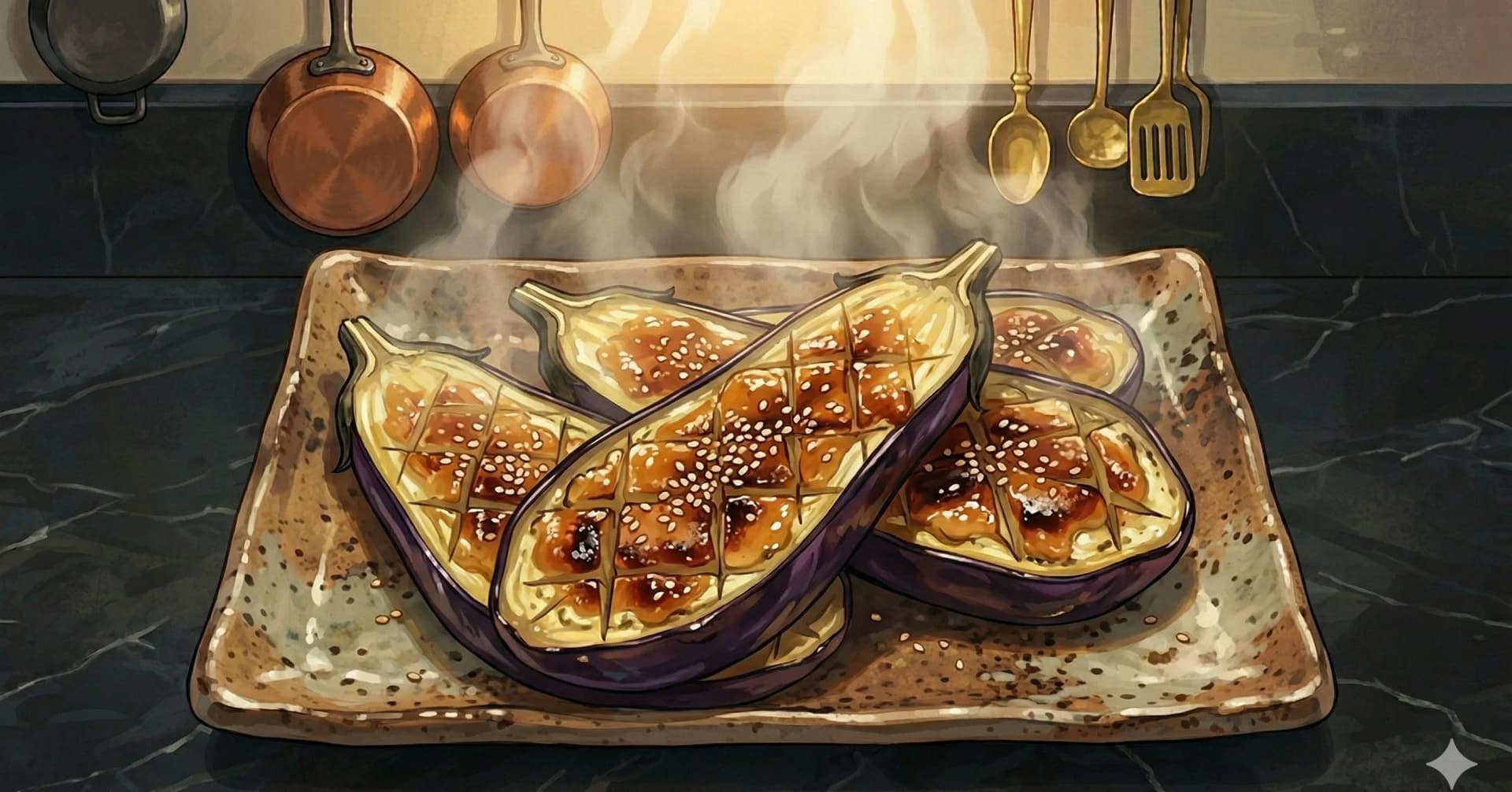
Roasted Japanese eggplant halves crowned with a sweet, caramelized miso glaze and finished with sesame seeds
The miso glaze bubbles and browns under the broiler, its surface turning from smooth and pale to crackled and caramel-dark in a matter of seconds. The scent that rises is intoxicating: sweet, fermented, slightly smoky, with the deep savory weight that only miso can deliver. Beneath it, the eggplant flesh has collapsed into something almost obscenely soft, its cell walls broken down by roasting until the texture is closer to custard than vegetable. A spoon passes through it without resistance. The combination of the intense, salty-sweet glaze and the mild, yielding eggplant is one of the great partnerships in Japanese cuisine.
Dengaku is an ancient preparation, dating back to the Muromachi period (14th to 16th century), where skewered tofu was grilled and coated with miso paste. The name comes from a form of folk dance: the grilled items on their sticks supposedly resembled the stilted performers. Over the centuries, dengaku expanded beyond tofu to include daikon radish, konnyaku, and most successfully, eggplant. Nasu dengaku, made with the slender, thin-skinned Japanese eggplant, became a staple of Buddhist temple cuisine (shojin ryori) and a permanent fixture of the izakaya menu.
Japanese eggplant is preferred for its thin skin, mild flavor, and fewer seeds compared to globe eggplant. It does not need salting or soaking, and it roasts beautifully, its flesh turning creamy and almost sweet. Scoring the flesh in a crosshatch pattern before roasting allows the oil to penetrate evenly and gives the miso glaze something to grip. The glaze itself is a simple cooked mixture of miso, mirin, sugar, and sake, reduced until thick and spreadable. It can be made entirely with white miso for a milder, sweeter profile, or with a blend of white and red for more depth and complexity.
At a Glance
Yield
4 servings
Prep
10 minutes
Cook
25 minutes
Total
35 minutes
Difficulty
Easy
Ingredients
Eggplant Ingredients
- 4Japanese eggplants (about 150 g each), or 2 large globe eggplants
- 2 tbspneutral oil such as vegetable or rice bran
- —Fine sea salt
Glaze Ingredients
To Garnish
- 1 tbspwhite sesame seeds, lightly toasted
- 2scallions, thinly sliced into rings
- —Sansho pepper, optional
Method
- 1
Preheat your oven to 200 degrees Celsius with a rack in the upper third. Line a baking sheet with parchment paper.
- 2
Halve each Japanese eggplant lengthwise. Score the flesh side of each half in a crosshatch pattern, cutting about 5 mm deep and spacing the lines about 1 cm apart. Be careful not to pierce through the skin. This scoring serves three purposes: it helps the eggplant cook faster, allows oil to penetrate, and creates grooves for the miso glaze to pool in.
- 3
Brush the cut sides of the eggplant generously with oil, making sure it seeps into the scored lines. Season lightly with salt. Place the halves cut-side down on the prepared baking sheet.
- 4
Roast for 15 minutes until the flesh is soft and yielding when pressed gently through the skin. The eggplant should be cooked through but not collapsed or mushy. The skin may wrinkle slightly, which is normal.
- 5
While the eggplant roasts, prepare the miso glaze. Combine the white miso, red miso (if using), mirin, sugar, and sake in a small saucepan. Stir over low heat until smooth and the sugar dissolves completely. Continue cooking, stirring constantly, for 3 to 4 minutes. The glaze will thicken and become glossy, pulling away from the sides of the pan slightly. It should be the consistency of thick peanut butter. If it becomes too thick, add water a teaspoon at a time. Remove from heat.
- 6
Remove the eggplant from the oven and flip the halves so the cut side faces up. If any pieces have shifted, rearrange them on the sheet.
- 7
Spread a generous layer of miso glaze over the cut surface of each eggplant half, using a spoon or pastry brush. Cover the entire surface, allowing the glaze to settle into the scored grooves. Be generous; the glaze is the soul of this dish.
- 8
Switch the oven to broiler mode (or set it to its highest temperature, about 250 degrees Celsius). Place the eggplant under the broiler for 2 to 3 minutes, watching carefully. The miso glaze will bubble, darken in spots, and develop patches of caramelization. Some areas may char lightly, which is desirable for flavor, but do not let it burn uniformly. The difference between beautifully caramelized and burnt is about 30 seconds under a broiler.
- 9
Remove from the oven and let the eggplant rest for 2 minutes. The glaze will continue to set and thicken slightly as it cools.
- 10
Transfer the glazed eggplant halves to serving plates. Sprinkle with toasted sesame seeds and scatter scallion rings across the top. Add a light dusting of sansho pepper if using.
- 11
Serve warm or at room temperature. The eggplant flesh should scoop easily from the skin with a spoon. In Japan, nasu dengaku is often eaten by scooping the glazed flesh directly from the skin, treating it as a natural bowl.
- 12
If making this for a larger group, the miso glaze can be prepared in advance and the eggplant halves roasted ahead. Assemble and broil just before serving for the freshest result.
Key Ingredient Benefits
Japanese eggplant's purple skin contains nasunin, an anthocyanin that research suggests may have antioxidant properties and may help protect cell membranes. Eggplant is also a source of dietary fiber, potassium, and manganese. Miso, as a fermented soy product, provides amino acids, B vitamins, and trace minerals. While the live probiotic bacteria in miso are killed during the cooking and broiling process, the fermentation byproducts (including organic acids and peptides) remain. Sesame seeds provide calcium in a plant-based form, along with magnesium and lignans traditionally associated with antioxidant activity.
Why This Works
Roasting the eggplant cut-side down first accomplishes two things. The direct contact with the hot baking sheet caramelizes the surface of the flesh, adding flavor. And the steam trapped between the eggplant and the pan cooks the flesh evenly from below, producing a creamy, uniform texture throughout. Scoring the flesh beforehand allows the heat to penetrate more deeply and more quickly, reducing the overall cooking time.
The miso glaze gains its complexity from cooking. Raw miso is alive with fermented flavor, but it can taste sharp and one-dimensional when spread directly on food. Heating it with sugar and mirin triggers Maillard reactions between the amino acids in the miso and the sugars, developing caramel notes and rounding the flavor. The sake contributes volatile aromatic compounds that lift the otherwise dense, salty miso. The final broil adds another layer of Maillard browning directly on the surface, creating a crust of complex, bittersweet, deeply savory flavor.
Blending white and red miso produces a glaze with more range than either alone. White miso is sweet, mild, and pale, while red miso is saltier, more assertive, and darker. Together they create a glaze that is simultaneously sweet and savory, gentle and complex.
Substitutions & Variations
- Globe eggplant: If Japanese eggplant is unavailable, halve a globe eggplant lengthwise and score more deeply (about 1 cm). Increase the initial roasting time to 20 to 25 minutes.
- All white miso: For a sweeter, milder glaze, use 80 g of white miso and omit the red. This is closer to the Kyoto-style preparation.
- Dengaku tofu: Firm tofu, sliced 2 cm thick and pressed dry, can be grilled or broiled and topped with the same miso glaze.
- Grilled version: Instead of oven roasting, grill the eggplant halves over charcoal or a gas grill, cut-side down first, then flip and apply the glaze while still on the grill.
- Yuzu miso: Add 5 ml yuzu juice to the finished glaze for a citrus note that brightens the dish considerably.
- Walnut miso: Fold 30 g finely chopped toasted walnuts into the miso glaze for a textured variation traditional to some regions.
Serving Suggestions
Nasu dengaku works as a side dish in almost any Japanese meal. Pair it with grilled fish or meat, steamed rice, and miso soup for a complete dinner. It is a natural component of a shojin ryori (Buddhist vegetarian) spread alongside agedashi tofu, rice, and pickled vegetables. As an izakaya-style snack, serve it alongside beer or sake with other small plates. It is also excellent as part of a larger vegetable-focused meal with kinpira gobo and hijiki salad.
Storage & Reheating
The miso glaze can be made up to 1 week in advance and stored in the refrigerator in an airtight container. Roasted eggplant without the glaze keeps for 2 days refrigerated. For best results, assemble and broil just before serving. Fully assembled nasu dengaku can be reheated in a 180 degree Celsius oven for 8 to 10 minutes, though the glaze will not have the same fresh-broiled quality. This dish does not freeze well, as the eggplant becomes watery upon thawing.
Cultural Notes
Nasu dengaku (茄子田楽) is one specific dish inside an older tradition called dengaku (田楽). Dengaku covers any preparation where an ingredient gets skewered, grilled, and coated with a sweet miso glaze. The name comes from somewhere unexpected: a medieval Japanese ritual dance called dengaku-mai, in which performers balanced on a single tall stilt while moving. The earliest grilled-tofu skewers reminded people of the dancers, and the word migrated from the dance to the food. The dengaku technique itself goes back at least to the Heian period (794-1185), which makes it one of the oldest documented Japanese miso-glaze methods.
The eggplant version is the most popular of the dengaku family. Japanese eggplant (nasu, 茄子) reached Japan in the 8th century from China by way of Korean intermediaries, and the varieties that took hold are smaller, longer, and milder than their Mediterranean cousins. That difference matters here. Japanese eggplant has thin skin and dense flesh, which means it holds its shape through both stages of the dengaku method, the initial grill and then the second pass under the broiler with the glaze.
Nasu dengaku shows up especially in Buddhist temple cooking (shōjin ryōri, 精進料理), where the meatless glaze and the plant ingredient both fit within the monastic precepts. Several historic Buddhist temples in the Kyoto region built reputations on their dengaku, and one Kyoto restaurant, Tofu Dengaku Mukade-ya in Sakyo ward, has been serving dengaku continuously since the late Edo period. At home, the dish belongs to midsummer, when Japanese eggplant hits its peak. At izakaya, the sweet miso glaze is one of the great matches for cold beer and chilled sake. Vegetarian Japanese restaurants outside Japan have made nasu dengaku into a signature alternative protein course for non-meat eaters.
Nutrition Facts
Calories: 196kcal (10%)|Total Carbohydrates: 23g (8%)|Protein: 4g (8%)|Total Fat: 10g (13%)|Saturated Fat: 1g (5%)|Cholesterol: 0mg (0%)|Sodium: 680mg (30%)|Dietary Fiber: 5g (18%)|Total Sugars: 10g
You Might Also Like



Ratings & Comments
Ratings & Comments
Ratings
Share your thoughts on this recipe.
Sign in to rate and comment