Japanese Cuisine
Hijiki Seaweed Salad (Hijiki no Nimono)
Tender strands of wild sea vegetable simmered with vegetables and tofu in a sweet soy broth
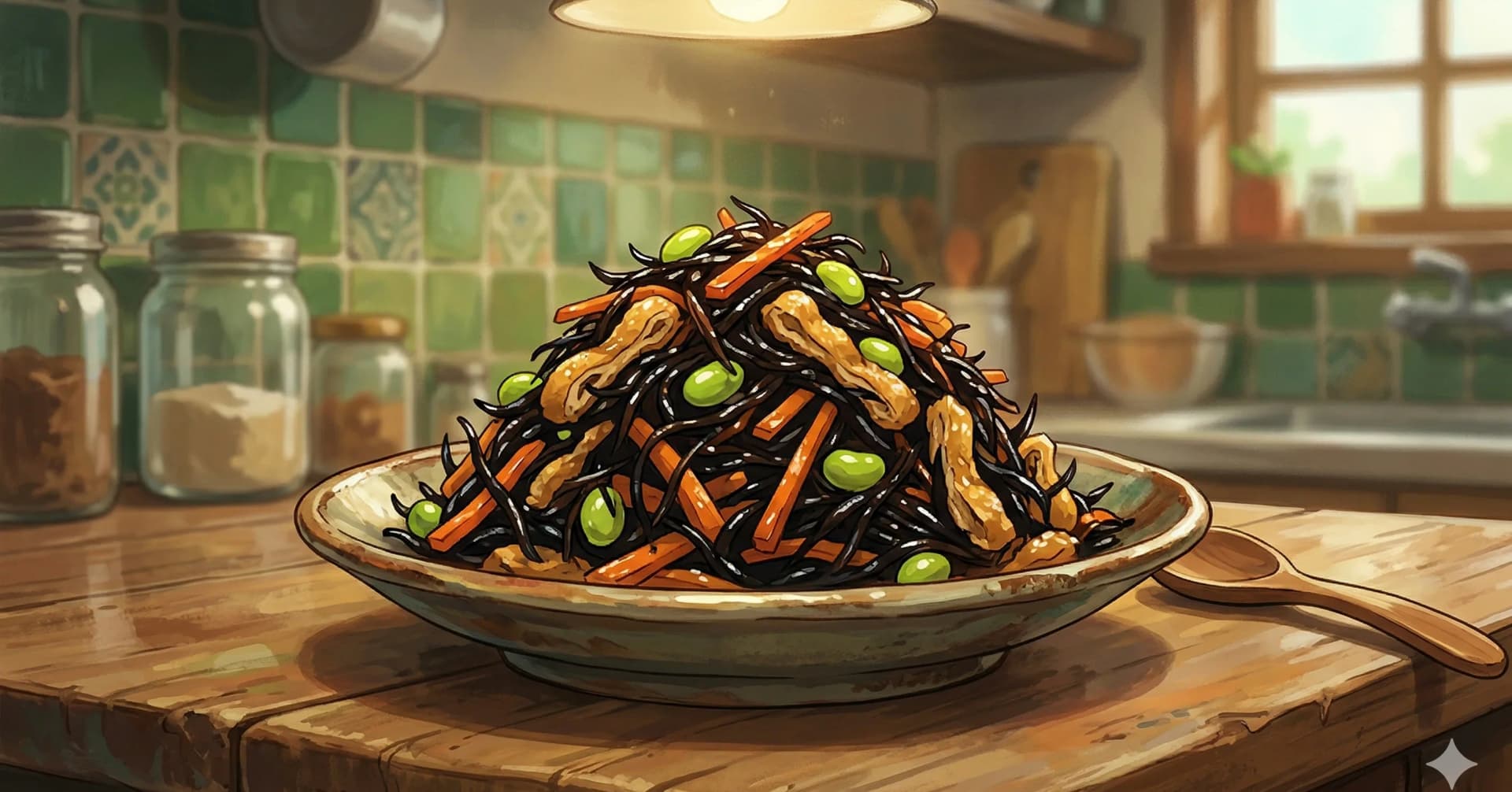
Hijiki no nimono is one of those quiet dishes that appears on nearly every Japanese table but rarely gets written about with much fanfare. It belongs to the family of simmered side dishes called nimono, where ingredients cook slowly in a seasoned broth until they absorb its flavor completely. The finished dish is dark and unassuming, the kind of thing you might overlook at a buffet. But a single bite reveals a gentle sweetness layered over the mineral depth of the sea, and a satisfying chew that makes you reach for more.
The seaweed itself is hijiki, a wild brown algae harvested from rocky coastlines along Japan and Korea. After drying, it shrinks into wiry black threads that rehydrate into tender, slightly springy strands. Paired with sliced aburaage (fried tofu pouches), julienned carrot, and bright green edamame, it becomes a dish of quiet contrast: dark and light, chewy and soft, sweet and savory. The cooking method is straightforward. Everything simmers together in dashi seasoned with soy sauce, mirin, and a touch of sugar until the liquid reduces to a thin glaze.
In Japanese home cooking, hijiki no nimono is a staple of bento boxes and weekly meal prep. It keeps beautifully in the refrigerator for several days and freezes well, making it a practical addition to any rotation of side dishes. You will find similar approaches to braised vegetables in kinpira gobo, which uses the same soy-mirin base for burdock root. If you enjoy the mineral quality of sea vegetables, miyeok-guk offers another perspective through the Korean tradition of seaweed soup, while miso shiru provides a lighter way to bring ocean flavors to a daily meal.
At a Glance
Yield
4 servings
Prep
15 minutes
Cook
45 minutes
Total
1 hour
Difficulty
Easy
Ingredients
- ½ ozdried hijiki seaweed
- 1 qtwater (for soaking)
- 2sheets aburaage (deep-fried tofu pouches), about 60 g total
- 3 ozcarrot (roughly 1 medium), cut into thin matchsticks
- 3 ozkonnyaku (konjac), cut into thin strips (optional)
- 1¼ ozlotus root (renkon), peeled and cut into thin quarter-rounds (optional)
- 1 tbspneutral oil (such as rapeseed or rice bran)
- 2 cupdashi
- ¼ cupmirin
- 2½ tbspsugar
- ¼ cupsoy sauce
- 1¾ ozshelled edamame, cooked (optional)
Method
- 1
Place the dried hijiki in a bowl and cover with the soaking water. Let it sit for 20 to 30 minutes. The strands will swell to several times their dry volume and turn from stiff to pliable. Drain through a fine-mesh strainer and rinse under cold running water. Squeeze gently and set aside.
- 2
Bring a small pot of water to a boil. Pour the boiling water over the aburaage in a bowl to remove excess surface oil, or briefly blanch them for 30 seconds. This step keeps the finished dish from tasting greasy. Pat dry, cut each sheet in half lengthwise, then slice crosswise into thin 5 mm strips.
- 3
If using konnyaku, tear or cut it into thin strips about 5 cm long. Boil for 3 minutes to remove its alkaline odor, then drain. The surface should feel less slippery after blanching.
- 4
Cut the carrot into matchsticks roughly the same length as the konnyaku strips. If using lotus root, cut into thin quarter-rounds about 3 mm thick.
- 5
Heat the oil in a medium pot over medium heat. Add the carrot and lotus root and stir for about 1 minute until the oil coats the pieces evenly and the carrot begins to soften slightly at the edges.
- 6
Add the drained hijiki, konnyaku, and aburaage strips. Stir everything together for another minute so the flavors begin to mingle.
- 7
Pour in the dashi and raise the heat to bring the mixture to a gentle boil. Skim any foam that rises to the surface.
- 8
Add the mirin, sugar, and soy sauce. Stir once to dissolve the sugar, then reduce the heat to medium-low. Cover with a lid and simmer for 20 to 25 minutes. The hijiki should be tender and the broth noticeably reduced.
- 9
Remove the lid and raise the heat slightly. Cook uncovered for another 5 to 8 minutes, stirring occasionally, until most of the liquid has evaporated and a thin glaze coats the ingredients. You should see the bottom of the pot between stirs.
- 10
If using edamame, fold them in gently during the last minute of cooking. They need only enough time to warm through and absorb a little of the glaze.
- 11
Remove from heat and let the salad cool to room temperature before serving. The flavors deepen as it sits.
Key Ingredient Benefits
Hijiki (Sargassum fusiforme): A brown sea vegetable harvested from the coastlines of Japan, Korea, and China. It is traditionally valued as a source of dietary fiber, calcium, iron, and magnesium. The calcium content is notably high among plant foods. However, hijiki also contains inorganic arsenic at levels higher than other edible seaweeds such as wakame or kombu. Japanese dietary guidelines consider moderate consumption (a few times per month as a small side dish) safe within a balanced diet. Soaking and discarding the soaking water before cooking is an important step that reduces arsenic content.
Aburaage: Thin slices of tofu that have been deep-fried twice, first at a lower temperature to puff them up, then at a higher temperature to crisp the surface. They provide plant-based protein and readily absorb the cooking liquid, acting as little sponges of flavor in simmered dishes.
Konnyaku (konjac): A firm, gelatinous food made from the corm of the konjac plant. It is almost entirely water and glucomannan fiber, making it extremely low in calories. The glucomannan fiber is a soluble fiber that may support digestive regularity.
Edamame: Young soybeans harvested before they fully mature. They provide complete plant protein, dietary fiber, folate, and vitamin K.
Why This Works
Soaking the hijiki fully before cooking ensures even texture throughout the dish. Under-soaked hijiki remains tough in places, and no amount of simmering will fix that unevenness.
Blanching the aburaage removes excess oil from the frying process. Without this step, an oily film coats the broth and mutes the clean sweetness of the dashi and mirin.
Building the dish in layers matters. Sauteing the harder vegetables first in oil gives them a head start and helps them absorb the braising liquid more evenly. Adding the seasoning liquids after the dashi comes to a boil allows the sugar to dissolve quickly and distribute through the pot.
Cooking uncovered at the end concentrates the glaze and gives the dish its characteristic lacquered appearance. Stopping at the right moment, when the pot is nearly dry but not scorched, is the difference between a well-made nimono and a flat one.
Substitutions & Variations
Hijiki type: Dried hijiki comes in two forms. Naga-hijiki (long hijiki) consists of the stem pieces and has a firmer texture. Me-hijiki (bud hijiki) is finer and more tender. Either works here. Me-hijiki needs only 15 minutes of soaking; naga-hijiki may need up to 30.
Aburaage: If unavailable, use firm tofu cut into small rectangles and pan-fried until golden. Atsuage (thick fried tofu) also works well, cut into small cubes.
Konnyaku: Can be omitted without affecting the balance significantly. Shirataki noodles, cut into short lengths, provide a similar texture.
Lotus root: If fresh renkon is hard to find, simply leave it out. Canned bamboo shoots, sliced thin, offer a comparable mild crunch.
Dashi: For a fully vegan version, use kombu dashi or shiitake dashi in place of bonito-based dashi.
Protein additions: Some cooks add small dried shrimp (sakura ebi) or shredded chicken for a heartier version. Thin strips of pork simmered alongside the vegetables is another common home-cooking variation.
Sesame finish: A light sprinkle of toasted white sesame seeds just before serving adds a nutty fragrance and visual contrast against the dark hijiki.
Serving Suggestions
Hijiki no nimono is a side dish by nature. Serve a small mound alongside rice and miso shiru for a simple washoku meal. It pairs naturally with grilled fish and pickled vegetables in a traditional ichiju sansai (one soup, three sides) arrangement.
As a bento component, its dark color provides visual contrast against white rice, tamagoyaki, and pickled vegetables. Pack it at room temperature.
For a more substantial spread, set it alongside kinpira gobo and a bowl of takikomi gohan for a fully plant-centered Japanese meal. The earthy burdock root and the seasoned mixed rice complement the sea-mineral quality of the hijiki.
If you enjoy building meals around sea vegetables and fermented flavors, consider pairing it with gado-gado or som tam for an informal cross-cultural side dish spread where each plate brings a different kind of acidity, sweetness, and texture.
Storage & Reheating
Refrigerator: Store in an airtight container for up to 4 days. The flavor continues to develop over the first day or two in the refrigerator, making this an ideal make-ahead dish.
Freezer: Freeze in small portions for up to 1 month. Thaw overnight in the refrigerator. The texture holds up well, though edamame may soften slightly after freezing.
Reheating: Warm gently in a small pot over low heat with a splash of water if the glaze has thickened too much. Alternatively, serve at room temperature or cold, which is traditional and perfectly pleasant.
Cultural Notes
Hijiki no nimono (ひじきの煮物) belongs to the nimono (煮物) simmered tradition that runs through Japanese home cooking. Within that tradition it sits in the fukusai (副菜) side-dish category, the small individually-portioned plates that surround the main course. Among fukusai, hijiki is close to fundamental. A proper Japanese home meal without it feels slightly incomplete, almost the way it would without rice or miso soup.
The seaweed itself is Sargassum fusiforme, a brown sea vegetable that grows wild on rocky Japanese coastlines. Coastal communities have been harvesting it for over a thousand years. Late winter into early spring is the season, and traditional villages still mark the calendar by it. After harvest the hijiki gets dried quickly, then sold in those familiar tangles of black strands that look more like rope than food. Home cooks rehydrate it in cold water, drain, and simmer it slowly with soy, mirin, and a little oil. The drying and the long simmer are what turn something tough and marine into the dark, sweet, chewable strands you actually eat.
There is a complication. Hijiki contains naturally elevated levels of inorganic arsenic, and since 2001 the food-safety authorities in the UK, Canada, New Zealand, and a few other countries have warned against eating it often. Japan's Ministry of Health takes a different view: the traditional preparation, which means rehydrating in cool water and discarding the soaking liquid, drops arsenic to levels considered safe. Japanese home kitchens broadly haven't changed their habits. Japanese restaurants outside Japan, on the other hand, have often quietly pulled hijiki from menus rather than explain the gap.
The cook has to make their own call. Inside Japan, the dish remains one of the most distinctive vegetable preparations the cuisine has, and one of the clearest expressions of how seriously coastal foraging shaped what Japanese food became.
Nutrition Facts
Calories: 197kcal (10%)|Total Carbohydrates: 21g (8%)|Protein: 5g (10%)|Total Fat: 8g (10%)|Saturated Fat: 1g (5%)|Cholesterol: 0mg (0%)|Sodium: 780mg (34%)|Dietary Fiber: 4g (14%)|Total Sugars: 12g
You Might Also Like
Ratings & Comments
Ratings & Comments
Ratings
Share your thoughts on this recipe.
Sign in to rate and comment