Japanese Cuisine
Matcha Tiramisu
A Japanese twist on the Italian classic, layering matcha-soaked ladyfingers with a light mascarpone cream dusted in vivid green tea powder
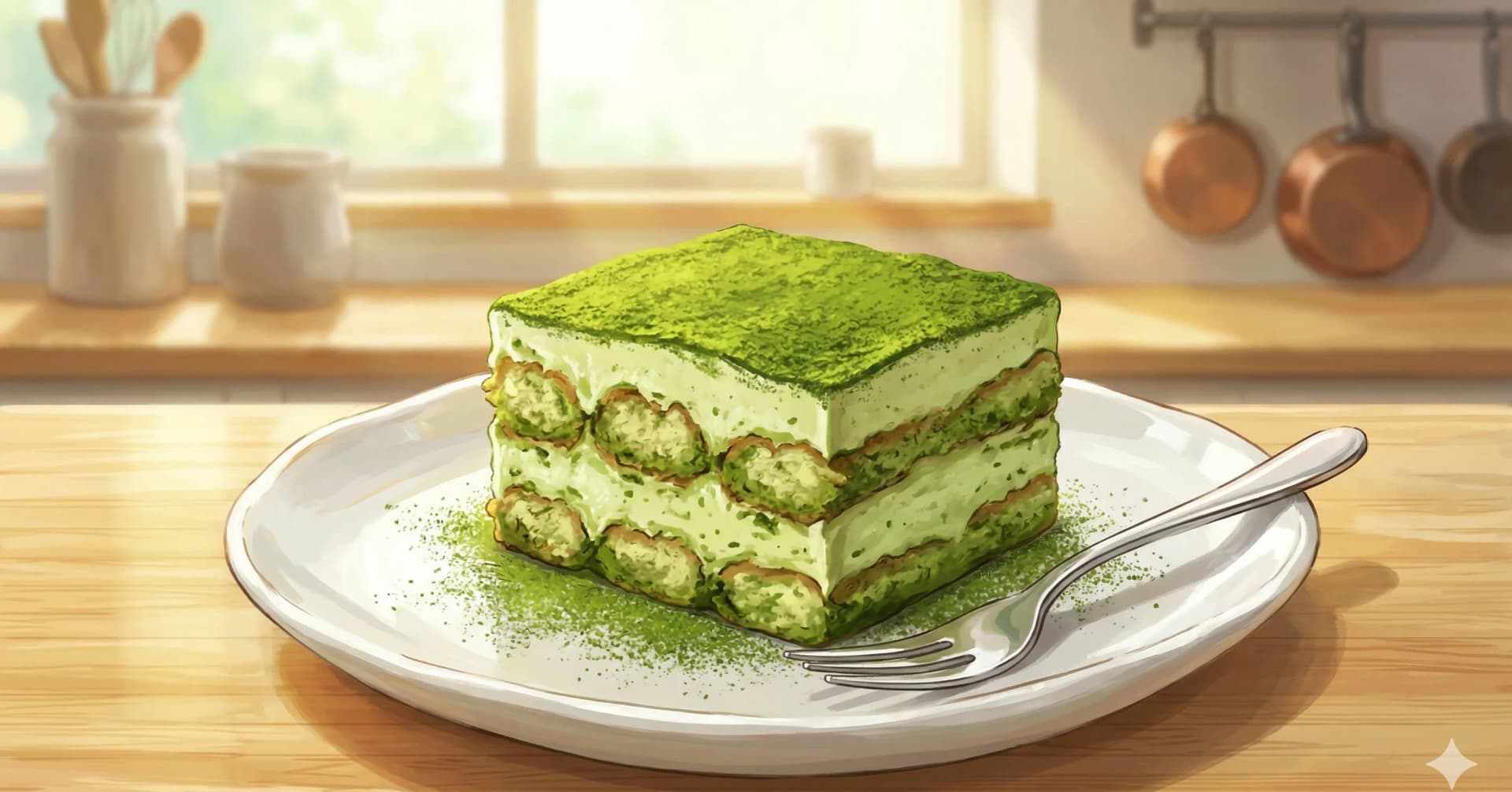
The color is the first thing. That particular shade of green, vivid and earthy and unmistakably matcha, dusted across the surface of the tiramisu like moss on stone. It promises something different from the coffee-dark original, something lighter and more floral, and it delivers. The first spoonful breaks through the powdered surface into a cream that is barely sweet, rich with mascarpone and faintly bitter from the tea, resting on a layer of ladyfingers that have absorbed just enough matcha syrup to turn soft and yielding without dissolving completely.
Matcha tiramisu emerged from the Japanese passion for adapting Western desserts through a Japanese lens. Japan has taken to tiramisu, cheesecake, and cream puffs with the same seriousness it applies to its own confections, and in many cases the Japanese versions have become distinct traditions. Matcha tiramisu is a natural marriage: the bitterness of matcha replaces the bitterness of espresso, the mascarpone cream needs no modification because it already suits the gentler flavor of green tea, and the layered, no-bake construction is perfectly at home in Japanese cafe culture.
The quality of the matcha matters enormously here. Because the matcha is used both in the soaking liquid and as a finishing dust, its flavor permeates every layer. Culinary-grade matcha is sufficient for the soaking syrup, but a higher-grade ceremonial matcha for the dusting will produce a noticeably more vibrant color and a smoother, less astringent flavor on the surface. The bitterness of the matcha should be present but balanced by the sweetness of the cream and the syrup. If the matcha you have tastes harsh or overly bitter, reduce the amount by a quarter and taste as you go. A good matcha tiramisu should taste like a calm, lightly sweet, faintly grassy dream.
At a Glance
Yield
8 servings
Prep
30 minutes (plus 4 hours chilling)
Cook
0 minutes
Total
4 hours 30 minutes
Difficulty
Medium
Ingredients
Soaking Syrup Ingredients
- ¾ ozmatcha powder (culinary grade)
- 1¼ cuphot water (about 80 degrees Celsius, not boiling)
- ¼ cupsugar
- 1 tbsprum, amaretto, or Kahlua, optional
Mascarpone Cream Ingredients
- 3large egg yolks
- ⅓ cupsugar
- 1 lbmascarpone cheese, at room temperature
- 1¼ cupheavy cream (at least 35 percent fat), chilled
- 1 tspvanilla extract
To Assemble
- 7 ozladyfinger biscuits (savoiardi), about 24 to 30 pieces
- ¼ ozmatcha powder (ceremonial grade preferred), for dusting
Method
- 1
Prepare the matcha soaking syrup. Sift 20 g of matcha powder through a fine-mesh sieve into a bowl to remove any lumps. Pour the hot water over the matcha and whisk vigorously until completely dissolved and smooth. Stir in the sugar until it dissolves. Add the alcohol if using. Let the syrup cool to room temperature. It should be a deep, opaque green with no visible clumps.
- 2
Prepare the mascarpone cream. Place the egg yolks and 75 g sugar in a large bowl. Whisk vigorously by hand or with an electric mixer for 3 to 4 minutes until the mixture is pale, thick, and falls in ribbons from the whisk. The sugar should be completely dissolved and the texture should be mousse-like.
- 3
Add the mascarpone to the egg yolk mixture and fold gently with a spatula until just combined. Do not beat vigorously, as over-mixing can cause the mascarpone to lose its smooth texture and become grainy. Fold until no streaks of mascarpone remain.
- 4
In a separate chilled bowl, whip the heavy cream and vanilla extract to soft peaks. The cream should hold its shape but still flow slightly when the whisk is lifted. Do not whip to stiff peaks; over-whipped cream makes the finished tiramisu dense and chalky rather than light and mousse-like.
- 5
Fold the whipped cream into the mascarpone mixture in two additions. First fold in one-third of the cream to lighten the base, then fold in the remainder. Use gentle, sweeping motions, cutting through the center and folding from the bottom. The finished cream should be light, airy, and uniformly smooth.
- 6
Choose a rectangular dish or deep baking pan, roughly 20 by 25 cm or similar. Pour the matcha soaking syrup into a shallow dish wide enough to dip the ladyfingers.
- 7
Working one at a time, briefly dip each ladyfinger into the matcha syrup. Hold it in the syrup for 1 to 2 seconds per side, no longer. The ladyfinger should absorb the green liquid on its surface but remain firm in the center. Over-soaking is the most common mistake; a waterlogged ladyfinger dissolves into mush and collapses the structure of the dessert.
- 8
Arrange the soaked ladyfingers in a single layer in the bottom of the dish, breaking pieces to fill gaps as needed. The layer should cover the entire bottom surface with minimal empty space.
- 9
Spread half of the mascarpone cream over the ladyfinger layer, using a spatula or the back of a spoon to create an even, smooth surface. Take your time here; an even layer ensures consistent texture in every serving.
- 10
Repeat with a second layer of matcha-dipped ladyfingers, followed by the remaining mascarpone cream. Smooth the top surface as evenly as possible.
- 11
Cover the dish tightly with plastic wrap, making sure the wrap does not touch the cream surface (tenting it slightly helps). Refrigerate for at least 4 hours, or ideally overnight. This resting period allows the flavors to meld, the ladyfingers to fully hydrate and soften, and the cream to firm up to a scoopable consistency. Overnight rest produces the best texture.
- 12
Just before serving, sift the remaining 10 g of matcha powder generously over the entire surface through a fine-mesh sieve. The matcha should land as an even, thick dusting of vivid green. Do not dust the matcha ahead of time, as it oxidizes and turns dull within an hour of contact with moisture. Serve by scooping portions with a large spoon, cutting through all layers.
Key Ingredient Benefits
Matcha is the whole tea leaf ground to powder, meaning the concentration of beneficial compounds is significantly higher than in steeped green tea. Research suggests that catechins in matcha, particularly EGCG (epigallocatechin gallate), may have antioxidant properties. Matcha also contains L-theanine, an amino acid associated with promoting calm focus without drowsiness in some studies. The caffeine content in the amount of matcha used here (about 30 g total) is moderate, roughly equivalent to one to two cups of coffee distributed across eight servings. Mascarpone provides calcium and fat-soluble vitamins A and D. Note that this recipe uses raw egg yolks; those with compromised immune systems may wish to use pasteurized eggs.
Why This Works
The success of matcha tiramisu rests on balancing the bitterness of the matcha with the richness and sweetness of the cream. Matcha is inherently bitter, more so than espresso in many cases, and it contains tannins that can produce astringency. The mascarpone cream, which is high in fat and moderately sweet, coats the palate and tempers the bitterness in the same way milk tempers tea. The sugar in the soaking syrup further mellows the matcha, so that what reaches the tongue is a complex interplay of bitter, sweet, grassy, and creamy rather than one-dimensional bitterness.
The brief dipping technique for the ladyfingers is borrowed directly from classic tiramisu methodology. Ladyfingers (savoiardi) are engineered for this purpose: their dry, spongy structure absorbs liquid quickly on the surface but retains a firmer core that provides structural integrity. Dipping for more than 2 seconds per side saturates the core, and the ladyfinger loses its ability to hold its shape. The resulting mushy layer cannot support the weight of the cream above it.
Whipping the cream to soft peaks rather than stiff peaks produces a lighter, more delicate final texture. The air incorporated at soft peaks is in larger, more fragile bubbles that create a mousse-like consistency. Stiff peaks produce smaller, tighter bubbles that result in a denser cream closer to whipped butter.
Substitutions & Variations
- Eggless version: Omit the egg yolks entirely. Increase the mascarpone to 600 g and add 30 g of powdered sugar to compensate for the lost body and sweetness. The cream will be slightly denser but still very good.
- Hojicha tiramisu: Replace the matcha with hojicha (roasted green tea) powder for a nuttier, less bitter, caramel-toned variation.
- White chocolate matcha: Fold 80 g of melted and cooled white chocolate into the mascarpone cream for additional sweetness and body.
- Individual servings: Assemble in small glasses or cups for elegant individual portions. Layer the components in the same order.
- Ladyfinger substitute: Sponge cake cut into thin slices works if ladyfingers are unavailable. Castella (Japanese sponge cake) is a particularly fitting alternative.
- Alcohol-free: Simply omit the rum or liqueur. The matcha syrup is flavorful enough to stand on its own.
Serving Suggestions
Matcha tiramisu is a dessert for occasions. Serve it after a Japanese meal in place of a traditional sweet, or as the finale to a dinner party. It pairs beautifully with a cup of hojicha (roasted green tea), whose toasty warmth complements the grassy matcha without competing with it. For a more indulgent presentation, serve each portion with a small scoop of vanilla ice cream or a few fresh raspberries, whose tartness contrasts the rich cream. In Japanese cafes, matcha tiramisu is often served alongside a small cup of black coffee to provide a bitter counterpoint.
Storage & Reheating
Matcha tiramisu keeps in the refrigerator, covered, for up to 3 days. The texture actually improves during the first 24 hours as the layers meld. After 3 days, the ladyfingers may become too soft and the matcha flavor will begin to oxidize. Dust with fresh matcha powder just before serving each time, as the surface dusting loses its vibrancy within an hour. This dessert does not freeze well, as the mascarpone cream separates and becomes grainy upon thawing.
Cultural Notes
Matcha tiramisu is a late chapter in a story that runs from Italian café culture to the Japanese tea ceremony and back. It belongs to the Japanese-Italian dessert wave that emerged in the 1990s and 2000s, when Japanese pastry chefs trained in classical European technique began rebuilding Western desserts around Japanese ingredients. The basic swap is direct: matcha replaces the espresso that soaks the ladyfinger layer in classical tiramisu. The structure stays. The flavor and the color do not.
Matcha has the older history of the two halves. The powdered green tea preparation came to Japan from China in the 12th century, carried by the Buddhist monk Eisai, and became the centerpiece of chanoyu (茶の湯), the formal tea ceremony. In the ceremony, matcha is whisked with hot water into a frothy bowl and served in a precisely choreographed ritual built around presence, seasonal awareness, and aesthetic restraint. Using matcha in dessert is a much newer move. The pastry application took off only in the 1980s and 1990s, during the Japanese boutique pastry boom, when matcha became a signature ingredient in cakes, mochi sweets, and Western-style desserts alongside everything else.
The tiramisu version itself emerged from the Tokyo pastry scene in the early 2000s. Several Tokyo confectioners claim to have done it first, and the question is mostly unresolved. What is clear is how quickly the dish spread. Within a decade it had become a signature item in Japanese-fusion cafés around the world, then moved further into mainstream Western coffee shops and bakeries.
Instagram helped. The vivid green dusting photographs unusually well, and matcha tiramisu became one of the visually defining café desserts of the 2010s. The detail most often missed in international versions is the matcha grade. Cheap culinary-grade matcha turns muddy and bitter in dessert applications. Ceremonial-grade matcha, the same kind used in tea ceremony, holds its color and gives the dish the clean grassy bitterness that makes the whole thing balance against the mascarpone.
Nutrition Facts
Calories: 580kcal (29%)|Total Carbohydrates: 34g (12%)|Protein: 7g (14%)|Total Fat: 41g (53%)|Saturated Fat: 24g (120%)|Cholesterol: 160mg (53%)|Sodium: 95mg (4%)|Dietary Fiber: 1g (4%)|Total Sugars: 27g
You Might Also Like
Ratings & Comments
Ratings & Comments
Ratings
Share your thoughts on this recipe.
Sign in to rate and comment