Korean Cuisine
Eomuk Soup (Fish Cake Soup)
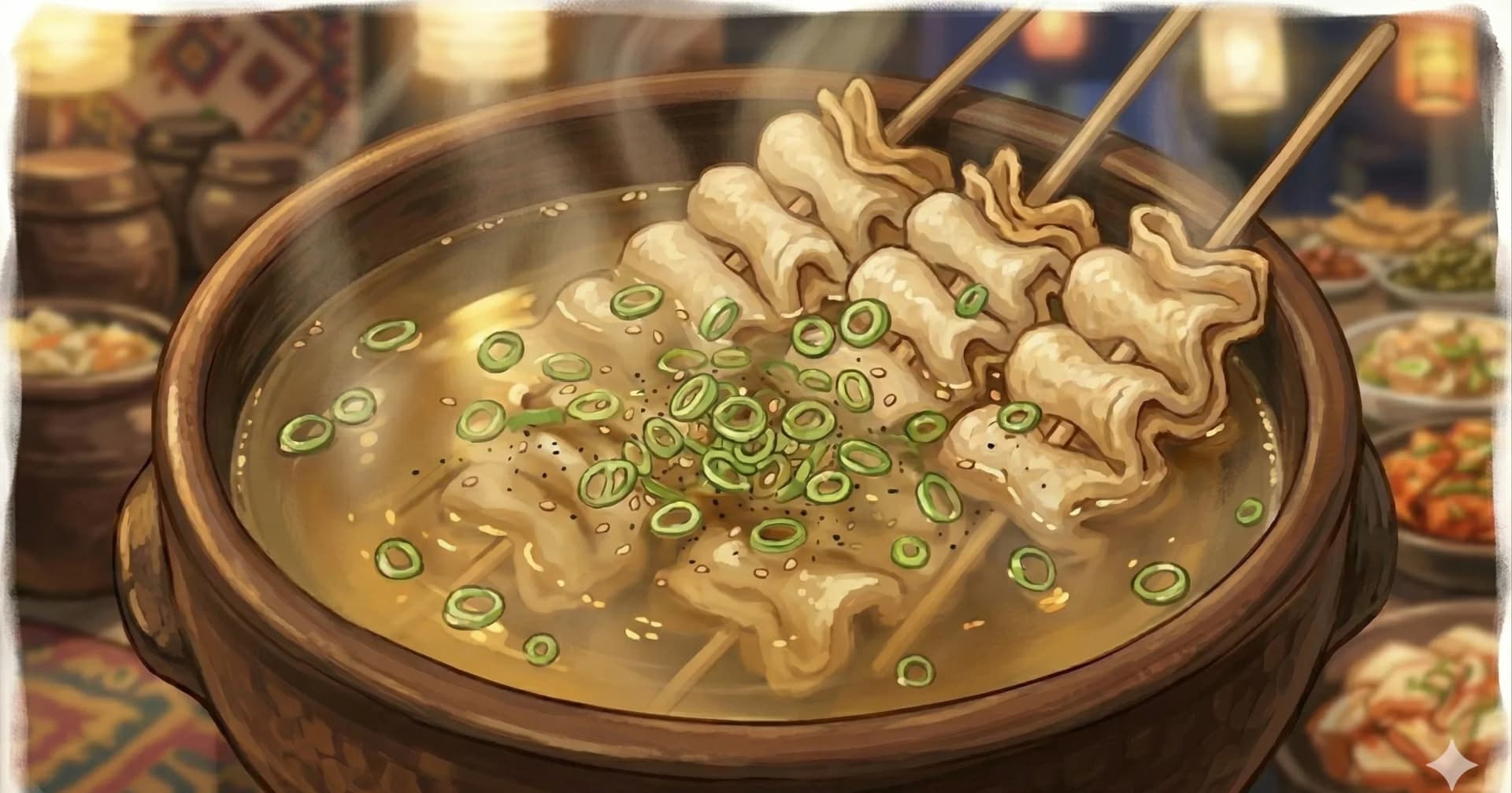
Skewered fish cakes simmered in a clear, warming anchovy and kelp broth
The broth is the first pleasure, clear and golden, tasting of the sea in the cleanest possible way. You lift a skewer of fish cake from the liquid, the thin, folded sheets wobbling gently, and take a bite that is soft, slightly chewy, and infused with the broth it has been simmering in. This is eomuk-guk, one of Korea's most comforting and least complicated soups, and a fixture of street stalls and home kitchens alike.
Eomuk, sometimes called odeng (from the Japanese oden, reflecting a shared culinary history), is processed fish cake made from white fish paste, formed into sheets, tubes, or sticks. It is a humble ingredient, but in a well-made broth, it becomes something genuinely wonderful. At Korean street stalls, eomuk skewers stand upright in large pots of bubbling broth, and customers pull a skewer, dip it in soy sauce, and sip the hot broth from paper cups on cold days. It is often sold alongside tteokbokki, and the combination of the sweet-spicy rice cakes with the mild, soothing fish cake soup is one of Korean street food's great pairings.
What this soup delivers is gentle, warming nourishment. There is no chili, no fermented paste, no complexity. Just a clean anchovy and kelp broth with the subtle sweetness of Korean radish and the mild, seafood-forward flavor of the fish cake. It is the kind of soup that children love and adults find comforting for its simplicity.
The practical insight is in the broth base. Dried anchovies (with heads and intestines removed to prevent bitterness) combined with dried kelp produce a broth called yuksu that is the foundation of countless Korean soups. A small piece of Korean radish (mu) adds a gentle sweetness that rounds out the briny, savory character. This simple broth takes 10 minutes but provides a depth of flavor that water alone never could.
At a Glance
Yield
4 servings
Prep
10 minutes
Cook
20 minutes
Total
30 minutes
Difficulty
Easy
Ingredients
Stock Ingredients
- 1 qtwater
- 10large dried anchovies, heads and intestines removed
- 1 piecedried kelp (about 10 cm square)
- 3½ ozmu (Korean radish) or daikon (about 1–1½ radishes), cut into 2 to 3 large pieces
Soup Ingredients
- 1 tbspsoy sauce
- ⅞ tspfine salt, or to taste
- 1 tspmirin or rice wine (optional)
- ¾ lbeomuk (Korean fish cake sheets), rinsed briefly with hot water
- —Wooden skewers (about 6–8)
- 2scallions, thinly sliced
- —Pinch of black pepper
Dipping Sauce Ingredients
- —Soy sauce
- —Korean mustard (gyeoja)
Method
- 1
Prepare the dried anchovies by removing the heads and splitting them open to remove the dark intestines. This step prevents the broth from tasting bitter. It is tedious but makes a noticeable difference in flavor.
- 2
Place the prepared anchovies, dried kelp, radish pieces, and water in a medium pot. Bring to a boil over medium-high heat.
- 3
Once the water reaches a boil, remove the kelp. Kelp becomes slimy and imparts a bitter taste if boiled for too long. The anchovies and radish should continue simmering.
- 4
Reduce heat to medium and simmer for 8 to 10 minutes. The broth will turn a pale gold and develop a clean, briny, slightly sweet aroma. The radish will soften and contribute a gentle sweetness.
- 5
Strain the broth through a fine mesh strainer, removing the anchovies and radish pieces. Return the clear broth to the pot. You can return the radish pieces to the broth for serving if you like.
- 6
Season the broth with soy sauce, salt, and mirin (if using). Taste it. The broth should be light, clean, and savory, with a gentle seafood character and a subtle sweetness from the radish.
- 7
Prepare the fish cakes while the broth simmers. Rinse the eomuk sheets briefly with hot water to remove excess oil from their surface. This step lightens the finished soup.
- 8
Cut the fish cake sheets into manageable pieces, then thread them onto wooden skewers by folding or weaving the pieces in a zigzag pattern. Each skewer should hold one or two pieces of fish cake, folded back and forth.
- 9
Add the fish cake skewers to the seasoned broth. Simmer gently for 5 to 7 minutes, allowing the fish cake to absorb the broth's flavor and warm through completely. The fish cake will swell slightly and become more tender.
- 10
Taste the broth one final time and adjust the seasoning if needed. The fish cake adds its own subtle savoriness to the liquid during cooking.
- 11
Serve the soup in deep bowls, placing 1 to 2 skewers in each bowl and ladling the hot broth over them. Include a piece or two of the radish if desired.
- 12
Garnish with sliced scallion and a pinch of black pepper. Place soy sauce and Korean mustard on the table for individual dipping.
Key Ingredient Benefits
Eomuk (fish cake): Made from processed white fish (typically pollock), eomuk provides lean protein with relatively low fat. It is a significant source of protein in the Korean diet and a staple ingredient in soups, stews, and street food.
Dried anchovies: A calcium-rich ingredient (the small bones are consumed) that also provides protein and omega-3 fatty acids. Traditionally valued in Korean cooking as both a broth ingredient and a banchan when stir-fried with soy sauce and sugar.
Kelp (dashima): One of the richest natural sources of iodine, which is essential for thyroid function. Kelp also provides natural glutamate, the amino acid responsible for umami flavor.
Mu (Korean radish): Contains digestive enzymes (diastase) traditionally valued for supporting digestion. Rich in vitamin C, especially when consumed raw or lightly cooked.
Why This Works
The combination of dried anchovies and kelp creates a broth rich in natural glutamate (from the kelp) and inosinate (from the anchovies). These two compounds create a synergistic umami effect, where the perceived savoriness is greater than the sum of its parts. This simple two-ingredient technique is the backbone of Korean soup-making.
Removing the anchovy heads and intestines before simmering prevents the release of bitter compounds that would cloud the clean, mild character of the broth. This is a standard Korean technique that is worth the small effort.
Rinsing the fish cake sheets with hot water removes the surface oil that accumulates during packaging and storage. Without this step, the broth develops an oily film that diminishes its clarity and lightness.
The Korean radish (mu) contributes a natural sweetness from its sugars, which are released during simmering. This sweetness balances the briny, savory character of the anchovy and kelp broth, producing a more rounded, complete flavor.
Substitutions & Variations
Fish cake shapes: Tube-shaped or stick-shaped eomuk can replace sheet eomuk. They do not need to be threaded on skewers. Simply cut into bite-sized pieces and simmer directly in the broth.
Without anchovies: A vegetable broth made from dried shiitake mushrooms, kelp, and radish can produce a satisfying umami broth for a vegetarian version.
Spicy version: Add 10 g of gochugaru or a halved fresh chili to the broth for a mildly spicy variation.
With rice cakes: Add sliced tteok (rice cakes) to the broth along with the fish cake for a more substantial soup. This is a common street food combination.
Oden-style: For a more substantial dish, add hard-boiled eggs, tofu, and daikon chunks to the broth alongside the fish cake.
Serving Suggestions
Eomuk soup is the classic companion to tteokbokki, served side by side at street stalls across Korea. The mild, soothing broth balances the fiery sweetness of the rice cakes. On its own, it serves as a light soup course alongside steamed rice and several banchan. The broth is often sipped on its own as a warming drink on cold days. In lunchbox (dosirak) meals, eomuk soup is served in a thermos or insulated container.
Storage & Reheating
Leftover soup: Store in the refrigerator for up to 2 days. The fish cake will absorb more broth over time, becoming softer.
Reheating: Warm gently over medium heat. Add a splash of water if the broth has reduced or been absorbed by the fish cake.
Broth only: The anchovy-kelp broth without fish cake stores well for up to 3 days in the refrigerator or 1 month in the freezer. It is a versatile base for many Korean soups.
Freezing: The fish cake can become rubbery after freezing. Freeze the broth separately and add fresh fish cake when serving.
Cultural Notes
Eomuk (어묵) is the Korean name for the molded, steamed-and-fried fish-paste cakes that show up across countless Korean preparations. As banchan. As a stir-fry component. As a school-lunch protein. And most iconically, as the long folded skewers simmering in a clear broth at the pojangmacha (포장마차) street tents that line Korean cities on cold winter nights. The Korean street-food name odeng (오뎅), still in wide use, is a borrowing from the Japanese oden. It is a reminder that Korean fish-cake culture was shaped a lot by the colonial period (1910-1945) and by Japanese fish-processing techniques.
The city most associated with eomuk is Busan, in the southeast. The first Korean fish-cake factory, Sambok Eomuk, opened in Busan in 1953 and is still in operation today. Busan's status as a major fishing port made fresh white-fish purée abundant and cheap, and within a generation the Busan eomuk style had become the national standard: chewier, less sweet, and made with a higher fish-to-starch ratio than its Japanese cousin.
Eomuk soup as a stand-alone dish belongs almost exclusively to the pojangmacha world. The folded skewered fish cakes get stewed for hours in an anchovy-and-kelp broth that picks up sweetness and savoriness from the cakes themselves. You stand at a cramped counter, pick skewers out of the simmering pot, eat them holding the stick in one hand, and drink the broth directly from a paper cup to chase the cold air.
Skewer plus broth plus a shot of soju has been a Korean winter ritual for decades. The smell of an eomuk pot is one of the defining seasonal markers of December in Seoul and Busan, the same way roasted-chestnut smoke marks the season further west.
Nutrition Facts
Calories: 121kcal (6%)|Total Carbohydrates: 10.7g (4%)|Protein: 14.4g (29%)|Total Fat: 2.5g (3%)|Saturated Fat: 0.5g (3%)|Cholesterol: 31mg (10%)|Sodium: 1595mg (69%)|Dietary Fiber: 0.6g (2%)|Total Sugars: 2.8g
You Might Also Like
Ratings & Comments
Ratings & Comments
Ratings
Share your thoughts on this recipe.
Sign in to rate and comment