Korean Cuisine
Hotteok (Sweet Korean Pancakes)
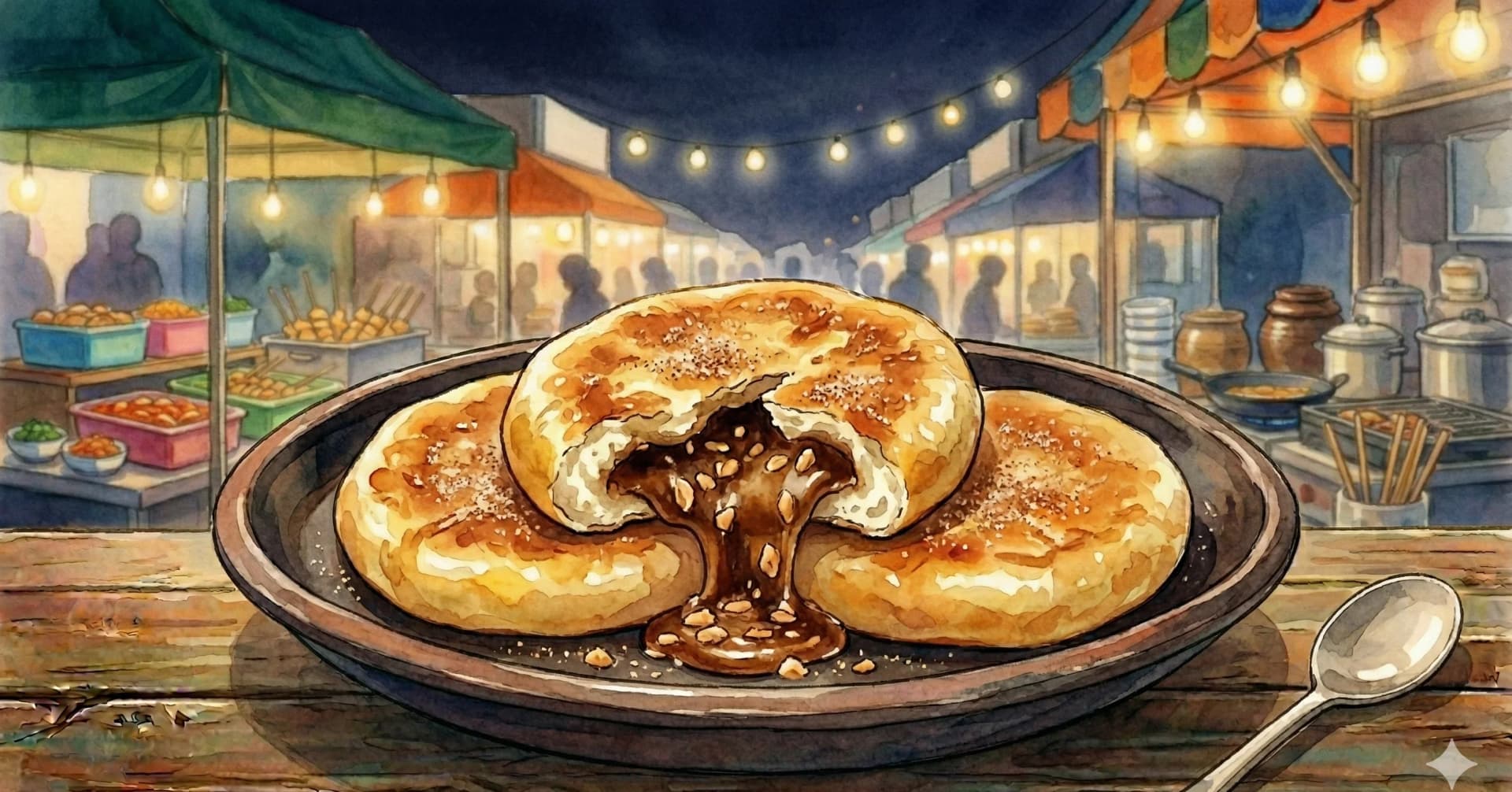
Crispy, golden dough stuffed with a molten filling of brown sugar, cinnamon, and crushed nuts
You hear the sizzle as the dough meets the oiled pan, and then the vendor presses it flat with a metal disc, spreading it into a golden circle that puffs and blisters at the edges. When you take it, still too hot to eat comfortably, wrapped in a paper cup, and bite through the crispy, chewy exterior, the filling spills out: a stream of molten brown sugar, fragrant with cinnamon, studded with crushed peanuts and sesame seeds. You burn your tongue and you do not care. This is hotteok, Korea's most beloved winter street food.
Hotteok traces its origins to Chinese immigrants who brought stuffed bread traditions to Korea in the early 20th century. The Korean version evolved into something distinct, using a softer, sweeter yeasted dough and a filling that is pure sugar and spice. During the cold months, hotteok vendors set up portable griddles on street corners across Korea, and the sight of the dough being flattened and fried is as much a symbol of Korean winter as falling snow.
What hotteok delivers is the comfort of contrast. The exterior is golden and slightly crispy from the oil, with a chewy, bread-like quality from the yeast-risen dough. The interior is liquid, dangerously hot, sweet, and intensely aromatic. The textural difference between the firm, satisfying chew of the dough and the flowing, caramelized filling is the heart of the experience.
The practical insight is patience with the dough. It needs to rise properly, becoming soft, puffy, and slightly sticky. Under-risen dough produces dense, bready hotteok that lack the characteristic lightness. And when filling, seal the edges completely. Any opening lets the precious molten sugar escape into the pan rather than staying trapped inside where it belongs.
At a Glance
Yield
8 pancakes
Prep
20 minutes (plus 1 hour rising)
Cook
20 minutes
Total
1 hour 40 minutes
Difficulty
Medium
Ingredients
Dough Ingredients
- 2 cupall-purpose flour
- 1¾ ozglutinous rice flour (chapssal-garu)
- ¼ ozinstant yeast
- 1½ tbspsugar
- ½ tspfine salt
- ¾ cupwarm milk (about 38°C)
- 1 tbspvegetable oil
Filling Ingredients
- ⅓ cupbrown sugar (dark or light)
- 1¼ tspground cinnamon
- 1 ozpeanuts, roughly chopped
- 1¾ tbsptoasted sesame seeds
- ½ ozsunflower seeds or mixed nuts, chopped (optional)
For Frying
- —Vegetable oil for pan-frying
Method
- 1
Make the dough. Combine the all-purpose flour, glutinous rice flour, instant yeast, sugar, and salt in a large mixing bowl. Add the warm milk and vegetable oil. Stir with a wooden spoon or spatula until a shaggy dough forms.
- 2
Knead the dough in the bowl or on a lightly oiled surface for 5 to 7 minutes until it becomes smooth, soft, and slightly sticky. It should feel pillowy and elastic, stretching easily when pulled. If it is too dry, add warm milk 1 tablespoon at a time. If too sticky, add a small amount of flour.
- 3
Cover the bowl with plastic wrap or a damp towel. Let the dough rise in a warm place for 1 hour, or until it has roughly doubled in size. The dough should be puffy, soft, and slightly airy when poked.
- 4
While the dough rises, prepare the filling. Mix together the brown sugar, cinnamon, chopped peanuts, sesame seeds, and sunflower seeds (if using) in a small bowl. Break up any lumps in the brown sugar.
- 5
Once the dough has risen, punch it down gently and divide it into 8 equal pieces, about 60 to 65 g each. Oil your hands lightly to prevent sticking.
- 6
Flatten one piece of dough in your palm into a round disc about 8 cm across. Place about 1 tablespoon of the filling in the center.
- 7
Gather the edges of the dough up and around the filling, pinching them together firmly to seal. Roll the sealed ball gently between your palms to form a smooth round. The seam should be completely closed. Place it seam-side down on a lightly oiled plate. Repeat with the remaining dough and filling.
- 8
Heat a skillet or flat griddle over medium-low heat. Add enough vegetable oil to lightly coat the surface, about 15 ml.
- 9
Place 2 to 3 filled dough balls seam-side down in the skillet, leaving space between them. Let them cook for about 1 minute until the bottom begins to set and turn lightly golden.
- 10
Press each ball flat with a spatula or hotteok press, spreading it into a disc about 10 to 12 cm in diameter and 1 cm thick. Press firmly but smoothly. The dough will resist slightly because of the filling inside. If any filling leaks, press a bit of the dough over the opening to seal it.
- 11
Cook for 2 to 3 minutes on the first side. The bottom should turn a deep golden-brown and feel crispy when tapped. You may see the dough puffing slightly around the edges as the sugar inside begins to melt.
- 12
Flip carefully and cook for another 2 to 3 minutes until the second side is equally golden and crispy. The filling inside is now molten and extremely hot.
- 13
Transfer to a wire rack or plate lined with paper towels. Let the hotteok cool for at least 2 to 3 minutes before eating. The filling is liquid sugar and will cause serious burns if eaten immediately, even though the temptation is real.
- 14
Repeat with the remaining filled dough balls, adding small amounts of oil to the pan between batches.
- 15
Serve warm. Hotteok are at their best within 15 minutes of cooking, when the exterior is still crispy and the filling is still molten inside.
Key Ingredient Benefits
Glutinous rice flour (chapssal-garu): Despite its name, glutinous rice flour is naturally gluten-free (the "glutinous" refers to its sticky quality, not to gluten protein). It is made from short-grain sticky rice and provides the chewy, slightly stretchy texture that distinguishes Korean rice-based desserts and snacks.
Brown sugar: Contains small amounts of molasses, which provides minerals including calcium, potassium, and iron. The molasses also contributes the characteristic caramel flavor and darker color compared to white sugar.
Cinnamon: Contains cinnamaldehyde, a compound that research suggests may have anti-inflammatory properties and a modest effect on blood sugar regulation. Traditionally used in Korean cuisine in teas and sweet preparations.
Peanuts: Provide protein, healthy monounsaturated fats, and vitamin E. The roasting process enhances their flavor and slightly increases the bioavailability of certain antioxidants.
Why This Works
The combination of all-purpose flour and glutinous rice flour creates a dough with the best of both worlds. The all-purpose flour provides structure and a slight chewiness from gluten. The glutinous rice flour adds a soft, slightly stretchy, mochi-like quality that makes the finished hotteok tender and chewy rather than bready. Without the glutinous rice flour, the dough would be too firm and bread-like.
Yeast provides lift and airiness. The risen dough is lighter and more tender than an unleavened version would be, and the fermentation contributes subtle flavor complexity to what would otherwise be a plain wheat dough.
Pressing the filled ball flat in the pan creates the characteristic shape and maximizes surface area in contact with the hot oil. This means more crispy exterior per bite. The pressing also thins the dough layer, so the ratio of crispy-chewy dough to molten filling is well balanced.
Medium-low heat is essential. Too high, and the exterior burns before the filling melts. Too low, and the dough absorbs oil without crisping. At the right temperature, the dough develops a golden, crispy exterior while the brown sugar inside has time to fully liquefy into a hot, flowing caramel.
Substitutions & Variations
Filling variations: Honey and cheese is a popular modern filling. Sweet red bean paste (pat) is a traditional alternative. Some street vendors offer a savory version filled with japchae (glass noodles) and vegetables.
Without glutinous rice flour: Use 300 g all-purpose flour total. The texture will be more bread-like and less chewy, but it will still be delicious.
Without yeast: A quick version can be made using baking powder (8 g) instead of yeast, skipping the rising time. The texture will be more cake-like and less chewy.
Nuts: Walnuts, almonds, or pine nuts can replace peanuts. Omit all nuts for a nut-free version.
Seed hotteok: A popular variation in Busan uses a generous filling of mixed seeds (sunflower, pumpkin, sesame) bound with honey or syrup instead of brown sugar.
Serving Suggestions
Hotteok is traditionally eaten as a street food snack, standing up at the vendor's stall, biting carefully through the crispy exterior into the molten center. At home, serve as an afternoon snack with tea or as a dessert after a Korean meal. For a special presentation, dust lightly with powdered sugar or drizzle with honey. Hotteok pairs beautifully with hot barley tea (boricha) or any warm Korean tea like saenggang-cha (ginger tea).
Storage & Reheating
Leftover hotteok: Store in an airtight container at room temperature for up to 1 day, or in the refrigerator for up to 2 days. The filling will solidify as it cools, which is normal.
Reheating: The best method is to re-crisp in a dry or lightly oiled skillet over medium-low heat for 2 minutes per side. An oven at 180°C for 5 to 7 minutes also works. Microwaving softens the dough and makes it chewy rather than crispy.
Freezing: Uncooked filled hotteok balls freeze well. Place them on a parchment-lined tray, freeze until solid, then transfer to a freezer bag. Cook directly from frozen, adding 1 to 2 minutes per side. Cooked hotteok can also be frozen and reheated in the oven.
Dough: Unrisen or risen dough can be refrigerated overnight, covered tightly. Let it come to room temperature before filling and cooking.
Cultural Notes
Hotteok (호떡) is the defining Korean winter street food. Walk past any open-air market or downtown shopping street in Seoul, Busan, or any Korean city between November and February, and you will almost certainly find a hotteok vendor. A small cart. A flat griddle. A tub of flour-and-yeast dough. A hot sticky line of customers waiting in the cold for one of these brown sugar-filled discs. The smell of caramelized brown sugar and cinnamon sizzling on the griddle is one of the most distinctive olfactory markers of Korean winter.
The dish is a 19th-century cultural import. Ho-tteok translates literally as "barbarian rice cake," with ho (호) being an old Korean prefix used for things from China. The dish was brought to Korea by Chinese merchants and Hui Muslim traders who settled in port cities like Incheon during the late Joseon dynasty. The Korean adaptation, which kept the round flat shape but added the now-iconic brown sugar, cinnamon, and crushed nut filling, took shape over the early 20th century. By the 1970s, hotteok had fully naturalized as Korean street food.
Two regional variations have reached iconic status. Ssiat hotteok (씨앗호떡, "seed hotteok") from Busan is loaded with sunflower seeds, sesame, and crushed nuts inside the brown sugar filling, served slit open with the seed-syrup spilling out. Nokcha hotteok (녹차호떡, green tea hotteok) and yeongguk-ho-tteok (잉크호떡, ink-colored hotteok made with charcoal or black sesame) are more recent variants developed by celebrity street vendors in the 2010s.
Each November, certain Korean food publications run their annual "Where to find the best hotteok" guides, and the dish features prominently in K-drama scenes of winter dates and student outings.
Nutrition Facts
Calories: 256kcal (13%)|Total Carbohydrates: 44.2g (16%)|Protein: 6.2g (12%)|Total Fat: 6.2g (8%)|Saturated Fat: 0.8g (4%)|Cholesterol: 1mg (0%)|Sodium: 160mg (7%)|Dietary Fiber: 1.9g (7%)|Total Sugars: 13.6g
You Might Also Like
Ratings & Comments
Ratings & Comments
Ratings
Share your thoughts on this recipe.
Sign in to rate and comment