Chinese Cuisine
Dong Gua Tang (Winter Melon Soup)
A light, cooling broth where tender winter melon dissolves into pork-scented clarity
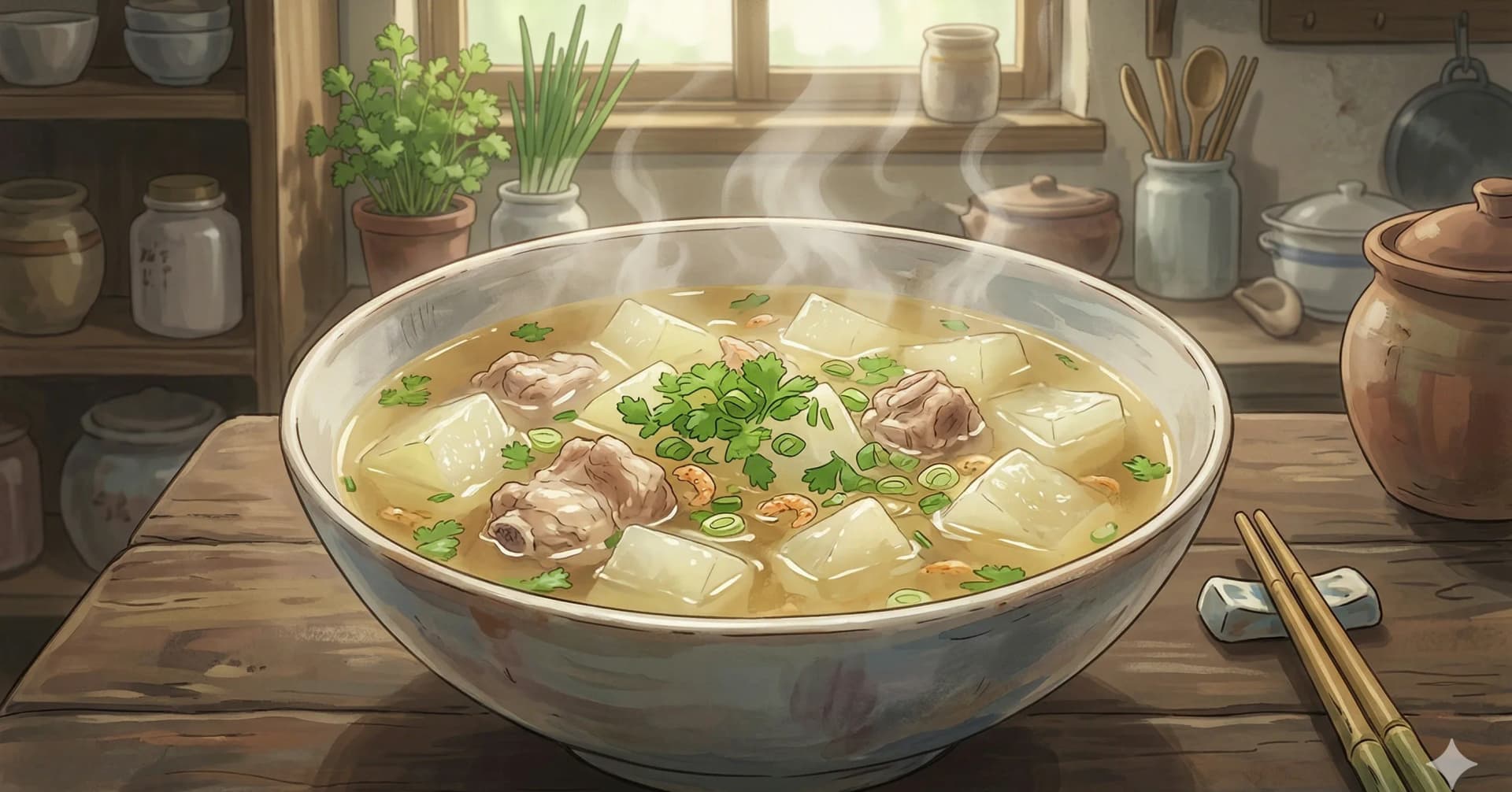
Winter melon is a strange vegetable. It is enormous, pale green, covered in a waxy white bloom, and tastes like almost nothing when raw. But cook it in a well-made pork broth and it transforms. The flesh turns translucent, soft as custard, and takes on the full flavor of whatever surrounds it. It becomes a vehicle for the broth, absorbing the ginger and pork and white pepper while contributing its own subtle, clean sweetness.
Despite its name, winter melon is really a summer ingredient. The "winter" refers to the waxy coating on its skin, which resembles frost. In southern China and Southeast Asia, this soup appears most often during the hotter months, when its light, cooling character is especially welcome. It is the opposite of the rich, long-simmered tonic soups like Wu Ji Tang or Ren Shen Ji Tang. Where those soups build warmth and heaviness, dong gua tang aims for transparency and refreshment.
The technique is straightforward but the timing matters. The pork ribs need at least 90 minutes of slow simmering to give up their collagen and flavor. The winter melon, by contrast, needs only 15 to 20 minutes. Add it too early and it disintegrates into the broth. Add it at the right moment and each piece holds its shape while being tender enough to cut with a spoon. White pepper, added at the end, gives the soup a gentle, lingering heat that lifts everything without overpowering it.
At a Glance
Yield
6 to 8 servings
Prep
15 minutes (plus 1 hour soaking)
Cook
2 hours
Total
3 hours
Difficulty
Easy
Ingredients
- 2 lbpork spare ribs or rib tips, cut into 1 to 2-inch pieces
- 1½ lbwinter melon
- 5 slicesfresh ginger, about 1/8-inch thick, lightly smashed
- ¼ ozdried shrimp, rinsed and soaked for 15 minutes (optional)
- 2¼ qtcold water
- 1⅓ tspsea salt, plus more to taste
- —White pepper to taste
- —Light soy sauce for serving alongside the ribs
- 1 handfulfresh cilantro, roughly chopped
- 2scallions, thinly sliced
Method
- 1
Soak the ribs. Place the pork ribs in a large bowl and cover with cold water. Soak for 1 hour, changing the water once. This draws out blood and impurities for a cleaner-tasting broth.
- 2
Blanch the ribs. Drain the ribs and place them in a large pot. Cover with fresh cold water and bring to a rolling boil over high heat. Let them cook for 1 to 2 minutes while the grey foam rises. Drain, rinse each piece under cool running water, and scrub off any clinging residue. Clean the pot thoroughly.
- 3
Simmer the pork broth. Return the blanched ribs to the clean pot along with the smashed ginger slices and dried shrimp, if using. Add 9 cups of cold water. Bring to a boil over medium-high heat, then immediately reduce to a low simmer. Cover and let it cook for 90 minutes. Skim any fat or foam from the surface during the first 15 minutes. The broth will gradually turn a pale, clear gold.
- 4
Prepare the winter melon. While the broth simmers, trim the skin from the winter melon using a knife or vegetable peeler. Remove the seeds and spongy interior. Rinse the flesh and cut it into bite-sized pieces, about 1/4-inch thick slices. Winter melon is very mild, so do not worry about precise cuts. It will all soften into tenderness.
- 5
Add the winter melon. After the ribs have simmered for 90 minutes, skim any excess fat from the surface. Add the winter melon pieces and the salt. Cover and simmer for 15 to 20 minutes. The melon is done when it turns translucent and yields easily to a chopstick. It should be soft but not falling apart.
- 6
Season and serve. Taste the broth and adjust the salt. Add a generous pinch of white pepper. Stir in the chopped cilantro and sliced scallions. Ladle into bowls, making sure each serving gets a good mix of melon and ribs. Set out a small dish of light soy sauce for anyone who wants to dip the pork pieces.
Key Ingredient Benefits
Winter Melon (Dong Gua). A large gourd widely used across East and Southeast Asian cooking. In Traditional Chinese Medicine, winter melon is traditionally regarded as cooling in nature and is associated with clearing heat, promoting urination, and reducing swelling. It is extremely low in calories and high in water content, making it one of the lightest vegetables you can cook with. Research confirms its high water and potassium content, though specific therapeutic claims remain within the realm of traditional practice rather than clinical evidence.
Pork Ribs. The collagen in pork bones breaks down into gelatin during the long simmer, giving the broth its body. This is the same principle at work in bone-broth-style soups worldwide. The fat from the ribs enriches the broth, though much of it can be skimmed for a lighter result.
White Pepper. More than just a finishing spice, white pepper has been traditionally used in Chinese cooking to add warmth to cooling dishes. It is made from the same berry as black pepper but with the outer layer removed, producing a milder, more floral heat.
Dried Shrimp. A concentrated source of umami, common in Cantonese and Southeast Asian cooking. A small amount goes a long way. They are rich in protein and minerals, particularly calcium and phosphorus.
Why This Works
The two-stage cooking approach is the key to this soup's clarity and balance. The ribs need a long simmer to release their collagen, fat, and flavor into the water, building a broth with real body. The winter melon, however, is mostly water itself and cooks in a fraction of the time. By adding the melon only in the last 15 to 20 minutes, you get pieces that are tender and translucent without being mushy, floating in a broth that already has depth and structure.
Blanching the ribs in a separate round of water follows the same logic as Lian Ou Pai Gu Tang and Hong Zao Ji Tang. The impurities that rise during blanching would otherwise cloud the broth and leave a mineral, off-taste. Starting the second simmer with cold water allows the collagen to extract gradually, producing a smoother, more full-bodied liquid than if you dropped the ribs into already-boiling water.
White pepper is the traditional finishing spice for this soup, and it serves a specific purpose. Its heat is milder and more aromatic than black pepper, with a slightly floral quality that complements the delicate melon. In Chinese culinary thinking, white pepper also adds a touch of warmth to counterbalance the cooling nature of the winter melon, creating a more balanced dish.
The optional dried shrimp add a layer of sea-sweet umami that deepens the broth considerably. Even a small handful transforms the soup from pleasant to compelling, reinforcing the savory backbone without making it taste overtly of seafood.
Substitutions & Variations
No winter melon? Chayote squash or fuzzy melon (mao gua) are the closest substitutes and behave similarly when simmered. Zucchini can work in a pinch but cooks even faster, so add it in the last 8 to 10 minutes.
Chicken version. Replace the pork ribs with bone-in chicken thighs or a whole chicken cut into pieces. The broth will be lighter and more delicate.
Dried scallops. For a more luxurious version, add 4 to 5 dried scallops (conpoy) to the broth at the beginning of the simmer. They contribute an intense, sweet umami that elevates the soup considerably.
With vermicelli. Some families add a small bundle of mung bean vermicelli (glass noodles) in the last 5 minutes of cooking for a more substantial meal.
Vegetarian. Replace the pork with a combination of dried shiitake mushrooms and dried kelp. Simmer for 45 minutes before adding the winter melon. The result is lighter but still flavorful.
Serving Suggestions
Dong gua tang is best served as part of a multi-dish Chinese dinner. Its lightness makes it an ideal counterpoint to richer dishes like Char Siu, Mapo Tofu, or Dan Dan Noodles. The broth is sipped alongside the meal, not before it.
In summer, serve it at room temperature or slightly warm rather than steaming hot. Its cooling nature makes it particularly refreshing in this form.
With a bowl of steamed rice, a plate of stir-fried greens, and the pork ribs dipped in soy sauce on the side, this soup becomes a satisfying, light weeknight dinner.
Storage & Reheating
The soup keeps in the refrigerator for up to 3 days. The winter melon will continue to soften as it sits, becoming even more tender. A thin layer of pork fat will solidify on top when cold and can be removed before reheating.
Reheat gently on the stovetop over medium-low heat. The winter melon is delicate and will break apart if boiled vigorously.
This soup does not freeze particularly well. The winter melon turns spongy and waterlogged after thawing. If you want to freeze the broth for later use, strain out the melon and ribs first, and add fresh winter melon when you reheat.
Cultural Notes
Dong gua tang (冬瓜湯, "winter melon soup") is the Cantonese summer soup of clear broth simmered with cubes of winter melon (Benincasa hispida, the large white-fleshed gourd that despite its name is harvested in summer), pork bones or chicken, dried shrimp, and sometimes dried scallop or barley. The soup is one of the staples of Cantonese summer cooking, where the cuisine's seasonal focus on cooling foods (qing re, "clearing heat") makes winter melon one of the most important vegetables of the hot months. The melon itself is remarkably bland (the flesh tastes of little more than slightly sweet water), which allows it to serve as a vehicle for the broth's flavor rather than competing with it.
The traditional preparation simmers pork bones (or a whole chicken or chicken carcass) in water for an hour to develop the base broth, then adds large cubes of winter melon, soaked dried shrimp, dried scallops (gan bei) or dried mushroom, and sometimes pearl barley (yi mi) for added body. The soup cooks for another forty-five minutes to an hour until the winter melon turns translucent and tender enough to fall apart at the touch of a spoon. The finished soup is seasoned with a small amount of salt and white pepper just before serving, often with chopped scallion and a few drops of sesame oil on top.
The dish has a special form for formal banquets: the dong gua zhong (冬瓜盅, "winter melon vessel"), in which a whole hollowed-out winter melon serves as both the cooking vessel and the serving bowl, with the broth simmered inside the melon for hours so the flavor of the gourd flesh and skin infuses the soup. The exterior of the melon is often carved with auspicious characters or designs, making the dish a centerpiece of formal Cantonese banquets and a particular fixture of wedding meals. The cooling and hydrating qualities of winter melon are documented in traditional Chinese medicine texts including the Bencao Gangmu, where the gourd is classified as cooling and supportive of urinary function, and modern households continue the tradition of cooking dong gua tang during the hottest summer weeks for its perceived cooling effect.
Nutrition Facts
Calories: 325kcal (16%)|Total Carbohydrates: 2.9g (1%)|Protein: 23g (46%)|Total Fat: 23.8g (31%)|Saturated Fat: 8.8g (44%)|Cholesterol: 97mg (32%)|Sodium: 496mg (22%)|Dietary Fiber: 0.6g (2%)|Total Sugars: 0.1g
You Might Also Like
Ratings & Comments
Ratings & Comments
Ratings
Share your thoughts on this recipe.
Sign in to rate and comment