Chinese Cuisine
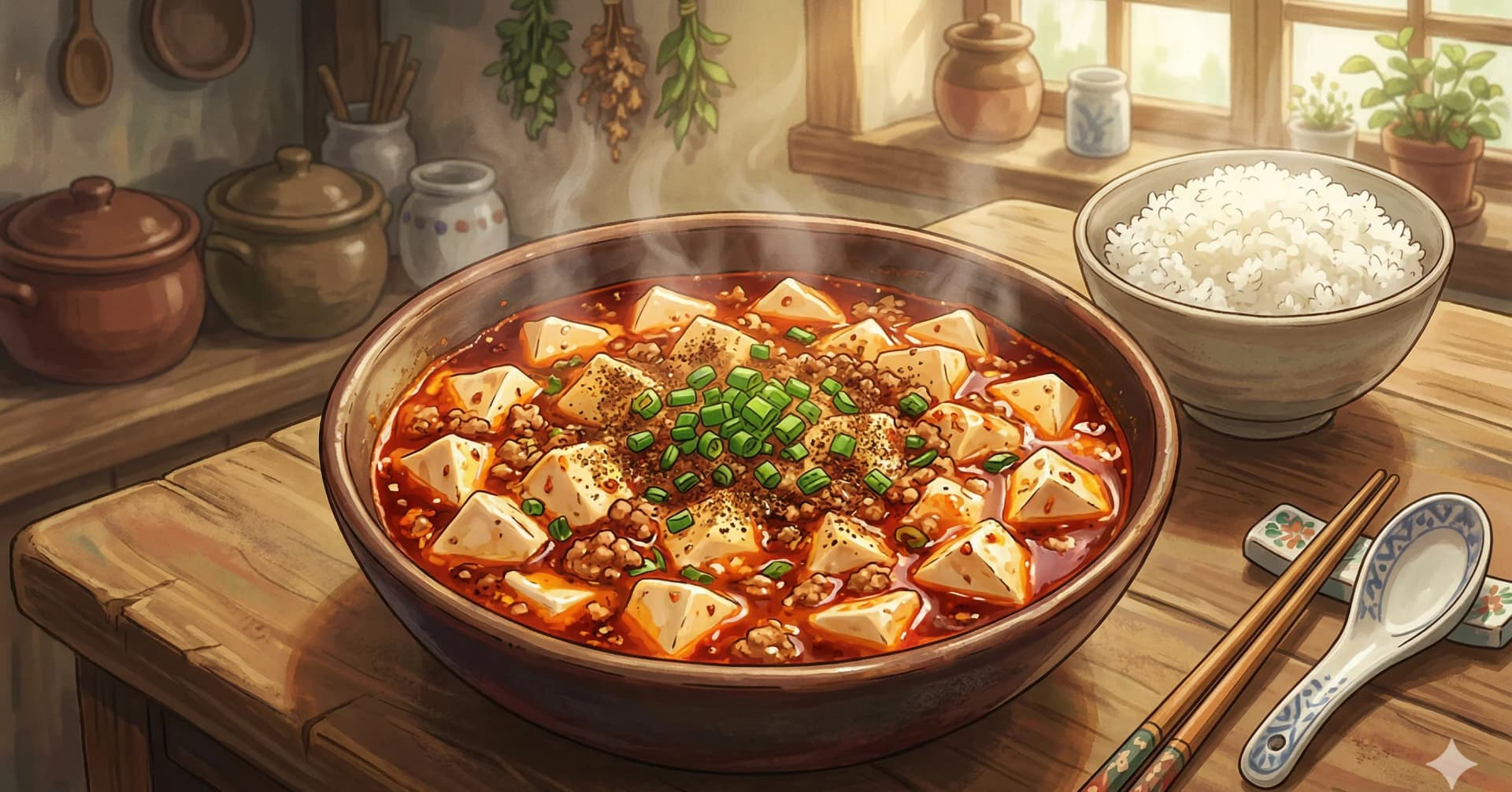
Ma Po Dou Fu (Mapo Tofu)
Sichuan's most famous tofu dish, with silky cubes in a fiery, numbing sauce of doubanjiang, ground pork, and Sichuan peppercorn
The name translates roughly to "pockmarked grandmother's tofu," a reference to the woman credited with creating the dish in a small Chengdu restaurant over a century ago. Whatever the truth of the origin story, the dish itself has become the single most recognized tofu preparation in the world. It has also been one of the most frequently adapted, softened, and diluted as it traveled from Sichuan to other provinces and then overseas. This recipe pulls it back toward the original.
Authentic mapo tofu rests on a handful of non-negotiable ingredients. Pixian doubanjiang, the fermented broad bean and chili paste from a small county in Sichuan, provides the savory depth and ruddy color. Sichuan peppercorns deliver the ma, the numbing tingle that distinguishes Sichuan cooking from every other spicy cuisine. Ground pork adds richness without competing with the tofu for center stage. And the tofu itself should be soft enough to tremble on the spoon, barely holding its shape.
Sichuan chefs describe perfect mapo tofu with five words: spicy, numbing, aromatic, tender, and hot. The heat should hit both ways: the chili burn that builds on your tongue and the physical temperature of the dish as it arrives steaming at the table. Tofu holds heat remarkably well, so eat carefully.
The technique is simpler than you might expect. The oil is infused with dried chilies first, then set aside. Ginger, garlic, and pork go into fresh oil and cook quickly. Doubanjiang and ground Sichuan peppercorn follow, then broth, tofu, and the chili oil all come together in the final minutes. A cornstarch slurry thickens the sauce into a glossy coating. The whole process takes about 25 minutes, and the result is rice-is-absolutely-not-optional good.
At a Glance
Yield
6 servings
Prep
10 minutes
Cook
25 minutes
Total
35 minutes
Difficulty
Easy
Ingredients
Chili Oil Ingredients
- ¼ cupvegetable oil
- 1to 2 fresh Thai bird chilies, thinly sliced
- 6to 8 dried red chilies, roughly chopped
Tofu Ingredients
- ¼ cupvegetable oil
- ½ cupfresh ginger, finely minced
- ½ cupgarlic, finely minced
- 8 ozground pork
- 3to 9 g Sichuan peppercorns, ground to a coarse powder (adjust to taste)
- 17to 34 g Pixian doubanjiang (spicy fermented bean paste)
- ⅔ cuplow-sodium chicken broth
- 1 lbsilken tofu, cut into 1-inch cubes
- ¼ cupwater
- 1½ tbspcornstarch
- 0 tbspsesame oil (optional)
- ¼ tspsugar (optional)
- 1scallion, finely chopped
- —Ground Sichuan peppercorn for garnish
Method
- 1
Make the chili oil. Heat 1/4 cup oil in a wok or small saucepan over low heat. Add the sliced fresh chilies and dried chilies. Stir occasionally and heat gently for about 5 minutes until the oil is fragrant and the dried chilies have darkened slightly but are not burnt. The kitchen will smell smoky and warm. Remove from heat and set aside. If you have homemade chili oil on hand, you can skip this step and use about 2 tablespoons later.
- 2
Cook the aromatics and pork. Heat the remaining 1/4 cup oil in a clean wok over medium heat. Add the minced ginger and cook for 1 minute until it releases its scent. Add the garlic and cook for another minute. Turn the heat to high and add the ground pork. Break the meat into small crumbles with a spatula and fry until cooked through and starting to brown, about 3 to 4 minutes.
- 3
Add the spice base. Add the ground Sichuan peppercorn to the pork and stir for 15 to 30 seconds. Take care not to let it burn, as it will turn bitter. Add the doubanjiang and stir well until the oil takes on a deep red color and the mixture is very fragrant, about 1 minute.
- 4
Build the sauce. Pour in the chicken broth and stir to combine. Let this simmer for 1 to 2 minutes so the flavors meld. Meanwhile, combine the water and cornstarch in a small bowl and stir until smooth.
- 5
Add the cornstarch slurry. Pour the cornstarch mixture into the wok and stir gently. Let the sauce bubble and thicken. If it becomes too thick, add a splash of broth or water.
- 6
Add the chili oil and tofu. Pour in the reserved chili oil, peppers and all. Stir the oil into the sauce. Gently slide the tofu cubes into the wok. Use a spatula to very carefully turn the tofu in the sauce, taking care not to break the cubes. Let everything cook together for 3 to 5 minutes until the tofu is heated through and has absorbed some of the sauce.
- 7
Finish and serve. Add the sesame oil and sugar if using, along with the chopped scallion. Stir gently until the scallion just wilts. Transfer to a serving bowl and sprinkle a final pinch of ground Sichuan peppercorn over the top. Serve immediately with plenty of steamed white rice.
Key Ingredient Benefits
Tofu: Silken tofu is traditional for mapo tofu because its soft, custard-like texture contrasts with the bold sauce. It is high in protein (about 8g per half-cup serving), provides all essential amino acids, and is a good source of calcium and iron. The isoflavones in soy have been studied for potential cardiovascular and bone health benefits, though clinical evidence remains mixed. Firm tofu can be substituted for easier handling. See the Silken Tofu ingredient guide.
Doubanjiang: This fermented paste is the foundation of Sichuan cooking. The fermentation process produces beneficial enzymes and creates complex flavor compounds. It is high in sodium, so no additional salt is needed when using the amounts in this recipe. Pixian brand, from Sichuan province, is considered the standard. See the Doubanjiang ingredient guide.
Ground Sichuan peppercorn: The numbing compound sanshool activates light-touch nerve fibers rather than pain receptors, which is why the sensation feels like buzzing rather than burning. Traditional Chinese medicine regards it as warming and digestive. Modern research has identified mild analgesic properties, though this is not a therapeutic claim.
Why This Works
Mapo tofu succeeds or fails on three decisions: the quality of the doubanjiang, the handling of the Sichuan peppercorn, and the gentleness with which you treat the tofu.
Pixian doubanjiang is fermented for months or even years. That fermentation creates layers of umami that fresh chili paste cannot match. It is salty, so the recipe uses low-sodium broth and no additional salt. The red oil that bleeds from the paste colors the entire sauce.
Red House Spice's approach adds fermented black beans (douchi) alongside the doubanjiang for even deeper umami complexity. This is traditional in many Sichuan kitchens and worth including if you have them on hand. Rinse and roughly chop about 1 tablespoon and add them with the doubanjiang.
The Sichuan peppercorn presents the biggest variable. Quality ranges enormously, and fresh, high-quality peppercorns are far more potent than stale ones. Start with less if your peppercorns are freshly purchased. You can always add more as a garnish but cannot remove what is already in the sauce.
The cornstarch slurry transforms thin broth into a sauce that clings to each tofu cube. Without it, the flavors pool at the bottom of the bowl. The starch also gives the dish its characteristic glossy, almost lacquered appearance.
Substitutions & Variations
Protein: Ground beef is the other traditional option and produces a slightly richer sauce. Ground chicken or turkey will work but are milder. For a vegan version, replace the pork with finely chopped rehydrated dried shiitake mushrooms and use vegetable broth. Omnivore's Cookbook notes that mushrooms add a complex umami that compensates well for the missing meat.
Tofu firmness: Medium-firm or firm tofu are easier to handle and will not fall apart during stirring. The trade-off is a denser, less custard-like texture. Soft regular tofu (labeled nen doufu in Chinese markets) is the preferred choice in Sichuan restaurants, sitting between silken and firm.
Heat level: Reduce the doubanjiang to 1 tablespoon and omit the fresh Thai chilies for a milder dish. For more heat, increase the dried chilies or add a tablespoon of chili flakes.
Greens: A handful of baby spinach, garlic chives, or chopped baby bok choy stirred in at the end adds color and nutrition without altering the core flavor.
Serving Suggestions
Mapo tofu demands steamed white rice. The sauce is rich, salty, and intense, and it needs the neutral sweetness of plain rice to balance it. For a full Sichuan meal, serve alongside Gong Bao Ji Ding for contrasting textures and Yu Xiang Eggplant for a sweeter, more aromatic dish. A bowl of Hot and Sour Soup makes a warming starter. A simple steamed or stir-fried green vegetable rounds out the table and gives the palate a place to rest between bites of heat and numbing spice.
Storage & Reheating
Refrigerator: Store in an airtight container for up to 3 days. The flavors deepen overnight as the tofu absorbs more sauce.
Reheating: Reheat gently in a saucepan over medium-low heat, adding a splash of broth or water to thin the sauce, which will have thickened considerably. Stir carefully to avoid breaking the tofu. The dish reheats very well and many find it even better the second day.
Freezing: Tofu texture changes significantly when frozen and thawed, becoming spongy and chewy. This is a valid texture in some dishes but is not desirable for mapo tofu. Freezing is not recommended.
Cultural Notes
Mapo tofu (麻婆豆腐, "pockmarked grandmother's tofu") is the Sichuan tofu dish that anchors the Chengdu culinary tradition and remains the most internationally recognized expression of the Sichuan málà (numbing-spicy) flavor system. The dish takes its name from a real person. Around 1862, in the late Qing dynasty, a woman named Chen surnamed and known locally as Chen Mapo (Mrs. Chen the pockmarked, for the smallpox scars on her face) ran a small restaurant in the Wanfu Bridge district of Chengdu, near the docks where porters and traders stopped for cheap meals. Her tofu dish, made from the inexpensive ingredients available to her, became famous enough that the restaurant took her name and the dish absorbed it permanently. Chen Mapo Tofu still operates in Chengdu today, with multiple locations descended from the original.
The flavor architecture is built from a specific stack of Sichuan ingredients. Doubanjiang, the fermented broad bean and chili paste from Pixian county in Sichuan, supplies the deep red oil and the salty fermented backbone. Douchi (fermented black soybeans) add a second layer of umami and a slightly funky depth. Sichuan peppercorns, toasted and ground, contribute the citrusy floral note and the characteristic tingling numbness on the lips and tongue that gives the má in málà its meaning. Ground beef or pork is browned first to render fat and crisp the edges, then the aromatics go in, then the broth, and finally cubes of soft silken tofu that are simmered briefly so they pick up flavor without breaking apart.
The cultural standing of mapo tofu in Sichuan cuisine is hard to overstate. The dish is featured in nearly every Sichuan cookbook published in the last century, including Fuchsia Dunlop's Land of Plenty and The Food of Sichuan, and it serves as the benchmark by which Sichuan restaurants are judged. The version served at Chen Mapo Tofu in Chengdu remains the canonical reference. Diners visiting Sichuan for the first time are often advised to order mapo tofu as their introduction to the cuisine, since the dish contains in concentrated form the seven flavors of Sichuan (numbing, spicy, salty, sweet, sour, fragrant, and savory) that define the broader regional style.
Nutrition Facts
Calories: 272kcal (14%)|Total Carbohydrates: 9.7g (4%)|Protein: 11.9g (24%)|Total Fat: 20.4g (26%)|Saturated Fat: 4g (20%)|Cholesterol: 30mg (10%)|Sodium: 1302mg (57%)|Dietary Fiber: 1g (4%)|Total Sugars: 2.4g
You Might Also Like
 Easy
EasyCross-Cultural · China
Braised Pork with Potatoes (薯仔炆豬肉)
40 minutes
 Medium
Vietnamese Cuisine
Bun Rieu (Vietnamese Crab and Tomato Noodle Soup)
2 hours
 Medium
Vietnamese Cuisine
Spicy Beef Noodle Soup (Bún Bò Huế)
3 hours 45 minutes
 Medium
Chinese Cuisine
Char Siu (Chinese BBQ Pork)
9 hours (including marinating)
Ratings & Comments
Ratings & Comments
Ratings
Share your thoughts on this recipe.
Sign in to rate and comment