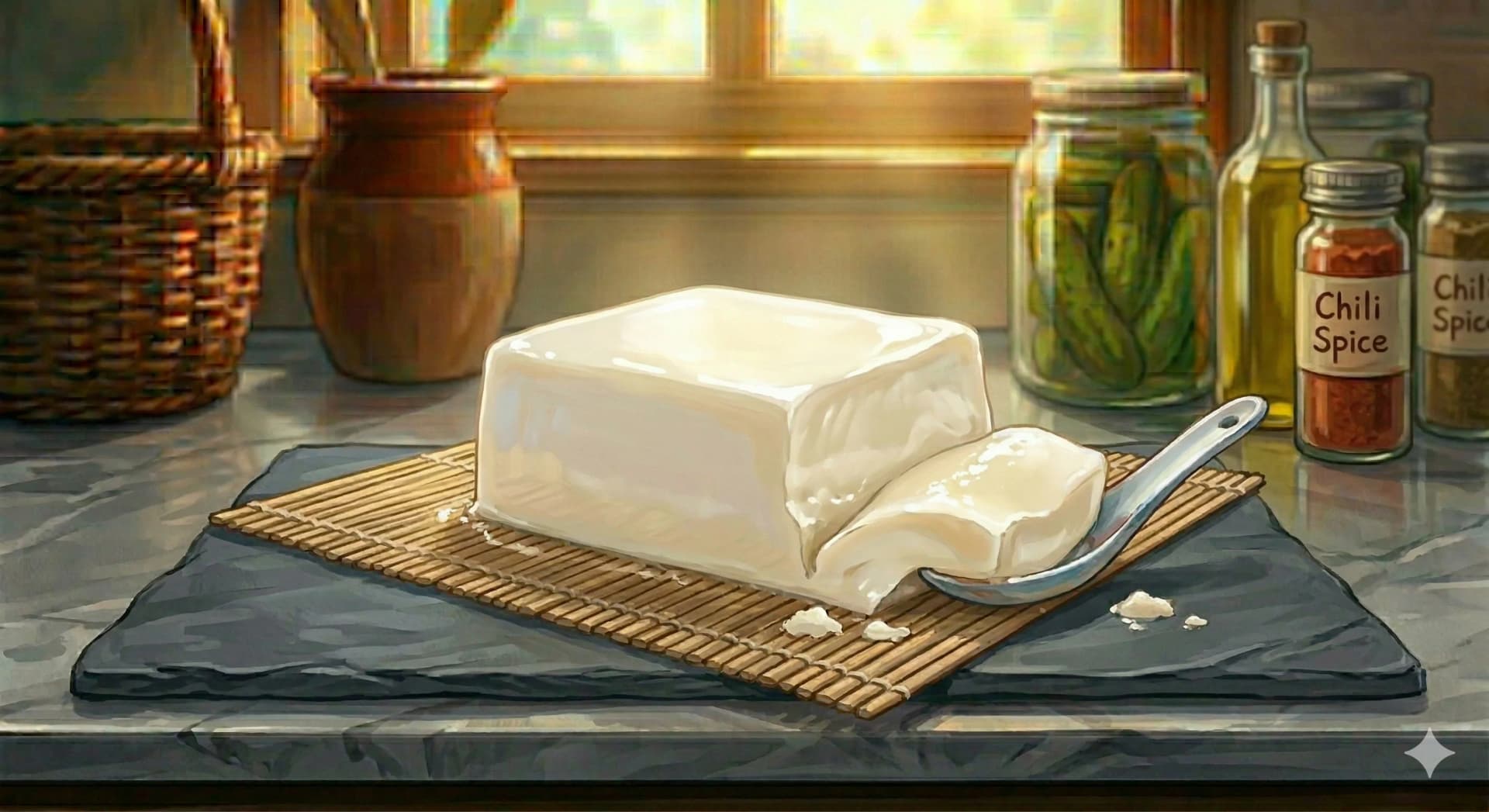
Silken Tofu
Also known as: Nen Doufu, Soft Tofu, Kinugoshi Tofu, Smooth Tofu, Japanese Soft Tofu
Silken tofu is the most delicate form of tofu — made without pressing, so the coagulated soy milk retains all its water content and sets into a custard-like block with a smooth, silky texture that trembles when moved.
It cannot be stir-fried, pressed, or roughly handled without breaking apart. Instead, silken tofu's extraordinary texture — somewhere between a soft custard and a firm panna cotta — is the star of cold preparations, gently dressed dishes, smooth sauces, and preparations where its custardy quality is allowed to shine.
Key facts at a glance:
- Made without pressing — retains all water content for custard-like texture
- Cannot be stir-fried or roughly handled — breaks apart easily
- Texture between soft custard and firm panna cotta — trembles when moved
- High bioavailability of soy isoflavones — due to soft texture
- Used across Japanese, Chinese, and Korean cuisines — from yudofu to sundubu jjigae
Flavor Profile
Origin
China, Japan, East Asia
Traditional Medicine Perspectives
Traditional Chinese Medicine
Silken tofu is considered the most cooling and Yin-nourishing form of tofu in TCM — its high water content and delicate nature make it particularly effective for clearing heat, generating fluids, and nourishing Yin. Prescribed for heat patterns, thirst, and Yin deficiency with heat signs. In summer, cold silken tofu dressed with light soy sauce and ginger is considered both delicious and medicinally appropriate for the season.
Modern Scientific Research
Silken tofu has lower protein density than firm tofu due to higher water content but retains all soy isoflavones and has particularly high bioavailability due to its soft texture.
The smooth texture makes it appropriate for those with digestive difficulties. Its high water content contributes to hydration.
Cultural History
Silken tofu in its most refined form is associated with Japanese Kyoto cuisine, where the art of tofu-making achieved extraordinary delicacy — yudofu (tofu simmered in a clear kombu broth) is a celebrated preparation that showcases the texture of perfect silken tofu.
In Chinese cooking, soft tofu topped with century egg, ginger, and scallion oil is a common cooling dish.
In Korean cooking, soft tofu (sundubu) is simmered in a spicy broth to make sundubu jjigae — one of Korea's most beloved comfort dishes.
Culinary Uses
Serve cold, dressed with premium soy sauce, grated ginger, sesame oil, and scallion. Top with century egg and chili oil.
Use in cold blended preparations and smoothies. Simmer very gently in broth for Korean-style preparations.
Make agedashi tofu by dusting in starch and deep-frying.
Preparation Methods
Handle with extreme care — silken tofu breaks at the slightest pressure.
For cold preparations: cut into cubes using a very sharp, thin knife.
For agedashi tofu: drain in a colander for 30 minutes, dust with potato starch, and lower gently into hot oil. Never stir-fry silken tofu.
Traditional Dishes
- Cold silken tofu with soy and ginger
- Pi dan tofu (century egg and silken tofu)
- Agedashi tofu
- Korean sundubu jjigae
- Yudofu (Kyoto simmered tofu)
Comments
Share your thoughts on this ingredient.
Sign in to comment0 Comments