Chinese Cuisine
Ren Shen Ji Tang (Ginseng Chicken Soup)
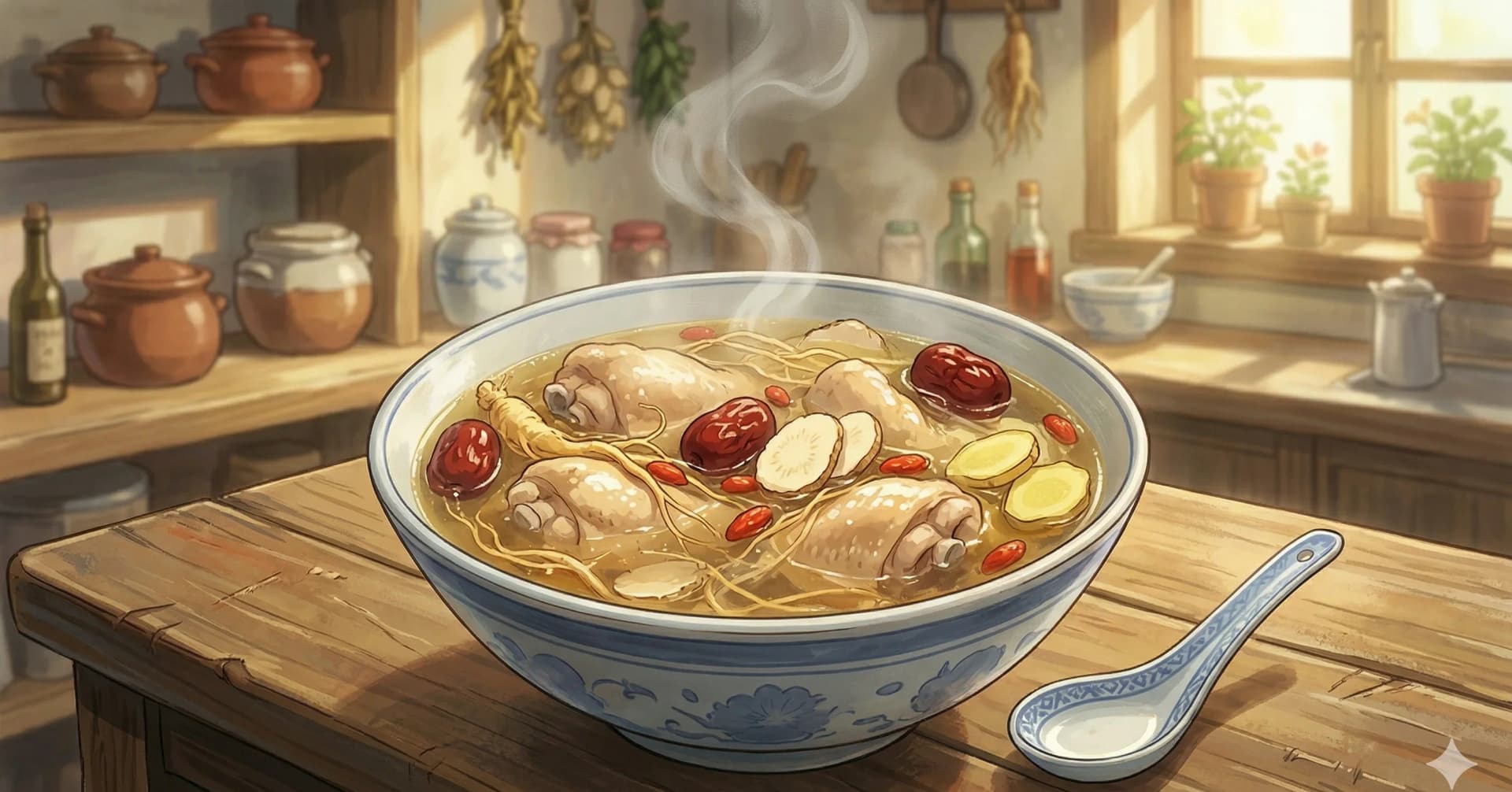
A quietly powerful broth where ginseng root infuses chicken with its bittersweet warmth and uplifting fragrance
There is a particular smell that fills the kitchen when ginseng hits hot broth. It is earthy and slightly medicinal, with a sweetness underneath that reminds you of tree bark and wild honey. If you grew up in a Chinese household, you recognize it immediately. It is the smell of someone taking care of you.
Ren shen ji tang is one of the foundational tonic soups in Chinese home cooking, a broth built around the belief that slow-simmered ginseng can restore what daily life takes away. The version here uses ginseng beard, the thin, wispy rootlets that are far less expensive than whole ginseng root but carry much of the same fragrance and gentler warmth. They are easy to find at Chinese herbal shops, often sold in small packets for just a few dollars.
The flavor of ginseng is distinctive and polarizing. It is bittersweet, with the bitter becoming more pronounced the longer it simmers. This is why the recipe includes red dates, dried honey dates, and goji berries. They do not mask the ginseng but round it out, building a broth that balances earthy bitterness with fruity sweetness. Huai shan, the dried Chinese yam, adds a starchy smoothness to the liquid and dissolves into near-invisibility after an hour of cooking.
One practical consideration: cooking time directly controls the intensity. Forty-five minutes gives you a mild, approachable ginseng flavor suitable for those new to the taste. An hour and a half produces something bolder and more assertive. Adjust according to your household's preference.
At a Glance
Yield
4 servings
Prep
10 minutes
Cook
1 hour 10 minutes
Total
1 hour 20 minutes
Difficulty
Easy
Ingredients
- 1 lbbone-in chicken pieces (thighs, drumsticks, or a combination)
- 1¼ ozginseng beard (ren shen xu), about a generous handful
- ¾ ozhuai shan (dried Chinese yam), about 5 to 6 slices
- 6dried red dates (hong zao), rinsed
- 1dried honey date (mi zao)
- 1 ozdried goji berries (gou qi zi)
- 3 slicesfresh ginger
- 1½ qtcold water
- —Salt to taste
Method
- 1
Rinse the herbs. Give the ginseng beard, huai shan, red dates, and honey date a quick rinse under cold running water. Set them aside. The ginseng beard looks thin and fragile, but it holds up well to simmering and releases its flavor slowly.
- 2
Blanch the chicken. Place the chicken pieces in a pot and cover with cold water. Bring to a boil over high heat and let it cook at a rolling boil for 3 minutes. A layer of grey foam and impurities will rise to the surface. Drain the chicken, rinse each piece under cool water, and clean the pot. This step ensures a clear, golden broth.
- 3
Build the soup. Bring 6 cups of fresh water to a boil in the clean pot. Add the blanched chicken, ginseng beard, huai shan, red dates, honey date, and ginger slices. Return to a boil and let it bubble vigorously for 3 minutes. This initial burst of heat helps extract flavor from the dried herbs.
- 4
Simmer gently. Reduce the heat to low so the surface barely trembles. Cover and simmer for 1 hour. For a milder ginseng flavor, check at 45 minutes. For a stronger, more assertively bitter broth, continue for up to 1 hour 30 minutes. The aroma will shift from gently sweet to deep and earthy as the ginseng gives up more of its character.
- 5
Add the goji berries. In the last 10 minutes of cooking, add the goji berries. They need very little time to soften and will bloom into bright orange jewels in the golden broth.
- 6
Season and serve. Season with salt to taste. Ladle into bowls, distributing chicken, red dates, and goji berries evenly. The ginseng beard is edible but can be left in or removed according to preference.
Key Ingredient Benefits
Ginseng Beard (Ren Shen Xu). The fine rootlets of the ginseng plant, much milder than whole ginseng root but carrying a similar aromatic profile. In Traditional Chinese Medicine, ginseng is traditionally associated with replenishing qi (vital energy), supporting stamina, and aiding recovery from illness or fatigue. Research has examined ginsenosides, the active compounds in ginseng, for potential effects on immune function and cognitive performance, though results remain mixed and dosage-dependent. Ginseng beard is considered neutral in thermal nature, making it suitable for a wider range of constitutions than stronger ginseng varieties.
Huai Shan (Dried Chinese Yam). A staple in Chinese herbal cooking and TCM, traditionally associated with supporting the spleen and stomach. When simmered, it dissolves into a starchy smoothness that thickens and enriches soups. It is a source of dietary fiber and potassium.
Dried Red Dates (Hong Zao). One of the most widely used ingredients in Chinese kitchens. Traditionally associated with tonifying the blood and calming the spirit. They provide natural sweetness without added sugar. A modest source of vitamin C and iron.
Honey Date (Mi Zao). A darker, stickier variety of dried date with a deeper, almost molasses-like sweetness. Used specifically to balance bitterness in herbal soups. One or two are usually sufficient for a whole pot.
Why This Works
Ginseng releases its active compounds gradually through heat extraction, which is why a long, gentle simmer produces a more flavorful and aromatic soup than a quick boil. The thin ginseng rootlets have a higher surface area relative to their mass compared to whole roots, which means they infuse the broth more readily and at a lower cost. This is the same principle at work in Hong Zao Ji Tang, where dried fruits slowly dissolve their sugars into the liquid over hours.
The combination of red dates and honey dates is deliberate. Red dates bring a concentrated, almost caramel sweetness, while the honey date adds a softer, rounder quality that smooths out the ginseng's bitterness. Together, they create a broth that is complex rather than one-note. Huai shan reinforces this by contributing starch to the liquid, giving the broth a subtle viscosity that carries the flavor across your palate.
Blanching the chicken first is non-negotiable for a clear broth. The same two-water method appears in Wu Ji Tang, Lian Ou Pai Gu Tang, and nearly every slow-simmered Chinese soup. Skipping it produces a cloudy, grey liquid that tastes fine but looks unappetizing.
The goji berries go in last because they are fragile. Overcooked goji berries lose their color, collapse into mush, and can impart a mild bitterness to the broth. Ten minutes is enough to hydrate them and release their gentle tartness.
Substitutions & Variations
No ginseng beard? Codonopsis root (dang shen) is a common substitute that provides a gentler, less bitter herbal quality. Use about 15 g of dried codonopsis slices. The soup will taste milder but still deeply nourishing.
Whole chicken. For a more substantial version, use half a whole chicken (about 750 g) instead of cut pieces. The bones add more collagen to the broth. This approach mirrors the Korean Samgyetang, which stuffs a whole small chicken with ginseng and rice.
Silkie chicken. Swapping regular chicken for silkie, as in Wu Ji Tang, produces a darker, more mineral-rich broth that pairs beautifully with the ginseng's earthiness.
Additional herbs. A few slices of astragalus root (huang qi) or dried longan flesh can be added for extra complexity. Keep the total volume of herbs moderate to avoid an overly medicinal flavor.
Pressure cooker. Combine all ingredients (except goji berries) with 5 cups water. Cook at high pressure for 25 minutes with natural release. Stir in goji berries and let them steep for 5 minutes.
Serving Suggestions
Serve this soup as the centerpiece of a simple, restorative meal with steamed rice and a plate of lightly stir-fried greens. The broth is meant to be sipped slowly throughout the meal, not consumed as a first course.
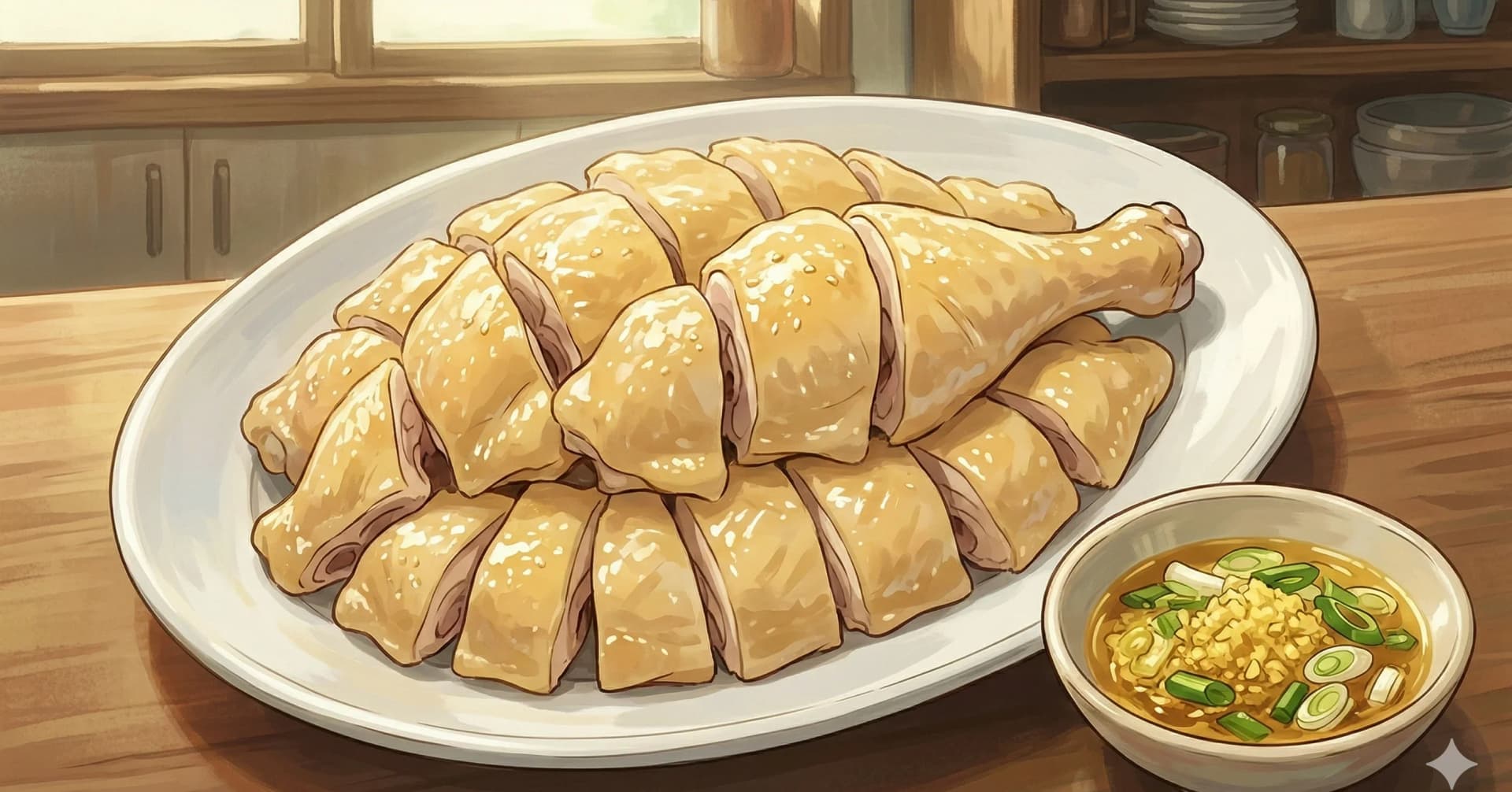
For a more complete spread, pair it with Bai Qie Ji and a bowl of Congee. The gentle herbal warmth of the ginseng soup contrasts beautifully with the clean simplicity of poached chicken and plain rice porridge.
This is also a wonderful soup to serve to someone recovering from illness or going through a demanding stretch. In Chinese households, it carries an implicit message of care and restoration.
Storage & Reheating
The soup keeps in the refrigerator for up to 3 days. The ginseng flavor will continue to intensify as it sits, so be aware that reheated soup will taste bolder than it did fresh. Reheat gently on the stovetop over medium-low heat. Avoid boiling.
The broth freezes well for up to 2 months. The chicken is best eaten fresh or within a day or two, as its texture deteriorates with freezing. If freezing, strain the broth and store separately from the solids.
Cultural Notes
Ren shen ji tang (人參雞湯, "ginseng chicken soup") is the Chinese tonic soup built around ren shen (人參, ginseng, Panax ginseng), the most prestigious and most expensive of the classical Chinese tonic herbs. The dish is closely related to the Korean samgyetang (삼계탕), which uses Korean ginseng (Panax ginseng grown in Korea and called insam) and which has become the more internationally famous of the two versions. The Chinese version uses Chinese-grown ginseng (most commonly the cultivated Panax ginseng from Jilin and Heilongjiang provinces in northeast China) or American ginseng (Panax quinquefolius), and the preparation tends to be simpler than the Korean stuffed-chicken format.
The traditional Chinese preparation simmers a whole chicken (or chicken legs) with a single small root of ginseng, jujube dates, ginger, and sometimes a small amount of Chinese yam or wolfberries. The ginseng releases its complex aromatic compounds (the ginsenosides, which are the chemical compounds responsible for ginseng's distinctive bitter-sweet flavor and its claimed therapeutic effects) into the broth over a two-to-three-hour gentle simmer or longer steam in a double-boiler. The finished soup has a faintly bitter undertone from the ginseng, a sweet note from the jujubes, and a warming quality that diners traditionally describe in terms of internal energy (qi) and circulation rather than in terms of flavor alone.
The traditional Chinese medicine context for ginseng is foundational. The herb is one of the four most prestigious tonic herbs in Chinese herbal medicine (the others being dang gui, astragalus, and rehmannia) and has been documented in Chinese medical texts continuously since the Shennong Bencao Jing in the second century CE. Modern research has explored the ginsenosides for various effects including immune modulation, fatigue reduction, and cognitive enhancement, with studies appearing in journals including the Journal of Ginseng Research, though the clinical evidence for specific therapeutic uses remains mixed and the herb is best treated as a traditional culinary tonic rather than a clinical treatment. The soup is expensive to prepare at home given ginseng costs, and most Chinese households reserve it for special occasions like winter solstice, postpartum recovery, or the convalescence of family elders.
Nutrition Facts
Calories: 308kcal (15%)|Total Carbohydrates: 22.2g (8%)|Protein: 18.1g (36%)|Total Fat: 13.5g (17%)|Saturated Fat: 3.6g (18%)|Cholesterol: 98mg (33%)|Sodium: 194mg (8%)|Dietary Fiber: 2.1g (8%)|Total Sugars: 14.3g
You Might Also Like
Ratings & Comments
Ratings & Comments
Ratings
Share your thoughts on this recipe.
Sign in to rate and comment